
Onycholipini
Alonso-Zarazaga & Lyal, 1999
Genus Guides
5Onycholipini is a tribe of weevils in the Cossoninae, established by Alonso-Zarazaga and Lyal in 1999. The tribe includes at least four —Dipnotyphlus, Hauseriola, Leipommata, and Onycholips—plus Halorhynchus, which was transferred from Pentarthrini. Members are specialized for and psammophilous (sand-dwelling) lifestyles, with adaptations including reduced or absent , compact body form, and modified legs for burrowing. The tribe has a disjunct distribution across coastal regions of the Mediterranean, Macaronesia, Arabia, and Australasia, with some exhibiting transoceanic capabilities.
Pronunciation
How to pronounce Onycholipini: //ˌɒnɪkoʊlɪˈpaɪnaɪ//
These audio files are automatically generated. While they are not always 100% accurate, they are a good starting point.
Identification
Distinguished from other Cossoninae tribes by the combination of adaptations: reduced/absent , compact body, and modified legs for burrowing. Halorhynchus can be separated from other Onycholipini by its distribution in Australasia and Madagascar, versus the Palearctic and Macaronesian ranges of other genera. Closest relatives appear to be in Pentarthrini, from which Halorhynchus was transferred based on morphological reassessment.
Images
Appearance
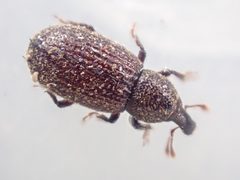
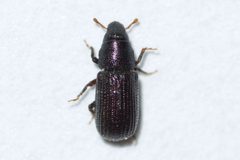
Members exhibit adaptations for burrowing: reduced or absent (anophthalmous or microphthalmous), compact body form, and modified legs with setae adapted for digging. Body shape is generally cylindrical or somewhat flattened, suited for movement through sand or soil. Specific morphological details vary by ; Halorhynchus show particularly pronounced specializations.
Habitat
Coastal sandy shores, sand dunes, and beach debris; specifically psammophilous at the interface between dry and damp sand. Some occupy endogean microhabitats deep in soil and humus. All known habitats are associated with sandy substrates near coastlines or in arid coastal environments.
Distribution
Disjunct distribution: Yemen (Dipnotyphlus); Crete (Hauseriola); Madeira, Selvagens, Canary Islands, and Morocco (Leipommata); Canary Islands and Morocco (Onycholips); Western Australia and Madagascar (Halorhynchus). The tribe spans the Palearctic, Afrotropical, and Australasian regions with notable gaps between distribution centers.
Life Cycle
Burrowing beetles remain underground for most of their life, emerging primarily to find mates. Specific developmental stages and duration are not documented at the tribe level.
Behavior
Psammophilous (sand-burrowing) habit with locomotion. Some exhibit 'rowing' movement through sand using modified legs and setae. Endogean lifestyle involves dwelling deep in soil and humus. Transoceanic capability has been inferred for some lineages based on disjunct distributions.
Similar Taxa
- PentarthriniHalorhynchus was previously classified in Pentarthrini; the two tribes share some morphological features and both contain members, but Onycholipini is distinguished by specific adaptations for psammophily and revised phylogenetic placement
- Other Cossoninae tribesMost other Cossoninae lack the pronounced combination of anophthalmous/microphthalmous condition, compact body form, and psammophilous specialization seen in Onycholipini
More Details
Taxonomic history
The tribe was established by Alonso-Zarazaga and Lyal in 1999. The Halorhynchus was transferred from Pentarthrini to Onycholipini based on morphological evidence, significantly expanding the tribe's known distribution to include Australasia and Madagascar.
Data limitations
Most detailed biological information refers to Halorhynchus and other member rather than the tribe collectively. Direct evidence for Onycholipini as a whole is limited; tribe-level is largely inferred from member genera. plant associations documented for Halorhynchus (Atriplex sp., Spinifex sp.) cannot be confidently extended to the entire tribe.