
Pselactus
Broun, 1886
Species Guides
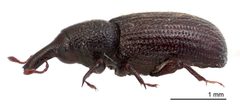
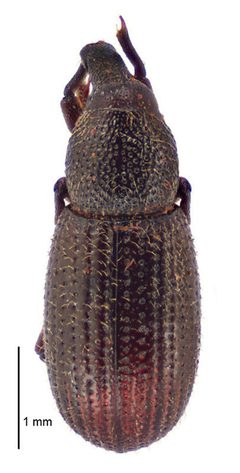
1Pselactus is a of weevils (Curculionidae: Cossoninae) distributed across Europe, Northwestern Africa, Northern America, and the Cape Verde Islands. At least one , Pselactus spadix, is a wood-borer of marine and coastal timbers, capable of completing its entire within wood without . The genus belongs to the tribe Onycholipini and includes species such as P. affinis, P. apionoides, P. obesulus, P. spadix, and P. strakai.
Pronunciation
How to pronounce Pselactus: //ˈsɛl.æk.təs//
These audio files are automatically generated. While they are not always 100% accurate, they are a good starting point.
Identification
identification requires examination of ; P. obesulus and P. strakai have been diagnosed and illustrated in recent taxonomic treatments. Larval morphology has been described for some species and may aid identification of stages.
Images
Habitat
Marine and coastal timber environments; at least one (P. spadix) has been investigated in Scots pine heartwood under laboratory conditions. The occurs in the Cape Verde Islands (São Vicente, São Nicolau).
Distribution
Europe, Northwestern Africa, Northern America, and Cape Verde Islands (São Vicente, São Nicolau). Distribution records from GBIF include Denmark, Norway, and Sweden.
Diet
Wood; P. spadix has been reared on Scots pine (Pinus sylvestris) heartwood.
Host Associations
- Pinus sylvestris - larval food sourceScots pine heartwood used in laboratory rearing of P. spadix
Life Cycle
Five larval instars identified by capsule width measurements. Development from 2nd instar to : 70.5±6.9 weeks. Pupal duration: 14.6±5.8 days. Development from 2nd instar to reproductive adult: 17–20 months. Total approximates 24 months at 22±2°C and 99±1% relative humidity. Oviposition occurs inside adult tunnels.
Behavior
mate within galleries at 2–3 months of age. The can complete without adults emerging from wood. Larval tunnels originate from adult tunnels and increase in diameter distally, terminating in -free pupal chambers.
Ecological Role
Wood decomposer and borer of coastal and marine timbers.
Human Relevance
P. spadix damages marine and coastal timbers, producing circular holes approximately 1.48 mm in diameter.
Similar Taxa
- Other Cossoninae generaPselactus is distinguished by its placement in the tribe Onycholipini; larval and diagnostic characters separate it from related .
More Details
Life cycle duration
Laboratory studies on P. spadix indicate a approximately 2-year under controlled conditions (22±2°C, 99±1% r.h.), though field timing may vary.
Sexual dimorphism in longevity
Post-mating longevity differs significantly between sexes in P. spadix: males live 11.7±2.9 months versus females 6.3±1.1 months.
Systematic position
The systematic position of Pselactus within Onycholipini and its placement in Cossoninae have been reviewed in recent taxonomic treatments.
Sources and further reading
- BugGuide
- Wikipedia
- GBIF taxonomy match
- iNaturalist taxon
- NCBI Taxonomy
- Catalogue of Life
- Characteristics of Attack of Coastal Timbers by Pselactus spadix (Herbst) (Col.: Curc.: Cossoninae) and an Investigation of its Life History
- Review of Cape Verde Pselactus Broun, 1886 (Coleoptera: Curculionidae: Cossoninae) with description of a new species, larvae and notes on biology