
Pselactus spadix
(Herbst, 1795)
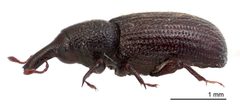
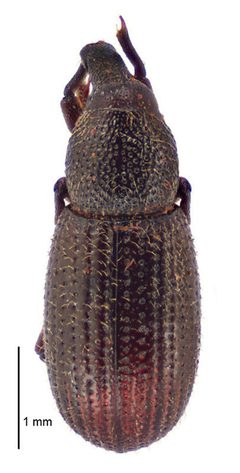
Pselactus spadix is a wood-boring weevil in the Cossoninae, native to Europe but also recorded in North America and the Azores. It develops within timber, particularly in marine and coastal environments, and can complete its entire without emerging from wood. The is known for distinctive circular holes and tunneling patterns in timber.
Pronunciation
How to pronounce Pselactus spadix: /sɛˈlæktəs ˈspeɪdɪks/
These audio files are automatically generated. While they are not always 100% accurate, they are a good starting point.
Identification
Distinguished by circular holes approximately 1.5 mm in diameter. tunnels measure 1.49±0.34 mm, breaking through wood surfaces. Larval tunnels originate from adult tunnels, increase in diameter away from the point of origin (0.407–1.892 mm), and terminate in -free pupal chambers measuring 1.6±0.3 mm × 3.5±0.7 mm.
Images
Habitat
Marine and coastal timbers; laboratory studies conducted on Scots pine (Pinus sylvestris) heartwood at high humidity (99±1% r.h.).
Distribution
Native to Europe; present in North America and the Azores (Faial, Pico, São Jorge, Terceira).
Diet
Wood; documented feeding on Scots pine (Pinus sylvestris) heartwood.
Host Associations
- Pinus sylvestris - Scots pine heartwood used in laboratory rearing studies
Life Cycle
Approximately 24 months at 22±2°C and 99±1% relative humidity. Five larval instars. Development from second instar to averages 70.5±6.9 weeks. lasts 14.6±5.8 days. Development from second instar to reproductive adult requires 17–20 months.
Behavior
can complete their entire within wood without emerging. Mating occurs in galleries by adults at least 2–3 months old. Oviposition takes place inside adult tunnels.
Ecological Role
Wood-boring organism in coastal marine timber environments; contributes to decomposition of submerged or waterlogged wood.
Human Relevance
Pest of marine and coastal timbers; attack characterized by distinctive circular holes and tunneling damage.
More Details
Adult longevity
Mean longevity is 11.5±6.5 months. Male post-mating longevity (11.7±2.9 months) significantly exceeds female post-mating longevity (6.3±1.1 months).