
Cossonini
Schönherr, 1825
Genus Guides
3Cossonini is a tribe of weevils within the Cossoninae, Curculionidae. The tribe contains approximately 60 described distributed across multiple continents. Members of this tribe are generally small to medium-sized weevils associated with wood-boring or bark-inhabiting habits. The group was established by Schönherr in 1825 and remains taxonomically active with ongoing revisions of constituent genera.
Pronunciation
How to pronounce Cossonini: /kɒsəˈniːnaɪ/
These audio files are automatically generated. While they are not always 100% accurate, they are a good starting point.
Identification
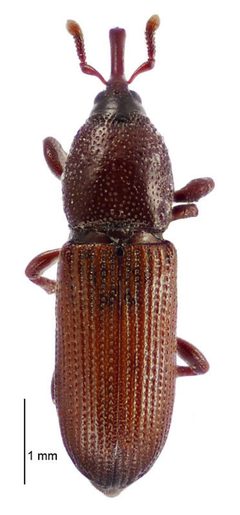
Identification to tribe level requires examination of rostral and antennal characters, particularly the position of antennal insertions relative to the rostrum base and the degree of rostral elongation. Cossonini typically exhibit a compact body form with elbowed, clubbed . Definitive separation from related tribes within Cossoninae (such as Dryotribini or Pselaphostena) depends on detailed examination of the prosternal region and tarsal segmentation patterns. -level identification relies on characters including pronotal shape, elytral striation patterns, and male genitalia structure.
Images
Habitat
within Cossonini are predominantly associated with dead or decaying wood, including bark crevices, galleries of other wood-boring insects, and fungal-colonized timber. Many inhabit forested environments across tropical, subtropical, and temperate zones. Some species occur in stored timber or wooden structures. Specific microhabitat preferences vary considerably among genera, with some restricted to particular tree while others are in decaying hardwood or softwood.
Distribution
The tribe has a distribution with recorded from Africa, Asia, Europe, North America, South America, and Oceania. Individual genera show varying geographic ranges: Afrocossonus and Deinocossonus are primarily African; Stereoborus occurs in East Asia including China; Cossonus has a broad Holarctic distribution; Pentamimus and related genera are predominantly Neotropical. The apparent distribution patterns likely reflect both true biogeographic history and uneven taxonomic sampling.
Host Associations
- Dead or decaying wood - Primary substrate for most ; specific tree associations vary by
- Fungi colonizing wood - Many occur in association with wood-decay fungi
- Galleries of other wood-boring insects - Some inhabit pre-existing tunnels in timber
Ecological Role
Members of Cossonini contribute to wood decomposition processes through their association with decaying timber and fungal . Their presence in dead wood facilitates nutrient cycling in forest . Some may function as secondary colonizers of wood previously damaged by other insects. The ecological role of most remains poorly documented due to their cryptic habits and small size.
Human Relevance
Certain have potential economic significance as pests of stored timber or wooden products, though documented cases of major damage are limited. The tribe has received attention in taxonomic research, with ongoing revisions clarifying generic boundaries. Some (e.g., Stereoborus) have been subjects of recent species-level taxonomic work in East Asia.
Similar Taxa
- DryotribiniAlso within Cossoninae; separation requires examination of prosternal channel structure and antennal scape length relative to rostrum
- PselaphostenaRelated tribe in Cossoninae; distinguished by differences in tarsal formula and abdominal ventrite structure
- Cossoninae (other tribes)Tribal boundaries within Cossoninae are historically fluid; morphological characters separating Cossonini from Rhyncolini and related groups require careful dissection and examination of mouthpart orientation
More Details
Taxonomic history
The tribe was established by Carl Johan Schönherr in 1825. Generic concepts within Cossonini have undergone substantial revision, with many historically placed here later transferred to other tribes or synonymized. The genus-level remains active, with recent work by Omar, Zhang & Davis (2007) and others clarifying boundaries in groups such as Stereoborus.
iNaturalist observations
The tribe has accumulated over 1,400 research-grade observations on iNaturalist, though identification to or level is often tentative due to the difficulty of distinguishing cossonine weevils from photographs.