
Thanasimus dubius
(Fabricius, 1777)
dubious checkered beetle, American bark beetle destroyer, checkered beetle predator, Wavering Checkered Beetle
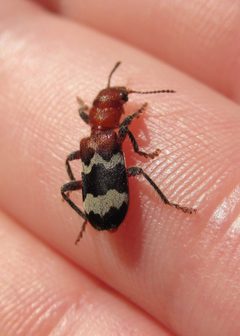
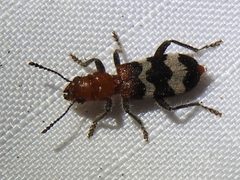
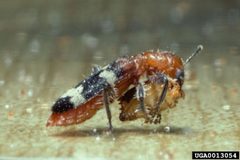
Thanasimus dubius is a predatory checkered beetle (Cleridae) native to North and Central America. It specializes in preying upon bark beetles, particularly in the Ips and Dendroctonus, with the southern pine beetle (Dendroctonus frontalis) being a well-documented prey item. exhibit a stereotyped five-act predatory sequence involving search/ambush, seizure, alignment, consumption, and . The species demonstrates chemotactic responses to bark beetle and tree volatiles, and shows regional genetic differentiation across its eastern North American range. It has been investigated as a potential agent for forest pest management.
Pronunciation
How to pronounce Thanasimus dubius: //θəˈnæsɪməs ˈdjuːbiəs//
These audio files are automatically generated. While they are not always 100% accurate, they are a good starting point.
Images
Habitat
Pine forests; specifically associated with areas of active bark beetle in coniferous trees. Pupae occur under bark of trees, with higher densities in loblolly pine (Pinus taeda) than shortleaf pine (P. echinata). Peak pupal densities occur at heights of 1–4 m on host trees, and increase with tree diameter class.
Distribution
North America and Central America. Eastern United States show significant genetic structure between northern and southern regions, possibly due to historical prairie barriers affecting pine distribution.
Diet
prey upon bark beetles (Scolytinae), specifically documented to feed on adults of Dendroctonus frontalis (southern pine beetle) and Ips grandicollis. Prey location involves chemotactic responses to bark beetle including ipsenol and frontalin.
Host Associations
- Dendroctonus frontalis - -preysouthern pine beetle; principal prey in documented studies
- Ips grandicollis - -preyattracted to ipsenol component
- Pinus taeda - loblolly pine; higher pupal densities than in P. echinata
- Pinus echinata - shortleaf pine; supports lower pupal densities than P. taeda
Life Cycle
Complete with pupal stage occurring under bark of trees. Within-tree distribution of pupae follows regression models predicting based on bark area, tree , diameter class, and height.
Behavior
follows a stereotyped five-act sequence: (1) searching or ambush, (2) seizure of prey, (3) alignment of prey, (4) consumption of prey, and (5) . Mean search/ambush duration before attack is 5.8 minutes. Capture is 72% in laboratory conditions. Handling time is significantly longer for male prey (13.81 min) than female prey (10.49 min), with consumption occupying 8–9 minutes as the major component. Vision is not essential for capture efficiency; maxillary and labial palps are critical sensory structures for prey capture. Adults exhibit upwind toward olfactory cues including bark beetle (ipsenol, frontalin) and tree volatiles (α-pinene), with antennal 'stand up' elevated in response to . Landing frequency is higher near black silhouettes. Chemotactic response improves with experience across trials.
Ecological Role
of scolytid bark beetles in coniferous forest . activity spatially tracks prey patterns. Potential agent for management of southern pine beetle and related forest pests.
Human Relevance
Investigated for of southern pine beetle (Dendroctonus frontalis), a major forest pest causing significant economic damage to pine timber. 'American bark beetle destroyer' reflects its perceived utility in forest pest management.
Similar Taxa
- Temnochila virescensco-occurring bark beetle in same guild (Trogositidae); both respond to from southern pine bark beetles
- Monochamus titillatorco-occurring cerambycid that also responds to behavioral chemicals of southern pine bark beetles; not a direct but shares chemical context
Sources and further reading
- BugGuide
- Wikipedia
- GBIF taxonomy match
- iNaturalist taxon
- NCBI Taxonomy
- Encyrtid Holdings | Entomology Research Museum
- Striped Sand Grasshopper
- Study: More IPM Knowledge Could Help Leafy Amaranth Farmers in East Africa
- Spatial Distribution of Flying Southern Pine Beetle (Coleoptera:Scolytidae) and the Predator Thanasimus dubius (Coleoptera:Cleridae) 1
- PREDATORY BEHAVIOR OF THE CLERID BEETLE THANASIMUS DUBIUS (COLEOPTERA: CLERIDAE) ON THE SOUTHERN PINE BEETLE (COLEOPTERA: SCOLYTIDAE)
- Mitochondrial DNA analysis of the bark beetle predator Thanasimus dubius F. (Coleoptera: Cleridae) reveals regional genetic differentiation
- Kairomonal Responses of Coleoptera, Monochamus titillator (Cerambycidae), Thanasimus dubius (Cleridae), and Temnochila virescens (Trogositidae), to Behavioral Chemicals of Southern Pine Bark Beetles (Coleoptera: Scolytidae)
- Relative effects of exophytic predation, endophytic predation, and intraspecific competition on a subcortical herbivore: consequences to the reproduction of Ips pini and Thanasimus dubius
- WITHIN-TREE DISTRIBUTION OF THE PUPAE OF THANASIMUS DUBIUS (COLEOPTERA: CLERIDAE), A PREDATOR OF THE SOUTHERN PINE BEETLE (COLEOPTERA: SCOLYTIDAE)
- Upwind flight response of the bark beetle predator Thanasimus dubius towards olfactory and visual cues in a wind tunnel