
Thanasimus
Latreille, 1805
checkered beetles, bark beetle destroyers
Species Guides
4- Thanasimus dubius(dubious checkered beetle)
- Thanasimus formicarius(ant beetle)
- Thanasimus trifasciatus(three-banded checkered beetle)
- Thanasimus undatulus(Wavy Checkered Beetle)
Thanasimus is a of predatory checkered beetles in the Cleridae, comprising approximately six described distributed across the Holarctic region. Species in this genus are specialized of bark beetles (), with well-documented potential against economically damaging forest pests such as and Dendroctonus frontalis. The genus exhibits a two-year in northern , with larvae in pupal chambers beneath bark and emerging to coincide with periods.
Pronunciation
How to pronounce Thanasimus: /θænəˈsaɪməs/
These audio files are automatically generated. While they are not always 100% accurate, they are a good starting point.
Identification
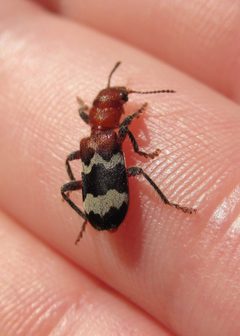
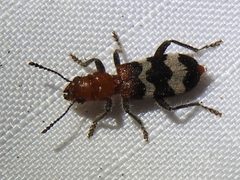
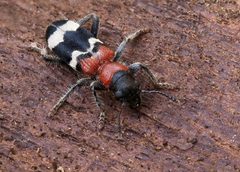
Members of Thanasimus can be distinguished from other Cleridae by their association with bark beetle-infested coniferous wood and their characteristic with nine flagellomeres. The antennae possess distinctive distributions, with greater of sensilla basiconica and sensilla trichodea on the three segments compared to segments. -level identification requires examination of external including coloration patterns and body proportions; T. formicarius is notable for its red abdominal coloration (European red-bellied clerid), while T. dubius and T. trifasciatus display banded or checkered elytral patterns.
Images
Habitat
Coniferous forests, particularly spruce and pine stands experiencing bark beetle . Larvae develop within subcortical spaces of attacked trees, constructing pupal chambers at the base of trunks. are found on bark surfaces and within bark crevices of living and recently dead conifers.
Distribution
Holarctic distribution including North America and Eurasia. Documented occurrences in Denmark, Norway, Sweden, and the northeastern United States (Vermont). T. formicarius occurs across Eurasia; T. dubius, T. trifasciatus, T. undatulus, and T. repandus are North American ; T. femoralis has Palearctic distribution.
Seasonality
activity coincides with spring and autumn bark beetle attacks in northern regions. In southern Norway, adults emerge in the second year of the , mature sexually during summer, overwinter in bark crevices, and oviposit the following spring. Mass flight events have been observed to synchronize with .
Diet
Specialized of scolytine bark beetles. T. formicarius preys upon and Ips subelongatus; T. dubius preys upon Dendroctonus frontalis (southern pine beetle) and Ips pini. consume adult bark beetles; larvae are endophytic predators within bark beetle galleries.
Life Cycle
Approximately two years and four months in southern Norway . dimensions 2.4 × 0.8 mm; development duration 28–7 days from 15 to 25°C. Three larval instars lasting 9–14 days at 21–25°C. Pupal stage 15–33.5 days across 15–25°C. Larvae overwinter in pupal chambers at bases of attacked trees; emerge in second year, mature sexually, overwinter in bark crevices, and oviposit in spring of third year.
Behavior
involves a stereotyped sequence of five acts: searching or ambush, seizure of prey, alignment of prey, consumption (8–9 minutes), and . Handling time averages 13.81 minutes for male prey and 10.49 minutes for female prey. capture prey with 72% ; capture efficiency is reduced by removal of maxillary and labial palps but not by blinding. Adults exhibit kairomonal responses to bark beetle behavioral chemicals. Flying adults show spatial distribution patterns tracking prey activity.
Ecological Role
Important agent of bark beetle in coniferous forest . pressure on scolytine bark beetles includes both exophytic predation by on emerging beetles and endophytic predation by larvae within galleries. closely track , with potential to regulate bark beetle .
Human Relevance
Significant forest protection value through of economically damaging bark beetles. T. formicarius has been used in China for biological control of Ips subelongatus and . T. dubius is recognized as an American bark beetle destroyer with potential for management of southern pine beetle .
Sources and further reading
- BugGuide
- Wikipedia
- GBIF taxonomy match
- iNaturalist taxon
- NCBI Taxonomy
- Catalogue of Life
- LIFE CYCLE OF THANASIMUS FORMZCARZUS (COLEOPTERA: CLERIDAE) IN SOUTHERN NORWAY*
- DEVELOPMENT AND REPRODUCTION OF THANASIMUS FORMICARIUS (L.) (COLEOPTERA: CLERIDAE) AT THREE CONSTANT TEMPERATURES
- Spatial Distribution of Flying Southern Pine Beetle (Coleoptera:Scolytidae) and the Predator Thanasimus dubius (Coleoptera:Cleridae) 1
- Morphology and Distribution of Antennal Sensilla of the Predatory Clerid Beetle, Thanasimus substriatus (Coleoptera: Cleridae)
- Evaluation of nutritional behavior and predation rate of Thanasimus formicarius (Coleoptera: Cleridae) in laboratory conditions
- PREDATORY BEHAVIOR OF THE CLERID BEETLE THANASIMUS DUBIUS (COLEOPTERA: CLERIDAE) ON THE SOUTHERN PINE BEETLE (COLEOPTERA: SCOLYTIDAE)
- Fine Structure and Distribution of Antennal Sensilla of the Predatory Clerid Beetle, Thanasimus lewisi (Coleoptera: Cleridae)
- Relative effects of exophytic predation, endophytic predation, and intraspecific competition on a subcortical herbivore: consequences to the reproduction of Ips pini and Thanasimus dubius
- Ein Beitrag zur Habitatselektion des Ameisenbuntkäfers,Thanasimus formicarius L. (Col., Cleridae) Studies on the habitatselection of the bark-beetlepredatorthanasimus formicarius L. (Col., Cleridae)
- Kairomonal Responses of Coleoptera, Monochamus titillator (Cerambycidae), Thanasimus dubius (Cleridae), and Temnochila virescens (Trogositidae), to Behavioral Chemicals of Southern Pine Bark Beetles (Coleoptera: Scolytidae)