
Monochamus titillator
(Fabricius, 1775)
Southern Pine Sawyer
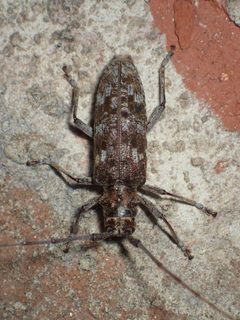
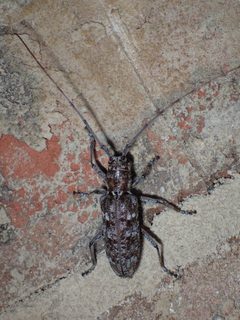
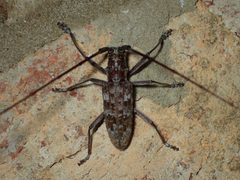
Monochamus titillator is a large longhorned beetle native to the United States, commonly known as the southern pine sawyer. are notable for their elongated , particularly in males, which may exceed body length. The develops in pine trees and has been documented to respond to produced by bark beetles, suggesting ecological interactions with these forest pests. Larvae produce distinctive acoustic signals detectable in the 1000-2800 Hz range, a trait that has been explored for detecting southern pine beetle .
Pronunciation
How to pronounce Monochamus titillator: //ˌmɒnəˈkeɪməs ˈtɪtɪˌleɪtər//
These audio files are automatically generated. While they are not always 100% accurate, they are a good starting point.
Identification
Males distinguished by that may exceed body length, with expanded front . Females have shorter antennae. As a member of the Monochamus, it can be separated from similar longhorned beetles by the combination of large size, pine-associated , and the extremely long antennae of males. Distinguished from the northeastern sawyer (M. notatus) by geographic range—M. titillator occurs in the southern United States while M. notatus ranges east of the Rocky Mountains.
Images
Habitat
Pine forests, particularly those with dead, dying, or stressed trees. Documented from loblolly pines (Pinus taeda) infested by Dendroctonus frontalis (southern pine beetle). Associated with southern pine .
Distribution
United States. GBIF records indicate presence in North America with specific distribution records from the Bahamas (BS) and Bermuda (BM), though primary range appears to be the continental southern United States based on and ecological associations.
Host Associations
- Pinus taeda (loblolly pine) - larval Development documented in trees infested by Dendroctonus frontalis
- Dendroctonus frontalis (southern pine beetle) - ecological associationCoexists in phloem of infested trees for at least 20 days; responds to bark beetle
Life Cycle
Partial age-specific indicate multiple larval stages with mortality ranging from 60.94% to 98.61%. Highest mortality typically occurs at and mid-stage larval phases. completed within pine trees.
Behavior
Larvae produce acoustic signals with audio spectra primarily in 1000-2800 Hz range, with intensity peaks at approximately 1300 and 2300 Hz. Sound repetition rate varies from 30-120 pulses per minute depending on environmental conditions. exhibit kairomonal responses to behavioral chemicals of southern pine bark beetles, suggesting chemically-mediated foraging or -finding .
Ecological Role
Member of bark beetle guild. Potential predator or competitor of bark beetles in pine . Mortality factors affecting include resinosis, beetles, , and woodpeckers.
Human Relevance
Larvae acoustic emissions have been studied for potential use in detecting southern pine beetle . Not considered a primary forest pest; development occurs in already compromised trees rather than healthy timber.
Similar Taxa
- Monochamus notatus (Northeastern Sawyer)Similar large size and elongated male ; distinguished by geographic range (M. notatus occurs east of Rocky Mountains, M. titillator in southern U.S.)
- Monochamus carolinensisCo-occurring congeneric with overlapping associations and responses; distinguished by specific pheromone response profiles and host-related differences in body mass and timing
- Monochamus scutellatus (White-spotted Sawyer)Similar and including male mate guarding; distinguished by geographic distribution (M. scutellatus primarily northern U.S. and Canada) and associations with true firs and Douglas fir in addition to pines
Sources and further reading
- BugGuide
- Wikipedia
- GBIF taxonomy match
- iNaturalist taxon
- NCBI Taxonomy
- Catalogue of Life
- Big, black (and red), and beautiful! | Beetles In The Bush
- Bug Eric: Mate Guarding and Oviposition in the White-spotted Sawyer, Monochamus scutellatus (Coleoptera: Cerambycidae)
- Bug Eric: An Insect "State of the Summer" Report
- Uncategorized | Blog - Part 43
- Bug Eric: July 2009
- Bug Eric: Results of the Red Rock Canyon Open Space Bioblitz
- Audio spectra and related behavior of Monochamus titillator F. larvae
- Partial age‐specific life tables for Monochamus titillator in Dendroctonus frontalis infested loblolly pines
- Kairomonal Responses of Coleoptera, Monochamus titillator (Cerambycidae), Thanasimus dubius (Cleridae), and Temnochila virescens (Trogositidae), to Behavioral Chemicals of Southern Pine Bark Beetles (Coleoptera: Scolytidae)
- Response of the Woodborers <I>Monochamus carolinensis</I> and <I>Monochamus titillator</I> (Coleoptera: Cerambycidae) to Known Cerambycid Pheromones in the Presence and Absence of the Host Plant Volatile α-Pinene
- Influence of host pine species on the adult body mass and emergence date of Monochamus carolinensis, M. notatus, M. scutellatus and M. titillator (Coleoptera: Cerambycidae)