
Monochamus scutellatus
(Say, 1824)
white-spotted sawyer, spruce sawyer, spruce bug, hair-eater
Monochamus scutellatus is a large cerambycid beetle native to North America, commonly known as the white-spotted sawyer. are notable for extreme in length, with male antennae reaching up to twice body length. The colonizes stressed, dying, or recently dead conifers, showing strong preference for burned forest . Larvae develop as wood-borers, creating galleries in phloem, cambium, and sapwood. Adults emerge mid-June to mid-August and feed on conifer bark and foliage before mating.

Pronunciation
How to pronounce Monochamus scutellatus: /mɒnəˈkeɪməs skjuːtəˈleɪtəs/
These audio files are automatically generated. While they are not always 100% accurate, they are a good starting point.
Identification
Distinguished from other Monochamus by the combination of white scutellar spot and variable white elytral spotting. Males are immediately recognizable by extraordinarily long . Differs from Monochamus notatus (northeastern sawyer) in geographic range and preferences. Separated from Monochamus maculosus (spotted pine sawyer) by spot pattern and antennae proportions. The white scutellar spot is diagnostic; other sawyers lack this or have different spot configurations.
Images
Appearance
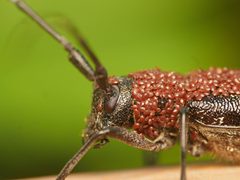
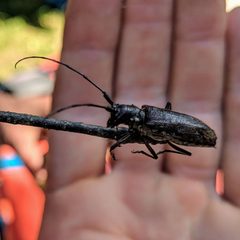
Large-bodied , 15–27 mm in length, with black bearing variable white spots. A distinct white spot is present at the base of each wing (scutellum). Both sexes possess a spine on the side of the prothorax. are exceptionally long: in males, up to twice body length; in females, only slightly longer than body. Male forelegs are elongated with expanded adapted for gripping females during mating.
Habitat
and northern temperate forests, with strong association to recently burned areas, fire-scorched stands, and logging sites. Occupies forests where conifers are stressed, dying, or recently killed by fire, windthrow, or other disturbance. Abundance positively correlated with fire severity, size of burned trees, and proximity to unburned forest (within 500 m). Requires dead or dying wood for larval development; feed on living conifer foliage and bark.
Distribution
Native to North America. Found across Canada from British Columbia to Labrador, and throughout northern United States. Occurs in major mountain ranges farther south. Absent from southeastern United States where replaced by related .
Seasonality
emerge mid-June to mid-August, with peak activity in July. One- to two-year depending on region and conditions; two years typical in northern ranges, potentially one year in warmer areas.
Diet
Larvae feed on phloem and cambium of coniferous trees, then tunnel into sapwood and heartwood. feed preferentially on bark and foliage of Pinaceae (pine and spruce ) for up to seven days after .
Host Associations
- Picea glauca - white spruce
- Picea mariana - black spruce
- Pinus resinosa - red pine
- Pinus banksiana - jack pine
- Pinus strobus - white pine
- Abies balsamea - balsam fir
- Larix laricina - tamarack
- Pseudotsuga menziesii - Douglas-fir
Life Cycle
Complete . Females chew small into bark of dead or dying trees, depositing one egg per niche with a brown plug. Larvae hatch and burrow into phloem and cambium, feeding until mature, then tunnel into wood. occurs in a chamber near the wood surface. emerge by chewing through bark. spans 1–4 years depending on region; typically 2 years in northern .
Behavior
Males produce 2-(undecyloxy)-ethanol that attracts both sexes. Males engage in -waving displays and physical contests for access to oviposition sites; larger males with longer antennae have competitive advantage. Males guard females during and after copulation while females chew oviposition holes. Females avoid laying on bolts containing eggs from other females, but accept their own eggs. are strong fliers and nocturnally active.
Ecological Role
Primary decomposer of stressed and dead conifers, facilitating nutrient cycling in forest . Larval tunneling creates for secondary cavity users. Acts as for fungal including blue stain fungi and potentially . Contributes to post-fire forest by accelerating decomposition of killed trees.
Human Relevance
Considered a pest of the logging industry due to wood degradation via boring holes and fungal staining, with estimated economic impacts in millions of dollars annually. However, salvage logging practices that remove wood too quickly after fires can cause localized extinction by interrupting . Delaying salvage 3–4 years supports persistence. Not a threat to living healthy forests; does not kill trees outright like longhorned beetles.
Similar Taxa
- Monochamus notatusSimilar size and but differs in geographic range (more eastern), preferences, and male proportions
- Monochamus maculosusOverlapping range and ; distinguished by different elytral spot pattern and scutellar spot characteristics
- Monochamus carolinensisSoutheastern ; M. scutellatus does not occur in southeastern United States
Misconceptions
Often mistakenly considered a forest pest that kills living trees. In reality, it colonizes already dead, dying, or stressed conifers and does not attack healthy living trees. The Asian longhorned beetle (Anoplophora glabripennis) is a true tree-killer; M. scutellatus is a native ecological component of coniferous forests.
More Details
Pheromone biology
Males produce 2-(undecyloxy)-ethanol as an ; females also produce monochamol. Cuticular hydrocarbon blends differ between sexes and maturation states, potentially encoding information for mate recognition.
Fire ecology
Abundance in burned forests is positively correlated with fire severity, burned tree abundance and size, and proximity to unburned forest. Females prefer trees with thick bark (>8–10 cm diameter) that better retain moisture post-fire.
Oviposition behavior
Females spend over 20 minutes chewing each oviposition hole, producing audible sounds. They will steal existing holes from other females to reduce time and risk. The brown plug may protect eggs and/or signal site occupancy.
Sources and further reading
- BugGuide
- Wikipedia
- GBIF taxonomy match
- iNaturalist taxon
- NCBI Taxonomy
- Catalogue of Life
- Bug Eric: Mate Guarding and Oviposition in the White-spotted Sawyer, Monochamus scutellatus (Coleoptera: Cerambycidae)
- Bug Eric: Beetle Bonanza
- Ascalaphidae | Beetles In The Bush
- August | 2022 | Beetles In The Bush
- Reproductive Behavior and Sexual Dimorphism in the White-Spotted Sawyer Monochamus scutellatus (Say)
- Field Response ofMonochamus scutellatus scutellatusandMonochamus notatus(Coleoptera: Cerambycidae) to the Male-Produced Pheromone, 2-(Undecyloxy)-Ethanol, and Host Volatiles
- Host Tree Species and Burn Treatment as Determinants of Preference and Suitability forMonochamus scutellatus scutellatus(Coleoptera: Cerambycidae)
- Some Notes on the Biology of Monochamus scutellatus (Say) (Coleoptera: Cerambycidae)
- Sensilla on the antennal flagellum of the sawyer beetles Monochamus notatus (Drury) and Monochamus scutellatus (Say) (Coleoptera: Cerambycidae)
- The effects of host and habitat preferences in mate location of Monochamus maculosus , Monochamus notatus , and Monochamus scutellatus (Coleoptera: Cerambycidae)
- Male size, mating success, and breeding habitat partitioning in the whitespotted sawyer Monochamus scutellatus (Say) (Coleoptera: Cerambycidae)
- The effect of sex and maturation on cuticular semiochemicals in Monochamus scutellatus (Coleoptera: Cerambycidae)
- A Practical Method for Rearing Monochamus scutellatus (Say) and M. notatus (Drury) (Coleoptera: Cerambycidae)
- An Observation of Monochamus Scutellatus Associated with Conifer Trees Damaged or Killed by Wildland Fire
- Oviposition behaviour and response of Monochamus scutellatus (Coleoptera: Cerambycidae) to conspecific eggs and larvae
- Landscape-Scale Habitat Selection Patterns of <I>Monochamus scutellatus</I> (Coleoptera: Cerambycidae) in a Recently Burned Black Spruce Forest
- An improved trap for large wood-boring insects, with special reference to Monochamus scutellatus (Coleoptera: Cerambycidae)
- Influence of host pine species on the adult body mass and emergence date of Monochamus carolinensis, M. notatus, M. scutellatus and M. titillator (Coleoptera: Cerambycidae)
- Chromosome-level genome assembly of the white-spotted sawyer Monochamus scutellatus (Coleoptera: Cerambycidae).
- The role of pheromones and temporal mechanisms in the reproductive isolation of Monochamus maculosus, Monochamus notatus, and Monochamus scutellatus (Coleoptera: Cerambycidae).