
Monochamus carolinensis
(Olivier, 1792)
Carolina Pine Sawyer
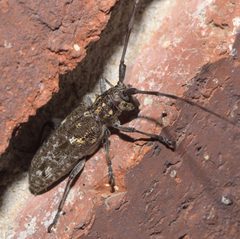
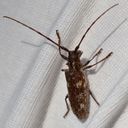
Monochamus carolinensis is a longhorn beetle in the Lamiinae, commonly known as the Carolina Pine Sawyer. It is a significant of the pinewood Bursaphelenchus xylophilus, the causative agent of . The is native to North America, occurring in Canada and the United States, and has been detected in China. are attracted to blacklights and are associated with pine forests.
Pronunciation
How to pronounce Monochamus carolinensis: //ˌmɒnəˈkeɪməs ˌkærəlɪˈnɛnsɪs//
These audio files are automatically generated. While they are not always 100% accurate, they are a good starting point.
Identification
Distinguished from by a combination of morphological characters and geographic distribution. Accurate identification to level requires examination of specific diagnostic features not detailed in the available sources; reference to specialized taxonomic keys for North American Monochamus is recommended.
Images
Habitat
Pine forests; specifically associated with Pinus including P. banksiana, P. resinosa, P. strobus, P. sylvestris, and P. echinata. have been collected in sandstone glades overlooking rivers and in campground settings with pine presence.
Distribution
Native to North America: Canada (New Brunswick, Ontario, Quebec) and the United States (Alabama, Arkansas, Florida, Georgia, Illinois, Indiana, Kansas, Kentucky, Louisiana, Maine, Massachusetts, Michigan, Minnesota, Mississippi, Missouri, New Jersey, New York, North Carolina, Ohio, Oklahoma, Pennsylvania, South Carolina, Tennessee, Texas, Virginia, Wisconsin). Introduced or detected in China (2022).
Seasonality
activity has been documented in June; timing varies with pine and geographic location. Specific seasonal patterns require further documentation.
Diet
Larvae feed internally in wood of dead or dying pine trees. have been observed feeding on sap flows.
Host Associations
- Pinus banksiana - larval development in wood
- Pinus resinosa - larval development in wood
- Pinus strobus - larval development in wood; documented in Illinois
- Pinus sylvestris - larval development in wood; documented in Illinois
- Pinus echinata - beaten from living branches
- Bursaphelenchus xylophilus - transmits pinewood ; nematode carried in tracheal system
Life Cycle
Complete with , larval, pupal, and stages. Eggs are laid on or in material. Larvae bore into wood, creating galleries; and result in high mortality (only ~12% of initial cohort completes development to adulthood). Pupal chambers are constructed within wood; chamber size is influenced by host tree . Adults emerge from dead pine material. time and voltinism not clearly established in available sources.
Behavior
are and attracted to ultraviolet light sources. Oviposition is modified by pinewood . Nematode transmission occurs during adult feeding on fresh pine branches. Reproductively females transmit a small proportion (2.5-11.5%) of carried nematodes. Initial nematode load increases with nematode in wood and adult body mass, but decreases with later date.
Ecological Role
Primary of Bursaphelenchus xylophilus, the pinewood that causes . In its native North American range, the nematode-vector system does not express , and do not occur in native pine forests. In invaded regions (Japan, China, Europe), this vector-nematode relationship contributes to devastating pine forest mortality. The also contributes to nutrient cycling through wood decomposition.
Human Relevance
pest in several countries due to its role in transmitting . Subject to international phytosanitary regulations. Potential for range expansion under climate change scenarios poses ongoing biosecurity concern. Predicted future distribution expansion to high latitudes with increasing suitable area.
Similar Taxa
- Monochamus titillatorCo-occurs in North American pine forests; shares similar and ; both respond to cerambycid and plant volatile α-pinene
- Monochamus notatusSympatric with similar pine-associated ; compared in studies of pine influence on body mass and timing
- Monochamus scutellatusSympatric with overlapping range; compared in demographic and host utilization studies
- Monochamus alternatusAsian that is the primary of Bursaphelenchus xylophilus in Japan; compared in studies of transmission and initial nematode load frequency distribution
- Acanthocinus obsoletusCo-occurs in pine and is attracted to blacklights alongside M. carolinensis; both are pine-associate cerambycids
More Details
Nematode Transmission Biology
The frequency distribution of initial pinewood load exhibits clumped distribution among . No evolutionary change in this distribution has been detected when comparing North American and Japanese systems. Transmission is lower in the native North American PWN-M. carolinensis system compared to the Japanese PWN-M. alternatus system, particularly at high nematode loads (>1000 nematodes).
Climate Change Predictions
Maximum entropy modeling indicates that biological suitability is driven primarily by precipitation factors (BIO18, BIO15, BIO19). Future suitable is predicted to expand to high latitudes with an average increase of 10,245,874.88 km² by the 2050s-2070s, with greatest expansion under SSP585 scenario (41.40% increase by 2070).
Laboratory Rearing Challenges
High mortality in laboratory colonies is attributed to and among larvae. is not directly related to oviposition , but is significantly correlated with log size.
Sources and further reading
- BugGuide
- Wikipedia
- GBIF taxonomy match
- iNaturalist taxon
- NCBI Taxonomy
- Catalogue of Life
- Erebidae | Beetles In The Bush | Page 2
- ID Challenge #9 | Beetles In The Bush
- Monochamus carolinensis . [Distribution map].
- Oviposition Biology of the Pine Sawyer, Monochamus carolinensis (Coleoptera: Cerambycidae)
- Oviposition Behavior of Monochamus carolinensis (Coleoptera: Cerambycidae) Infested with the Pinewood Nematode
- Population dynamics of Monochamus carolinensis (Col., Cerambycidae) under laboratory conditions
- Host tree effect on the pupal chamber size of Monochamus carolinensis (Coleoptera: Cerambycidae)
- Relationship between the initial number of carried Bursaphelenchus xylophilus and its transmission by Monochamus carolinensis with reference to virulence
- SEM Observations on the Intratracheal Existence and Cuticle Surface of the Pine Wood Nematode, Bursaphelenchus xylophilus, Associated with the Cerambycid Beetle, Monochamus carolinensis
- Frequency distribution of the initial number of Bursaphelenchus xylophilus carried by adult Monochamus carolinensis in Illinois, with reference to that by M. alternatus in Japan
- Response of the Woodborers <I>Monochamus carolinensis</I> and <I>Monochamus titillator</I> (Coleoptera: Cerambycidae) to Known Cerambycid Pheromones in the Presence and Absence of the Host Plant Volatile α-Pinene
- Influence of host pine species on the adult body mass and emergence date of Monochamus carolinensis, M. notatus, M. scutellatus and M. titillator (Coleoptera: Cerambycidae)
- Predicting the current and future distribution of Monochamus carolinensis (Coleoptera: Cerambycidae) based on the maximum entropy model