
Monochamus notatus
(Drury, 1773)
northeastern pine sawyer, notable sawyer
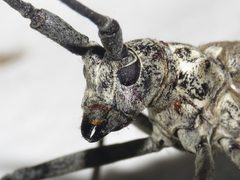
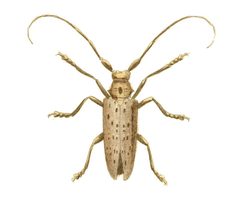
Monochamus notatus is a large longhorned beetle (Cerambycidae) native to North America, occurring in Canada and the United States east of the Rocky Mountains. are active from late spring through summer and are attracted to dead and dying conifers, particularly pines. The is notable for its pronounced : males possess up to twice their body length and elongated forelegs with expanded , while females have shorter antennae and unmodified legs. Like other Monochamus species, it responds to the monochamol and male-produced 2-(undecyloxy)-ethanol for mate location.
Pronunciation
How to pronounce Monochamus notatus: /mɒˈnɒkəməs nɔˈteɪtəs/
These audio files are automatically generated. While they are not always 100% accurate, they are a good starting point.
Identification
Monochamus notatus is distinguished from by the combination of: (1) extremely long in males, often exceeding twice the body length, versus shorter antennae in females; (2) male forelegs with expanded adapted for gripping females during mating; (3) overall body length of 23–35 mm; and (4) distribution primarily east of the Rocky Mountains. It overlaps geographically with M. scutellatus (white-spotted sawyer), which typically shows white scutellar markings and somewhat different associations. Males of M. notatus can be distinguished from M. scutellatus males by antennal proportions and body size range. Unlike M. maculosus, M. notatus shows no differential host attractivity to monochamol combined with specific host foliage.
Images
Habitat
Forested landscapes with coniferous trees, particularly pine stands. Found in association with dead, dying, injured, fire-scorched, or recently felled pines (Pinus spp.), balsam fir (Abies balsamea), and white spruce (Picea glauca). Vertical distribution across forest is similar to that of M. scutellatus. Inhabits both standing dead trees and downed woody material.
Distribution
Native to North America. Documented from Canada (Alberta, British Columbia, Manitoba, New Brunswick, and additional provinces) and the United States, occurring primarily east of the Rocky Mountains.
Seasonality
active from late spring through summer; timing varies with geographic location and local climate conditions.
Diet
Larvae bore in dead and dying conifer wood, feeding on phloem and later tunneling into heartwood. Specific nutritional requirements of are poorly documented.
Life Cycle
Requires one to two years to complete development. Larvae hatch from deposited in bark crevices, initially feed under bark, then tunnel deep into wood, sometimes reaching heartwood. occurs in a constructed near the wood surface. emerge by chewing through remaining wood and bark. In some , adults may overwinter in pupal chambers before spring .
Behavior
Males produce and respond to (monochamol and 2-(undecyloxy)-ethanol) that attract both sexes to oviposition sites. Males engage in antennal dueling and grappling contests for access to females and optimal oviposition substrates, with larger males typically dominating. Following mating, males may guard females during oviposition to prevent rival male interference. are strong fliers capable of locating scattered material across forested landscapes. Antennal show pronounced , with males possessing greater numbers of sensilla trichodea and sensilla basiconica, likely adaptations for pheromone detection.
Ecological Role
Primary decomposer of dead and dying conifer wood; contributes to nutrient cycling in forest . Creates gallery systems that provide for other organisms. Serves as for . Not a primary forest pest—does not kill living trees but may accelerate degradation of recently dead or stressed timber.
Human Relevance
Occasionally emerges from stored firewood, leading to incidental indoor encounters. Of interest in forest entomology research, particularly regarding and reproductive isolation mechanisms among sympatric Monochamus . Not considered a significant economic pest of standing timber or processed wood products.
Similar Taxa
- Monochamus scutellatusOverlapping distribution and use; distinguished by white scutellar markings, somewhat different preferences, and subtle differences in male antennal proportions and body size.
- Monochamus maculosusSympatric in parts of range; differs in showing strong preference for jack pine foliage when combined with monochamol , whereas M. notatus shows no differential host attractivity.
- Monochamus carolinensisOverlapping eastern North American range; similar but differs in body size, timing, and pine associations.
Sources and further reading
- BugGuide
- Wikipedia
- GBIF taxonomy match
- iNaturalist taxon
- NCBI Taxonomy
- Catalogue of Life
- Bug Eric: July 2009
- Bug Eric: Mate Guarding and Oviposition in the White-spotted Sawyer, Monochamus scutellatus (Coleoptera: Cerambycidae)
- Hitchin’ A Ride | Beetles In The Bush
- Bug Eric: Beetle Bonanza
- Pensoft Editorial Team | Blog - Part 148
- Bug Eric: An Insect "State of the Summer" Report
- The effects of host and habitat preferences in mate location of Monochamus maculosus , Monochamus notatus , and Monochamus scutellatus (Coleoptera: Cerambycidae)
- Sensilla on the antennal flagellum of the sawyer beetles Monochamus notatus (Drury) and Monochamus scutellatus (Say) (Coleoptera: Cerambycidae)
- Field Response ofMonochamus scutellatus scutellatusandMonochamus notatus(Coleoptera: Cerambycidae) to the Male-Produced Pheromone, 2-(Undecyloxy)-Ethanol, and Host Volatiles
- A Practical Method for Rearing Monochamus scutellatus (Say) and M. notatus (Drury) (Coleoptera: Cerambycidae)
- Influence of host pine species on the adult body mass and emergence date of Monochamus carolinensis, M. notatus, M. scutellatus and M. titillator (Coleoptera: Cerambycidae)
- The role of pheromones and temporal mechanisms in the reproductive isolation of Monochamus maculosus, Monochamus notatus, and Monochamus scutellatus (Coleoptera: Cerambycidae).