
Monochamus maculosus
Haldeman, 1847
spotted pine sawyer
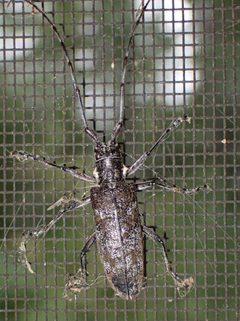
Monochamus maculosus, the spotted pine sawyer, is a longhorned beetle native to North America. It was formerly known as Monochamus mutator. are attracted to monochamol, a sex- produced by males. The breeds in stressed or recently dead conifers, with larvae tunneling in phloem and sapwood. It is a primary of the pinewood , the causal agent of .
Pronunciation
How to pronounce Monochamus maculosus: /mɒˈnɒkəməs ˌmækjʊˈloʊsəs/
These audio files are automatically generated. While they are not always 100% accurate, they are a good starting point.
Images
Habitat
Mixed wood forest stands, primarily in clear-cut areas. In the Great Lakes-St. Lawrence Forest Region of Ontario, Canada, found in stands dominated by Pinus banksiana (ca. 80%) with associated Pinus strobus, P. resinosa, Populus grandidentata, Betula alleghaniensis, Ostrya virginiana, Acer saccharum, and Acer rubrum. Occupies both down and standing dead trees with vertical distribution across the forest .
Distribution
Canada (Ontario, specifically Algoma District and Great Lakes-St. Lawrence Forest Region) and the United States (northeastern). Formerly known as Monochamus mutator.
Seasonality
activity occurs later in the season compared to sympatric Monochamus scutellatus. No diel rhythm in production has been demonstrated.
Diet
feed on foliage of Pinus resinosa. Larvae feed in phloem and excavate U-shaped galleries into sapwood of trees.
Host Associations
- Pinus banksiana - preferred in field attraction experiments
- Pinus strobus - associated in
- Pinus resinosa - foliage feeding documented
- Picea - attacked when severely stressed or recently dead
- Abies - attacked when severely stressed or recently dead
- Populus grandidentata - associatedpresent in
- Betula alleghaniensis - associatedpresent in
- Ostrya virginiana - associatedpresent in
- Acer saccharum - associatedpresent in
- Acer rubrum - associatedpresent in
Life Cycle
Females lay in phloem of trees through crevices or oviposition slits in bark. Larvae feed in phloem, then excavate deep U-shaped galleries into sapwood for . The complete duration has not been documented for this specifically.
Behavior
Males produce monochamol (2-(undecyloxy)ethanol), an - that attracts both sexes. Greater attraction to monochamol combined with jack pine foliage than with balsam fir or white spruce. activity occurs later in the season and day compared to M. scutellatus, which may contribute to partial reproductive isolation. No qualitative differences in components with sympatric M. scutellatus. Vertical abundance similar to M. scutellatus across forests.
Ecological Role
Secondary pest: larval tunneling downgrades wood value. Primary of pinewood Bursaphelenchus xylophilus, the causal agent of . Contributes to decomposition of stressed and dead conifers in forest .
Human Relevance
Economic pest due to wood degradation from larval tunneling. Significant forest health concern as the primary of pinewood , which causes . Formerly known as Monochamus mutator, which may appear in older literature.
Similar Taxa
- Monochamus scutellatusSympatric in Ontario; shares monochamol with no qualitative differences in components; distinguished by earlier seasonal activity and earlier daily flight times
- Monochamus notatusSympatric in Ontario; shares monochamol ; similar vertical abundance and spatial distribution within
- Monochamus clamatorAnother spotted pine sawyer with similar ; M. maculosus specifically associated with jack pine preference in field studies
More Details
Reproductive isolation mechanisms
No evidence that or preferences contribute to reproductive isolation among sympatric Monochamus . Minor temporal differences in times (seasonal and daily) may contribute to partial reproductive isolation between M. maculosus and M. scutellatus.
Pheromone characteristics
M. maculosus produces monochamol as an -. No diel rhythm in production has been detected in M. scutellatus, and this has not been directly tested for M. maculosus due to low lab colony numbers.
Taxonomic history
Formerly known as Monochamus mutator. The name change may cause confusion in older literature and collections.
Sources and further reading
- BugGuide
- Wikipedia
- iNaturalist taxon
- NCBI Taxonomy
- Catalogue of Life
- Bug Eric: An Insect "State of the Summer" Report
- Bug Eric: Results of the Red Rock Canyon Open Space Bioblitz
- Bug Eric: July 2018
- A Day Maker! | Beetles In The Bush
- Bug Eric: Mate Guarding and Oviposition in the White-spotted Sawyer, Monochamus scutellatus (Coleoptera: Cerambycidae)
- Bug Eric: Beetle Bonanza
- The effects of host and habitat preferences in mate location of Monochamus maculosus , Monochamus notatus , and Monochamus scutellatus (Coleoptera: Cerambycidae)
- The role of pheromones and temporal mechanisms in the reproductive isolation of Monochamus maculosus, Monochamus notatus, and Monochamus scutellatus (Coleoptera: Cerambycidae).