
Monochamus clamator
LeConte, 1852
spotted pine sawyer
Species Guides
3- Monochamus clamator latus(Spotted Pine Sawyer)
- Monochamus clamator nevadensis(Spotted Pine Sawyer)
- Monochamus clamator rubigineus(Spotted Pine Sawyer (for species complex))
Monochamus clamator, the spotted pine sawyer, is a of longhorn beetle in the Cerambycidae described by LeConte in 1852. The species exhibits several recognized across western North America and has been documented in pine woodland . Research indicates plants serve as a driving genetic divergence in this species. have been observed at blacklights and on stressed or dead pine trees.
Pronunciation
How to pronounce Monochamus clamator: //məˈnɒkəməs ˈkleɪmətɔr//
These audio files are automatically generated. While they are not always 100% accurate, they are a good starting point.
Identification
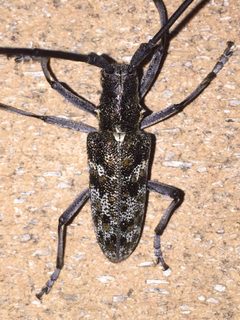
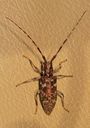
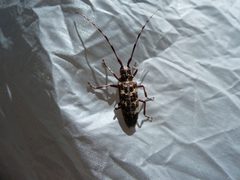
are large, robust longhorn beetles with distinctive spotted or mottled elytral patterns. Males possess notably longer than the body, while females have shorter antennae. The can be distinguished from other Monochamus species by specific elytral maculation patterns and geographic distribution. identification requires examination of subtle morphological differences in size, coloration, and antennal proportions.
Images
Habitat
Associated with coniferous forests, particularly pine woodlands. Found in montane and submontane zones where pines occur. have been documented on stressed, dying, or recently dead Pinus including ponderosa pine and Colorado pinyon pine. Occurs in juniper-oak-pinyon woodland transition zones and ponderosa pine forests at elevations ranging from approximately 7000 to 9000 feet.
Distribution
Western North America. Documented from the southwestern United States including Arizona, New Mexico, Utah, Nevada, and Colorado. Occurs in the Kaibab Plateau region of northern Arizona, southern Utah, and extends into the Rocky Mountain foothills. GBIF records indicate presence in Canada (CA), Rica (CR), and the United States (US), though primary range appears to be western North American coniferous forests.
Seasonality
activity observed from late spring through summer, with peak likely varying by elevation and latitude. Documented at blacklights in July. One observation notes a dead female specimen found in late June, suggesting earlier season emergence at lower elevations or in warmer years.
Host Associations
- Pinus ponderosa - breeding observed on stressed and dead trees; larvae develop in wood
- Pinus edulis - breeding Dead female found on trunk of dead Colorado pinyon pine
- Pinus monophylla - potential association in pinyon-juniper woodlands
Life Cycle
Complete with wood-boring larval stage. Larvae develop in the wood of stressed, dying, or dead pine trees, creating galleries under the bark and in the sapwood. holes are large and oval-shaped. occurs within the wood. Adults are active during summer months and are attracted to blacklights at night.
Behavior
are and attracted to ultraviolet light sources. Males have been observed mate-guarding females on tree trunks. Adults actively search trunks of stressed or recently dead pines, with females probing cracks and crevices for oviposition sites. The exhibits isolation by with plants serving as for genetic divergence among .
Ecological Role
Primary decomposer of dead and dying pine wood. Contributes to nutrient cycling in coniferous forest . As a wood-borer, creates for secondary colonizers and influences forest patterns. Serves as prey for woodpeckers and other . Interactions with bark beetles and other wood-boring insects in shared habitat likely influence dynamics.
Human Relevance
Occasionally attracted to blacklights at residences, where it may be mistaken for other longhorn beetles. Of interest to entomologists and collectors due to its size and distinctive appearance. Not a significant economic pest; primarily associated with already compromised or dead trees rather than healthy timber. Featured in citizen science documentation and bioblitz events.
Similar Taxa
- Monochamus scutellatusSimilar size and general appearance; distinguished by elytral pattern and geographic range
- Monochamus titillatorOverlaps in eastern range; requires examination of pronotal and elytral
- Prionus californicusSimilar large size and ; distinguished by much larger body, different antennal structure, and lack of spotted elytral pattern
More Details
Subspecies
Five recognized: M. c. clamator (LeConte, 1852), M. c. latus Casey 1924, M. c. linsleyi Dillon & Dillon 1941, M. c. nevadensis Dillon & Dillon 1941, and M. c. rubigineus (Bates 1880)
Research significance
Subject of molecular studies investigating isolation by ; plant associations demonstrate driving genetic divergence
Collection notes
Best collected by searching trunks of stressed, dying, or recently dead pines during daylight hours, or at blacklights at night. Chainsaw extraction of infested wood can yield larvae for rearing to
Sources and further reading
- BugGuide
- Wikipedia
- GBIF taxonomy match
- iNaturalist taxon
- NCBI Taxonomy
- Catalogue of Life
- Bug Eric: An Insect "State of the Summer" Report
- Bug Eric: Results of the Red Rock Canyon Open Space Bioblitz
- Bug Eric: July 2018
- Saldidae | Beetles In The Bush
- Chrysididae | Beetles In The Bush
- A Day Maker! | Beetles In The Bush
- Isolation by adaptation inMonochamus clamator: Host plants as a selective pressure