
Trichocnemis spiculatus neomexicanus
(Casey, 1890)
New Mexican ponderous borer
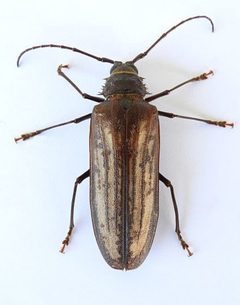
Trichocnemis spiculatus neomexicanus is a of the ponderous borer, a large prionine longhorn beetle native to western North America. The larvae are among the largest of any North American cerambycid, developing in dead or dying coniferous wood—particularly ponderosa pine. are and attracted to lights. This subspecies was described by Casey in 1890 and occurs in the southwestern United States and Mexico. The has gained notoriety as the inspiration for modern chainsaw design, after Joe Cox observed the larva's opposable in action.
Pronunciation
How to pronounce Trichocnemis spiculatus neomexicanus: /ˌtɹɪkoʊkˈniːmɪs spɪkjʊˈleɪtəs niːoʊmɛksɪˈkeɪnəs/
These audio files are automatically generated. While they are not always 100% accurate, they are a good starting point.
Images
Distribution
Southwestern United States (Arizona, New Mexico, Colorado, Utah) and Mexico. Records also exist from California and Hawaii (likely introduced). The name "neomexicanus" suggests particular association with New Mexico, though the full range extends more broadly across western North America.
Host Associations
- Pinus ponderosa - larval primary ; larvae develop in dead or dying wood
- Pinus edulis - larval also utilized
Behavior
are and attracted to artificial light sources. Larvae possess large, opposable adapted for chewing through wood—their cutting action inspired the design of modern chainsaw chains with alternating right and left cutting teeth.
Ecological Role
Larvae function as primary decomposers of dead coniferous wood, contributing to nutrient cycling in forest . Their wood-boring activity creates galleries that may subsequently be used by other organisms.
Human Relevance
The larval mandibular mechanism directly inspired Joe Cox's 1947 invention of the modern chainsaw chain with alternating cutting teeth, manufactured by what became Omark Industries. This biomimetic application represents one of the most consequential entomological influences on industrial technology.
Similar Taxa
- Trichocnemis spiculatus spiculatusNominate ; T. s. neomexicanus distinguished by geographic distribution and subtle morphological differences, though specific diagnostic characters require examination
- Ergates spiculatusFormerly placed in this ; now synonymized under Trichocnemis, but older literature may use this combination
- Other large Prioninae may be confused with other large prionines such as Prionus or Derobrachus, but Trichocnemis is distinguished by antennal structure and body proportions; larvae are uniquely large among North American cerambycids