
Psenocerus
LeConte, 1852
Species Guides
1- Psenocerus supernotatus(Currant-tip Borer)
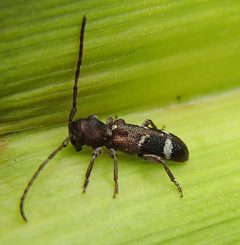
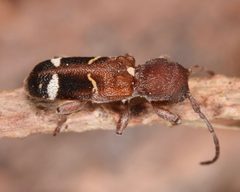
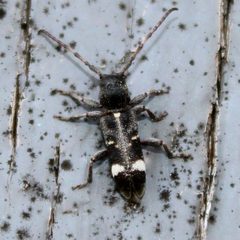
Psenocerus is a of longhorned beetles in the Cerambycidae, Lamiinae. The genus is , containing only the Psenocerus supernotatus, described by Thomas Say in 1823. Commonly known as the Currant-tip Borer, this small exhibits remarkable mimicry, with measuring approximately 4 millimeters in length. The genus was established by LeConte in 1852.
Pronunciation
How to pronounce Psenocerus: //ˌsɛnoʊˈsɪərəs//
These audio files are automatically generated. While they are not always 100% accurate, they are a good starting point.
Identification
Distinguished from other -mimicking cerambycids by its extremely small size (4 mm, smaller than Cyrtophorus verrucosus at 9 mm and Euderces pini at 7-8 mm), the downward-directed nearly hidden by the pronotum, and the specific pattern of white markings on the . The Lamiinae placement separates it from ant-mimicking Cerambycinae such as Molorchus, Euderces, and Tilloclytus. can be separated from true ants by the presence of elytra (hardened forewings) and the 's rapid, erratic running when disturbed.
Images
Appearance
Small beetles, approximately 4 millimeters in length. Body slender and -like in form. Coloration earth-toned and cryptic. White streaks or bars on the create the illusion of body segmentation, mimicking the constricted waist of ants. The is relatively small and directed downward, nearly hidden by the enlarged pronotum in P. supernotatus. of moderate length for the .
Habitat
Associated with deciduous forests and wooded areas. Larval development occurs in woody plants including currant (Ribes), Green Hawthorn (Crataegus viridis), Tulip Tree (Liriodendron tulipifera), and Black Willow (Salix nigra). have been observed on human-made structures such as air-conditioning units in residential settings.
Distribution
Widespread in North America east of the Rocky Mountains. Documented from Vermont and throughout the eastern and central United States. The sole P. supernotatus has been recorded from Kansas and other central states, with distribution extending across the eastern deciduous forest region.
Seasonality
active from April to June, with peak activity in early spring. This seasonal pattern aligns with other -mimicking cerambycids in the region.
Host Associations
- Ribes - larval currant; gives rise to common name
- Crataegus viridis - larval Green Hawthorn
- Liriodendron tulipifera - larval Tulip Tree, also known as Tulip Poplar or Yellow Poplar
- Salix nigra - larval Black Willow
- Physocarpus opulifolius - associationNinebark; recorded on flowers
Behavior
are active, running rapidly and flying well. They exhibit -mimicking , moving with quick, erratic movements characteristic of small ants. When disturbed, they display rapid escape behavior. Adults have been observed feeding on pollen and nectar of flowers, including ninebark. The ant mimicry likely provides protection from that avoid ants.
Ecological Role
Larvae function as wood-borers in living or dead branches of trees and shrubs, contributing to nutrient cycling and creating microhabitats within woody vegetation. serve as when feeding on flowers. The mimicry represents a case of , where a harmless gains protection by resembling unpalatable or aggressive ants.
Human Relevance
Not considered an agricultural or horticultural pest despite its referencing currant. Does not affect crops or orchard trees. Occasionally noticed by homeowners on structures or vegetation. Serves as an excellent example of insect mimicry for educational purposes.
Similar Taxa
- Cyrtophorus verrucosusAnother -mimicking cerambycid in Lamiinae, but larger (9 mm vs. 4 mm), with different pronotal structure and orientation
- Euderces pini-mimicking cerambycid in Cerambycinae, larger (7-8 mm), more slender, with different body proportions and frequently found on flowers
- Molorchus bimaculatus-mimicking cerambycid in Cerambycinae, similar size range but with different elytral markings and more frequently associated with flowers
- Tilloclytus geminatus-mimicking cerambycid in Cerambycinae with distinctive oblique and transverse markings creating different optical illusion of ant body plan
More Details
Taxonomic history
The sole was originally described by Thomas Say in 1823, with the Psenocerus established by LeConte in 1852. The species has been reared from multiple plants beyond currant, indicating the 'Currant-tip Borer' is somewhat misleading.
Ant mimicry mechanism
The white markings on the create the illusion of a constricted 'waist' between and , mimicking the petiole of ants. The enlarged pronotum resembles an 's , while the true head is concealed. This is a case of , as these beetles are harmless but gain protection from that avoid ants.