
Tragidion
Audinet-Serville, 1834
Species Guides
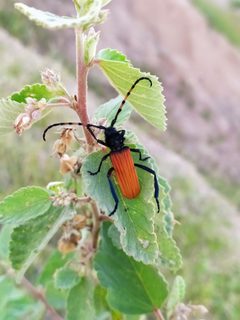
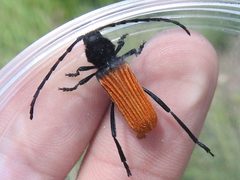
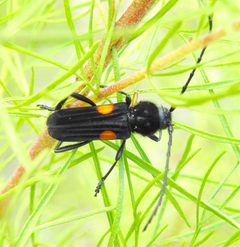
8Tragidion is a of longhorn beetles (Cerambycidae) distributed across North America and Mexico. are notable for their bright orange-red and black coloration, which functions in of tarantula hawk (Pompilidae: Pepsis, Hemipepsis). The genus contains eleven recognized species, with seven occurring in North America and four restricted to Mexico. Taxonomic clarity was recently provided by Swift & Ray (2008), who described two new species, revalidated one from synonymy, and proposed four new synonymies to resolve long-standing identification challenges.
Pronunciation
How to pronounce Tragidion: //træˈdʒɪdiːˌɒn//
These audio files are automatically generated. While they are not always 100% accurate, they are a good starting point.
Identification
of Tragidion are distinguished from other cerambycids by their robust body form, bright aposematic coloration, and association with mimetic resemblance to large spider wasps. Within the , species are differentiated by elytral (smooth versus ribbed), number and curvature of elytral , antennal length and coloration (sexually dimorphic in most species), body proportions, and plant associations. Males typically possess longer than females, and many species exhibit pronounced sexual dichromatism in elytral and body coloration.
Images
Habitat
occupy diverse ranging from xeric lowland deserts to montane woodlands. Specific habitat associations vary by species: some occur in desert scrub with Prosopis, Acacia, Yucca, and Agave; others in montane areas with Quercus; and one species in coastal California chaparral. Several species have been documented in recently burned areas, with one species strongly attracted to smoldering vegetation.
Distribution
North America (United States and Mexico), with distributed across the southwestern United States (California, Arizona, New Mexico, Texas), the Four Corners region, eastern and central United States, and northern Mexico. Individual species have more restricted ranges: T. agave in California and Baja California; T. annulatum in California and Baja California; T. armatum in desert southwest; T. auripenne in the Four Corners region; T. coquus across eastern and central U.S.; T. deceptum in montane southwest and northern Mexico; T. densiventre in desert southwest and northern Mexico.
Host Associations
- Prosopis glandulosa - larval T. densiventre
- Acacia greggii - larval T. densiventre
- Yucca - larval T. armatum; also observed on flower stalks
- Agave - larval T. agave, T. armatum
- Quercus - larval T. deceptum; recently dead branches
- Baccharis sarothroides - feeding/T. densiventre, T. deceptum; sap oozing from stems and flowers
- Nolina parryi - larval T. agave; inferred from collection records
- Various hardwoods - larval T. coquus; especially Quercus
- Burning/smoldering vegetation - oviposition substrateT. annulatum; females observed ovipositing on charred branches
Life Cycle
Larvae develop in dead or dying woody plant material, with specificity varying by . Larval development occurs in dead stalks of Agavaceae (Yucca, Agave), dead branches of Fabaceae (Prosopis, Acacia), Fagaceae (Quercus), or various hardwoods. One species has been documented ovipositing on burning vegetation. of some species have been collected using fermenting molasses traps.
Behavior
of several aggregate on sap flows and flowers of plants. One species exhibits strong attraction to brushfires and burning vegetation, with individuals landing on smoldering shrubs. Mimicry of tarantula hawk is visually striking; adults have been observed alongside their wasp models at shared resources. Adults of at least two species are attracted to fermenting molasses baits.
Ecological Role
Larvae function as wood decomposers, contributing to breakdown of dead plant material in desert and woodland . One likely plays a significant role in decomposition of burned woody material in coastal California. The mimicry complex involving Pepsis and Hemipepsis represents a notable example of in North American beetles.
Human Relevance
Popular among coleopterists due to attractive coloration and mimetic appearance. Taxonomic confusion historically complicated identification, now largely resolved. One may occasionally damage saguaro cactus flowers by chewing slits to access nectar, though this has limited impact on plant .
Similar Taxa
- Pepsis spp.Visual mimicry model; large spider wasps with similar orange-black coloration, often found at same resources
- Hemipepsis spp.Visual mimicry model; matt-black bodied with which beetles share microhabitat
- Other TrachyderiniSome other members of tribe share robust build and bright coloration, but lack the specific mimetic pattern and -like gestalt of Tragidion
Misconceptions
T. annulatum was long misapplied to southwestern desert ; true T. annulatum is restricted to California and Baja California. Former concepts of T. annulatum actually comprised T. densiventre (lowland desert) and T. deceptum (montane). T. armatum brevipenne was synonymized under T. armatum, as antennal length variation falls within limits.
More Details
Taxonomic history
The suffered from poorly defined limits, wide geographic variation, high , and apparent hybridization in zones of overlap. Swift & Ray (2008) provided the first comprehensive revision, clarifying species boundaries through examination of and detailed morphological analysis.
Mimicry complex
The resemblance to tarantula hawk (Pompilidae) is considered . Beetles benefit from avoidance due to wasps' formidable sting. The mimicry extends to : beetles often position themselves on shaded sides of flowers, similar to wasp posture, and share feeding resources with their models.
Fire association
T. annulatum exhibits exceptional attraction to fire, with landing on burning and smoldering vegetation. This is rare among cerambycids and may represent an for locating freshly killed material. Melted bodies of this have been found common on charred branches at post-burn sites.
Sources and further reading
- BugGuide
- Wikipedia
- GBIF taxonomy match
- iNaturalist taxon
- NCBI Taxonomy
- Catalogue of Life
- New species and a review of the genus Tragidion | Beetles In The Bush
- Tragidion confusion | Beetles In The Bush
- virga | Beetles In The Bush
- A review of the genus Tragidion Audinet-Serville, 1834 (Coleoptera: Cerambycidae: Cerambycinae: Trachyderini)