
Tragidion annulatum
LeConte, 1858
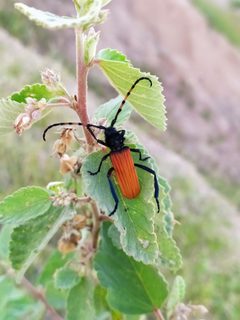
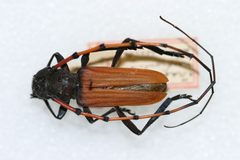
Tragidion annulatum is a of longhorn beetle (Cerambycidae) in the tribe Trachyderini, described by John Lawrence LeConte in 1858. It is one of seven recognized species in the Tragidion, which was taxonomically revised in 2008. The species is notable for its strong attraction to brushfires and burning vegetation, with observed landing on smoldering shrubs— that has resulted in specimens with melted legs and to charred branches. This species exhibits bright orange and black coloration that mimics spider wasps (Pompilidae), particularly tarantula hawks in the genera Pepsis and Hemipepsis.
Pronunciation
How to pronounce Tragidion annulatum: /træˈdʒɪdiən ænˈnjʊˌleɪtəm/
These audio files are automatically generated. While they are not always 100% accurate, they are a good starting point.
Identification
Distinguished from by geographic restriction to California and Baja California (following 2008 revision, which synonymized T. peninsulare and T. p. californicum with T. annulatum). Separated from T. deceptum, which occurs in montane areas of the southwestern U.S. and northern Mexico, and from T. densiventre and T. armatum, which occur in lowland desert . Antennal annulation and specific color pattern details distinguish it from other Tragidion ; precise identification requires reference to the dichotomous keys provided in Swift & Ray (2008).
Images
Appearance
Large, attractive cerambycid beetle with bright orange and black coloration. Exhibits pronounced and dichromatism, with males and females showing distinct morphological differences. annulated (ringed), a characteristic referenced in the epithet. Overall appearance closely resembles spider wasps ( Pompilidae) in the Pepsis and Hemipepsis.
Habitat
Coastal areas of California and Baja California. Associated with recently burned vegetation and post-fire environments. attracted to brushfires and smoldering shrubs.
Distribution
to California and Baja California. Restricted to coastal regions where fire-associated occurs.
Behavior
are strongly attracted to brushfires and burning vegetation. Individuals have been observed landing on still-burning and smoldering shrubs, with legs and melting to the surface of branches. Females oviposit on woody shrubs that have been burned. Frequently observed in association with its spider wasp models (Pepsis and Hemipepsis ) at sap flows on Baccharis and other plants.
Ecological Role
Plays an important role in the decomposition of burned woody material in coastal California . Contributes to nutrient cycling in post-fire environments through larval feeding on charred wood.
Human Relevance
Popular among coleopterists due to large size and attractive coloration. The ' unusual fire-associated makes it a subject of interest for studies on pyrophily in insects and mimicry systems.
Similar Taxa
- Tragidion deceptumOccurs in montane of southwestern U.S. and northern Mexico; utilizes Quercus rather than fire-associated ; previously confused with T. annulatum before 2008 revision restricted annulatum to California/Baja California.
- Tragidion densiventreOccurs in desert lowland of southwestern U.S. and northern Mexico; breeds in dead branches of Prosopis glandulosa and Acacia greggii rather than fire-associated .
- Tragidion armatumOccurs in xeric lowland ; breeds in dead flower stalks of Yucca and Agave rather than fire-associated woody shrubs.
- Tragidion coquusEastern and central U.S. that breeds in dead hardwoods, especially oak; lacks the strong pyrophilic of T. annulatum.
Misconceptions
Prior to the 2008 revision by Swift & Ray, specimens from Arizona and other southwestern U.S. locations were often identified as T. annulatum. These are now recognized as T. deceptum, T. densiventre, or T. armatum. The true T. annulatum is restricted to California and Baja California.
More Details
Taxonomic History
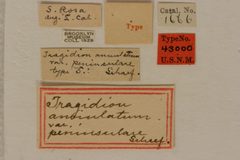
The was described by John Lawrence LeConte in 1858. In 2008, Swift & Ray proposed two new synonymies: T. peninsulare Schaeffer and T. p. californicum Linsley were synonymized under T. annulatum, and designated a lectotype for T. annulatum. This revision clarified species boundaries that had been confused due to high morphological similarity, geographic variation, , and apparent hybridization potential in areas of overlap.
Mimicry System
The bright orange and black coloration of Tragidion annulatum clearly functions in of spider wasps ( Pompilidae) in the Pepsis and Hemipepsis—the so-called 'tarantula hawks.' Both model and mimic have been observed together taking sap from Baccharis shrubs.
Fire Association
This represents one of the clearest examples of pyrophily (fire-loving ) in North American beetles. The melted remains of are commonly found on charred branches at post-burn sites, indicating the strength of this attraction and its potential costs to individual survival.