
Tragidion densiventre
Casey, 1912
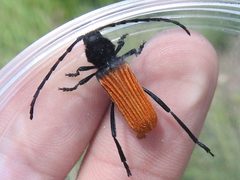
Tragidion densiventre is a longhorned beetle in the Cerambycidae, originally described by Casey in 1912 and later revalidated from synonymy under T. auripenne by Swift & Ray (2008). The exhibits striking orange and black coloration that mimics tarantula hawk (Pompilidae). It is one of several species in the that have been taxonomically confused due to high , geographic variation, and hybridization potential.
Pronunciation
How to pronounce Tragidion densiventre: /træˈɡɪdiːɒn dɛnˈsɪvɛntriː/
These audio files are automatically generated. While they are not always 100% accurate, they are a good starting point.
Identification
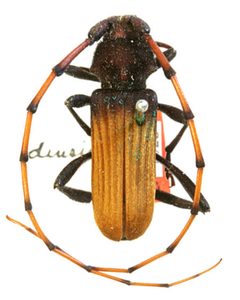
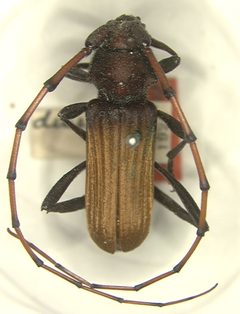
Distinguished from the sympatric T. deceptum by five (vs. four) elytral that curve inward toward the and extend nearly to the apices, and by a narrower basal black band. Females further distinguished by all black versus the distinctly annulated antennae of T. deceptum females. Males distinguished from T. deceptum males by red-brown (vs. black) , legs, and scape. Distinguished from T. armatum by ribbed (vs. smooth) .
Images
Appearance
Medium to large cerambycid beetle with bright aposematic coloration. Males have longer , tawny-tan , and distinctly red-brown , legs, and scape. Females have shorter antennae and red-orange elytra. Both sexes possess five elytral that curve inward toward the and extend nearly to the elytral apices. The basal black band on the elytra is relatively narrow compared to related . Females have all black or nearly black antennae.
Habitat
Xeric lowland desert in the southwestern United States and northern Mexico. Associated with desert scrub vegetation including mesquite and acacia.
Distribution
Arizona, New Mexico, and western Texas in the United States; northern Mexico. Predominantly found in lowland desert rather than montane areas.
Seasonality
have been observed in August, with activity likely coinciding with summer monsoon rains. Specific seasonal patterns otherwise undocumented.
Host Associations
- Prosopis glandulosa - larval Larvae develop in dead branches
- Acacia greggii - larval Larvae develop in dead branches
- Baccharis sarothroides - feeding/ site aggregate on sap oozing from stems
Life Cycle
Larvae develop in dead branches of Prosopis glandulosa and Acacia greggii. Detailed stages otherwise undocumented.
Behavior
aggregate on sap oozing from stems of Baccharis sarothroides and on flowers of larval plants. Exhibits of tarantula hawk (Pepsis and Hemipepsis). Adults are and avoid direct sunlight, often lurking on shaded sides of flowers.
Ecological Role
Contributes to decomposition of dead woody material in desert . Larval boring in dead branches of leguminous trees facilitates nutrient cycling. sap-feeding may aid in wound cleansing of plants.
Human Relevance
Popular among insect collectors due to attractive coloration and mimicry. No documented economic importance. Occasionally encountered by field biologists studying desert .
Similar Taxa
- Tragidion deceptumSympatric and superficially similar with ribbed , but distinguished by four (vs. five) elytral , broader basal black band, and different coloration of males (black vs. red-brown /legs/scape) and female (annulated vs. all black)
- Tragidion armatumSympatric in desert but distinguished by smooth (vs. ribbed) and association with Agave and Yucca (vs. Prosopis and Acacia) as larval
- Tragidion auripenneFormerly considered ; T. densiventre was revalidated from synonymy under T. auripenne; T. auripenne is a rare known only from the Four Corners region with different associations
Misconceptions
Formerly misidentified as T. annulatum, a name based on an erroneously labeled that actually refers to in California and Baja California. The classic T. 'annulatum' of desert southwest literature and field guides refers to T. densiventre. Also formerly synonymized under T. auripenne.
More Details
Taxonomic history
Originally described by Casey in 1912, subsequently synonymized under T. auripenne, and revalidated as a distinct by Swift & Ray (2008) based on examination of and ecological differences.
Mimicry system
Part of a Müllerian/ complex involving tarantula hawk (Pepsis and Hemipepsis). The bright orange and black coloration is convergent with these large, conspicuous wasps. Field observations suggest potential mutualistic relationships where beetles facilitate wasp feeding by chewing access slits in flower corollas.
Sources and further reading
- BugGuide
- Wikipedia
- GBIF taxonomy match
- iNaturalist taxon
- Catalogue of Life
- New species and a review of the genus Tragidion | Beetles In The Bush
- Tragidion confusion | Beetles In The Bush
- new species | Beetles In The Bush
- A review of the genus Tragidion Audinet-Serville, 1834 (Coleoptera: Cerambycidae: Cerambycinae: Trachyderini)