
Pepsis grossa
(Fabricius, 1798)
tarantula hawk, New Mexico state insect
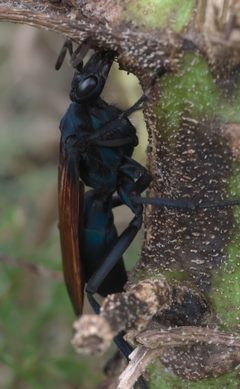
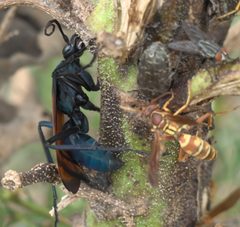
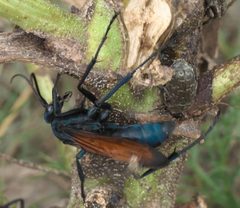
Pepsis grossa is one of the largest spider wasps in North America, reaching up to 51 mm in females. This hunts tarantulas exclusively, paralyzing them with a sting to serve as living food for its larvae. The sting is considered among the most painful of any insect, though not medically dangerous to humans. The species exhibits three distinct color morphs—orange-winged (xanthic), black-winged (melanic), and a dark-amber intermediate form (lygamorphic)—that are geographically segregated across its broad range from the southern United States to northern South America. It was designated the state insect of New Mexico in 1989.
Pronunciation
How to pronounce Pepsis grossa: /ˈpɛpsɪs ˈɡrɔsə/
These audio files are automatically generated. While they are not always 100% accurate, they are a good starting point.
Identification
Distinguished from similar Pepsis by its exceptional size—females average 43 mm, exceeding most . Males uniquely have 12 antennal segments versus 13 in all other Pepsis species. Females have characteristic hairs beneath the front . The melanic form is difficult to separate from P. mexicana, but P. grossa is noticeably larger. Wing venation distinguishes the from Hemipepsis, which has matte black rather than iridescent body coloration. The three color morphs are normally geographically separated: melanic in the western North American range, xanthic throughout most of the distribution, and lygamorphic in the southernmost range.
Images
Appearance
Very large with females 30–51 mm and males 24–40 mm in body length. Body is iridescent blue-black with contrasting wings that vary by morph: xanthic form has bright orange wings; melanic form has black wings with bluish reflections; lygamorphic form has dark wing bases with dark amber patches and pale tips. are long and prominent. Males are slimmer with longer antennae than females and possess only 12 antennal segments (scape, , and 10 flagellomeres), unique within the . Females have long, coarse hairs beneath the of the front leg, though these may be worn off in older specimens. The overall appearance combines aposematic warning coloration with a strong, distinctive odor.
Habitat
Arid and semi-arid regions including desert scrub, grasslands, and open woodlands. Associated with areas supporting tarantula , which require suitable soil for burrowing. frequently visit flowering plants for nectar, particularly milkweeds, mesquite, and other desert blooms. Males aggregate on trees and shrubs during midday heat and overnight.
Distribution
Southern United States (from Kansas south through Texas, Arizona, New Mexico, southern California, Nevada, with records to Arkansas and Missouri) through Mexico, Central America, and the Caribbean islands, south to northern South America (Ecuador, Peru, and adjacent regions). The xanthic form predominates from Arizona north and east plus central Mexico; the melanic form occurs in the western portion of the North American range; the lygamorphic form is restricted to southern Ecuador and northwest Peru.
Seasonality
Active primarily during warmer months. Males emerge earlier in the season than females in some regions. Females hunt primarily during periods—morning, evening, and overnight hours—to avoid intense daytime heat. Activity patterns vary geographically with local climate conditions.
Diet
feed on nectar, with documented preference for milkweeds (Asclepias texana, A. sperryi), Mexican buckeye (Ungnadia speciosa), and honey mesquite (Prosopis glandulosa). Larvae are obligate , feeding exclusively on paralyzed tarantulas (Theraphosidae), particularly Aphonopelma hentzi in Texas.
Host Associations
- Aphonopelma hentzi - preypreferred prey in Texas
- Theraphosidae - prey-level prey, almost exclusive
Life Cycle
Females hunt tarantulas, paralyzing them with a precisely targeted sting to a nerve center between the leg base and sternum. The paralyzed spider is dragged to a burrow—often the spider's own—and a single is laid upon it. The burrow is sealed, and the larva hatches to consume the still-living spider, beginning with non-vital tissues and finishing with vital organs. The larva then spins a silken cocoon, pupates, and emerges as an . Sex determination is environmentally influenced: fertilized eggs laid on larger female spiders produce female ; unfertilized eggs laid on smaller male spiders produce male wasps.
Behavior
Females hunt solitarily, flying low over ground or with intensive wing-flicking and -bobbing to detect tarantula burrows, possibly by visual cues or chemical detection of silk curtains over burrow entrances. Upon locating a spider, the enters the burrow, evicting the spider to gain maneuvering space. After paralysis, the wasp grooms extensively before transporting prey. Both sexes form mixed-, mixed-sex on vegetation during midday heat and overnight; these appear defensive and may assist in resource location and mating opportunities. Males do not hunt. When threatened, individuals adopt a defensive posture with wings splayed, curled, and release a strong odor.
Ecological Role
Top of tarantulas, regulating spider . serve as , particularly of milkweeds. The participates in Müllerian mimicry complexes with other tarantula hawks and with harmless species. Their aposematic coloration and odor warn predators of their formidable defense.
Human Relevance
State insect of New Mexico since 1989, selected by popular vote of over 10,000 schoolchildren. The sting is notorious for extreme pain—rated 4.0 on the Schmidt sting pain index, among the highest recorded—though venom is low and stings are not life-threatening except to allergic individuals. Females are generally placid unless provoked. Subject of scientific research on venom chemistry, pain mechanisms, and aposematism. Occasionally featured in educational materials and popular culture due to its striking appearance and formidable reputation.
Similar Taxa
- Pepsis mexicanaOverlaps in range and shares melanic coloration; distinguished by smaller size (always noticeably smaller than P. grossa)
- Hemipepsis ustulataAnother large tarantula hawk in western North America; distinguished by matte black (not iridescent) body coloration and different wing venation
- Pepsis thisbeSimilar size and appearance; shares Batesian mimics
More Details
Taxonomic history
Formerly known as Pepsis formosa (with P. formosa pattoni for the melanic form). C.R. Vardy synonymized all forms into P. grossa in 2002 based on recognition that color morphs represent intraspecific variation rather than distinct .
Antennal segment polymorphism
Males of P. grossa are the only Pepsis with 12 antennal segments; this trait is diagnostic but its evolutionary significance remains unexplained.
Predation and kleptoparasitism
Recorded include kingbirds (Tyrannus spp.), greater roadrunner (Geococcyx californianus)—which beats the against the ground before eating—and American bullfrog (Lithobates catesbeianus). Roadrunners also kleptoparasitize tarantula hawks, stealing paralyzed spiders while leaving the wasp unharmed.
Sources and further reading
- BugGuide
- Wikipedia
- GBIF taxonomy match
- iNaturalist taxon
- NCBI Taxonomy
- Catalogue of Life
- Of Lady Beetles and Green Fruit Beetle Larvae | Bug Squad
- Bug Eric: Wasp Wednesday: Pepsis grossa
- Bug Eric: Tarantula Hawks
- Bug Eric: Wasp Wednesay: Hemipepsis ustulata
- Do Chestnut, Lemon, or Peppermint Scents Repel Spiders?
- Bug Eric: Spider Sunday: Spider Enemies