
Pepsis thisbe
Lucas, 1895
Thisbe's tarantula-hawk wasp
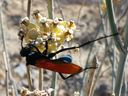
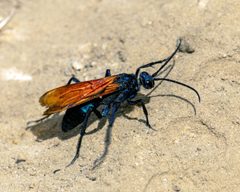
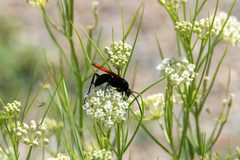
Pepsis thisbe is a large spider wasp in the Pompilidae, commonly known as Thisbe's tarantula-hawk . Females are 32–44 mm in length with a dark blue body and orange wings. The exhibits pronounced : females have curly and a 7 mm stinger, while males have straight antennae and lack stingers entirely. are nectarivorous, feeding primarily on flowers, but females hunt tarantulas as food for their larvae. The species is distributed throughout the American Southwest in desert areas.
Pronunciation
How to pronounce Pepsis thisbe: //ˈpɛp.sɪs ˈθɪz.bi//
These audio files are automatically generated. While they are not always 100% accurate, they are a good starting point.
Identification
Distinguished from similar Pepsis by female shape (curly vs. straight in males) and male antennal segment count. Males of P. thisbe have 12 antennal segments. May be confused with P. grossa, but P. grossa females average larger (43 mm) and males have 12 antennal segments (unique to that species). P. thisbe is generally smaller than P. grossa with different geographic distribution patterns. The orange-winged form is most common in the American Southwest.
Images
Habitat
Desert areas of the American Southwest, including creosote scrub, mesquite-acacia woodlands, and arid grasslands. Found in areas with suitable tarantula and flowering nectar sources.
Distribution
Throughout the American Southwest, including western Texas, southern New Mexico, and southeastern Arizona. Field studies have documented in Trans-Pecos, Texas and Zapata County, southern Texas. The ranges across arid and semi-arid regions where tarantula and flowering plants are present.
Seasonality
Active during warmer months. observed on flowers and at nectar sources. Hunting activity by females shows a bimodal daily pattern with peaks between 0800–0959 and 1600–1759 hours; activity declines when ambient temperatures exceed 38°C and drops abruptly after 1800 hours.
Diet
are nectarivorous, feeding on flower nectar. Milkweed (Asclepias spp.) is a preferred nectar source, but adults have been observed on creosote bush, blue palo verde, eucalyptus, mesquites, acacias, and burroweed (Isocoma tenuisecta). Females also drink water at puddle edges.
Host Associations
- Aphonopelma moderatum - primary Theraphosidae tarantula; over 91.2% of field-collected P. thisbe larvae were attached to this in southern Texas, despite similar abundance with alternative
- Aphonopelma texense - secondary Theraphosidae tarantula; only 8% of larvae attached to this in field collections from southern Texas
Life Cycle
Females paralyze tarantula with a sting to the nerve center, typically through the intersegmental between the sternum and of the first leg (>80% of stings). The paralyzed spider is dragged to a burrow—often the spider's own—and a single is laid on the host. The larva consumes the living but paralyzed spider, progressing through instars with ontogenetic changes in feeding patterns. Development from egg to requires approximately 41 days at 30°C and 70% relative humidity; eggs and larvae do not survive at 10% RH. The larva eventually spins a silken cocoon, pupates, and emerges as an adult.
Behavior
Females hunt tarantulas primarily during morning and evening hours to avoid overheating. Hunting involves low over ground to detect burrows visually or chemically, or random landing with rapid antennal flicking and wing vibration while searching on foot. Upon locating an occupied burrow, the female cuts the silk curtain and enters, often evicting the spider for surface combat. After paralyzing the , females may exhibit lapping (feeding on wound fluids) depending on search time invested. Males aggregate in multi- 'bachelor parties' on trees during midday heat and overnight, sometimes performing hill-topping behavior to intercept females. Both sexes adopt a threat posture with wings splayed and curled when agitated, accompanied by secretion of a distinctive odor.
Ecological Role
Specialized of tarantula spiders, regulating . As a large nectar-feeding insect, likely contributes to pollination of desert flowers. The ' abundance suggests substantial tarantula populations in the Sonoran Desert and related arid .
Human Relevance
Notable for possessing one of the most painful insect stings known, rated near the top of the Schmidt sting pain index. However, the venom causes no tissue damage and pain subsides within approximately three minutes. Stings are not life-threatening unless the victim has allergic reactions. The is generally placid unless provoked and is valued by entomologists and naturalists for its impressive size and coloration.
Similar Taxa
- Pepsis grossaLarger size (females average 43 mm vs. 32–44 mm for P. thisbe); males have 12 antennal segments (unique among Pepsis); exhibits both orange-winged and black-winged morphs; geographic range extends further east to Missouri and Arkansas
- Pepsis mexicanaVery similar appearance but smaller than P. grossa; males have fewer than 12 antennal segments; geographic distribution overlaps in parts of the Southwest
- Hemipepsis ustulataDifferent of tarantula hawk ; similar and but taxonomically distinct
More Details
Chemosensory Host Selection
Laboratory experiments demonstrate that P. thisbe females can discriminate between chemical cues from different tarantula , showing significantly greater response to Aphonopelma moderatum than to A. texense or novel cues. This selectivity correlates with field rates and may explain the disproportionate use of A. moderatum as a host despite comparable availability of alternative species.
Experience-Dependent Hunting Efficiency
Study of hunting in Trans-Pecos, Texas showed that time required for initial approach and paralyzation sequences decreases significantly with increasing encounter experience, indicating learned improvement in prey handling.
Host Sex Bias
Field data from southern Texas indicate that 81% of paralyzed A. moderatum with attached larvae were female spiders, suggesting possible sex-biased selection or differential vulnerability.
Sources and further reading
- BugGuide
- Wikipedia
- GBIF taxonomy match
- iNaturalist taxon
- Catalogue of Life
- Bug Eric: Wasp Wednesday: Pepsis grossa
- Belostomatidae | Beetles In The Bush
- Arthropoda | Beetles In The Bush | Page 7
- Bug Eric: Tarantula Hawks
- Behavioral Responses of Pepsis thisbe (Hymenoptera: Pompilidae) to Chemosensory Cues Associated with Host Spiders
- The Biology of the Spider Wasp, Pepsis Thisbe (Hymenoptera:Pompilidae) From Trans Pecos, Texas. II. Temporal Patterns ofActivity and Hunting Behavior With Special Reference to theEffects of Experience
- The Biology of the Spider Wasp Pepsis Thisbe (Hymenoptera: Pompilidae) From Trans Pecos, Texas. I. Adult Morphometrics, Larval Development and the Ontogeny of Larval Feeding Patterns