
Pepsis mexicana
Lucas, 1895
Mexican tarantula-hawk wasp
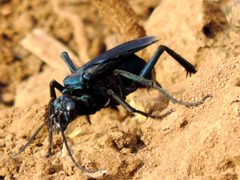
Pepsis mexicana is a of tarantula hawk in the Pompilidae. Females hunt and paralyze large theraphosid spiders to provision nests for their larvae. The species is notable for its relatively small size compared to other Pepsis species and its distinctive wing markings. Both sexes feed on nectar from flowering plants.
Pronunciation
How to pronounce Pepsis mexicana: //ˈpɛpsɪs ˌmɛksɪˈkɑːnə//
These audio files are automatically generated. While they are not always 100% accurate, they are a good starting point.
Identification
Distinguished from other tarantula hawk by the narrow white borders on wing apexes. Smaller than most ; females of P. grossa can be separated by presence of long, coarse hairs beneath front (absent or reduced in P. mexicana). Males of P. grossa have 12 antennal segments, a unique feature not shared with P. mexicana.
Images
Habitat
Arid and semi-arid environments including desert scrub, grasslands, and open woodlands. Occurs in xeric lowland deserts and montane areas up to 2500 m elevation.
Distribution
Southwestern United States (southern California, southern Arizona, western Texas) south through Mexico and Central America to Rica. In Mexico, recorded up to 2500 m in Chiapas.
Seasonality
active during warmer months; peak activity in spring and summer. Males may be observed earlier in the season than females in some regions.
Diet
feed on nectar from various flowering plants, with milkweed (Asclepias spp.) being a preferred source. Females also drink water at puddle edges. Larvae are obligate , feeding on paralyzed tarantulas provided by the mother.
Host Associations
- Theraphosidae - Females paralyze large theraphosid spiders (tarantulas) as food for larvae; specific spider not documented
Life Cycle
Females paralyze tarantulas with a sting, drag the immobilized spider into a burrow (often the spider's own), and deposit a single on the spider's . The burrow is sealed with compressed soil. Larva hatches and consumes the living but paralyzed spider, then pupates within a silken cocoon. emerges after pupal development.
Behavior
Females hunt tarantulas primarily during cooler periods (morning, evening, night) to avoid overheating. Hunting involves searching on foot with flickering wings and quivering , or detecting occupied burrows by sight or chemical cues. Males aggregate at nectar sources and may form overnight roosting clusters on vegetation. Both sexes adopt a threat posture with wings splayed and curled when disturbed, accompanied by release of a distinctive odor.
Ecological Role
of tarantulas; control of large spiders. contribute to pollination through nectar feeding. Serves as model for mimicry complexes (e.g., cerambycid beetles in Tragidion).
Human Relevance
Sting produces intense, short-duration pain (rated among the most painful of insect stings) but lacks significant vertebrate ; no lasting tissue damage. Females rarely sting without provocation; males cannot sting. Subject of scientific study for venom chemistry and pain mechanisms.
Similar Taxa
- Pepsis grossaLarger size; females have long coarse hairs beneath front ; males have 12 antennal segments (unique to this )
- Hemipepsis ustulataMatte black coloration rather than metallic-blue sheen; wing venation differs; typically flies earlier in season in southwestern U.S.
More Details
Nomenclature
Lectotype designated by Vardy (2000) from collection Lucas no. 46, housed at Museum für Naturkunde (MNHU), Berlin. epithet refers to type locality in Mexico (Cuernavaca).
Etymology
name Pepsis derived by Fabricius from Greek, possibly meaning 'kneading' or 'digestion'. name mexicana refers to Mexican origin of .
Sources and further reading
- BugGuide
- Wikipedia
- GBIF taxonomy match
- iNaturalist taxon
- Catalogue of Life
- Of Lady Beetles and Green Fruit Beetle Larvae | Bug Squad
- Bug Eric: Wasp Wednesday: Pepsis grossa
- Bug Eric: Tarantula Hawks
- Bug Eric: Wasp Wednesay: Hemipepsis ustulata
- Bug Eric: Spider Sunday: Spider Enemies
- New species and a review of the genus Tragidion | Beetles In The Bush
- STUDIES ON THE NATURAL HISTORY, ECOLOGY, AND BEHAVIOR OF PEPSIS CERBERUS AND P. MEXICANA (HYMENOPTERA: POMPILIDAE) FROM BIG BEND NATIONAL PARK, TEXAS