
Hemipepsis ustulata
Dahlbom, 1843
Flamed Tarantula-hawk Wasp, tarantula hawk
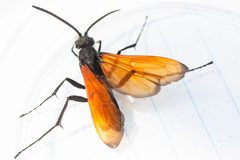
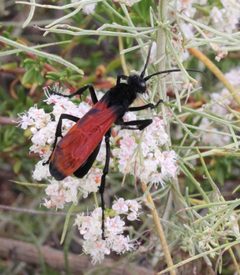
Hemipepsis ustulata is a large spider wasp in the Pompilidae, commonly known as a tarantula hawk. It is native to the Southwestern United States and is among the largest Hymenoptera, reaching up to 5 cm in length. Females hunt tarantulas, paralyzing them with a powerful sting to serve as living food for their larvae. Males exhibit complex lekking territorial , defending prominent perches on hilltops to intercept receptive females. The has matte black coloration with rust-orange wings, distinguishing it from the iridescent blue-black Pepsis species.
Pronunciation
How to pronounce Hemipepsis ustulata: /hɛ.mɪˈpɛp.sɪs ˌʌs.tjʊˈleɪ.tə/
These audio files are automatically generated. While they are not always 100% accurate, they are a good starting point.
Identification
Distinguished from Pepsis by matte black (not metallic blue-black) body coloration and rust-orange (not deep blue-striped) wings. Reliable separation requires examination of wing venation patterns. Males distinguished from females by more slender body, longer , and brighter wing hue. The curved twelve-segmented antennae also help distinguish it from other Pompilidae.
Images
Appearance
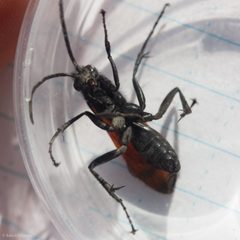
Large with matte black body and rust-orange wings. Body length up to 5 cm, making it among the largest Hymenoptera. Males have slender bodies, longer , and more vibrant wing coloration. Females have robust bodies and slightly darker wings. Antennae are curved with twelve segments. Wing venation patterns differ from related Pepsis.
Habitat
Arid and semi-arid environments of the Southwestern United States. Found in desert scrub, Sonoran Desert, and associated arid . Males establish territories on prominent vegetation, particularly palo verde trees (Cercidium microphyllum), at high elevations on mountain ridges and hilltops. Females forage on the ground searching for tarantula burrows.
Distribution
Southwestern United States: California, Arizona, New Mexico, Texas, Nevada, Oklahoma, and Kansas. Fieldwork has focused on the Sonoran Desert near Phoenix, Arizona.
Seasonality
Active primarily in spring and early summer. Males are among the first insects seen in spring. In the Southwest, flies earlier in the season than Pepsis , though both may be found together in fall when H. ustulata is in its second . Breeding season spans approximately two and a half months.
Diet
feed on nectar, particularly from milkweeds (Asclepias), western soapberry trees (Sapindus saponaria), and creosote bush. Females also feed on sap oozing from Desert Broom (Baccharis sarothroides). Larvae feed exclusively on paralyzed tarantulas provided by the mother.
Host Associations
- tarantulas (Theraphosidae) - Females paralyze tarantulas with their sting, lay a single on the spider, and seal it in a burrow. The larva consumes the living spider over approximately 35 days.
Life Cycle
Female lays a single (about 5 mm long, gently curved, creamy white) on a paralyzed tarantula. Egg hatches in about three days; larva emerges and attaches to , feeding while keeping spider alive. Larva several times, darkening in color as it grows. By fifth instar, develops stout three-toothed and becomes muscular. Spins brown silk cocoon after feeding complete; cocoon turns greasy amber yellow. duration varies by season—early summer may emerge same season, late summer or autumn broods overwinter until following spring or summer. Young cuts out of cocoon with mandibles and digs to surface.
Behavior
Solitary with complex mating system. Males exhibit lekking territorial : defend prominent perches on palo verde trees and other vegetation at high elevations (1500 m or higher), often on hilltops and ridge crests. Territories are landmark-based and lack resources for females. Males engage in aerial combat with intruders, spiraling upward in contests of endurance and speed. Larger males hold preferred territories closer to summits; smaller males use alternative tactics at lower elevations or as non-territorial visitors. Females search for tarantula burrows on foot with flickering wings and quivering , often during cooler morning, evening, or overnight hours. When tarantula located, female grapples with it and delivers paralyzing sting to underside, then drags spider up to 100 m to a cavity or burrow.
Ecological Role
Apex of tarantulas in arid . function as while feeding on nectar. The ' aposematic coloration and powerful sting contribute to deterrence, with documented Müllerian and by other species including beetles (Tragidion spp.) and .
Human Relevance
Sting ranked among the most painful in the insect world; described as 'blinding, fierce, shockingly electric' on the Schmidt sting pain index. Pain is intense but short-lived (approximately three minutes) and causes no tissue damage. State insect of New Mexico. Subject of extensive behavioral research by John Alcock. Generally placid unless provoked; females rarely sting when feeding at flowers.
Similar Taxa
- Pepsis spp.Similar size, , and . Distinguished by iridescent blue-black body with deep-blue striped wings (vs. matte black with rust-orange wings in H. ustulata). Reliable separation requires wing venation examination.
More Details
Territorial site fidelity
Males return to the same prominent palo verde trees year after year during mating season. Preference rankings for territories remain highly consistent across .
Size variation maintenance
Despite advantages of large size in male-male competition, wide size variation persists because female provisioning influences offspring size. Mothers may produce smaller male offspring when subduing large tarantulas would require excessive energy investment or risk.
Activity patterns
Males become early risers as season progresses, taking advantage of brief temperature windows before midday heat. Some hunting activities by females may occur at night or dusk, with females documented at blacklights.
Sources and further reading
- BugGuide
- Wikipedia
- GBIF taxonomy match
- iNaturalist taxon
- Catalogue of Life
- Bug Eric: Wasp Wednesay: Hemipepsis ustulata
- Bug Eric: Tarantula Hawks
- Tragidion confusion | Beetles In The Bush
- Bug Eric: June 2012
- New species and a review of the genus Tragidion | Beetles In The Bush
- Success in territorial defence by male tarantula hawk wasps Hemipepsis ustulata : the role of residency
- The Behavioral Significance of Male Body Size in the Tarantula Hawk Wasp Hemipepsis ustulata (Hymenoptera: Pompilidae)
- Hilltopping behaviour and mating success of the tarantula hawk wasp,Hemipepsis ustulata(Hymenoptera: Pompilidae), at a high elevation peak
- The Behavioural Consequences of Size Variation Among Males of the Territorial Wasp Hemipepsis Ust Ulata (Hymenoptera : Pompilidae)