
Tragidion deceptum
Swift & Ray, 2008
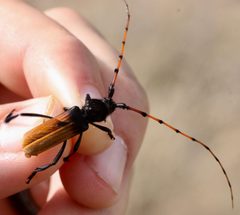
Tragidion deceptum is a longhorned beetle (Cerambycidae) described by Swift & Ray in 2008 during a comprehensive taxonomic revision of the . It occurs in montane of the southwestern United States and northern Mexico, where it breeds in recently dead oak branches. The exhibits of tarantula hawk (Pompilidae: Pepsis, Hemipepsis), with bright orange-red and black coloration. It is one of several Tragidion species historically confused under the name T. 'annulatum' prior to the 2008 revision.
Pronunciation
How to pronounce Tragidion deceptum: //trəˈɡɪ.di.ən dɪˈsɛp.təm//
These audio files are automatically generated. While they are not always 100% accurate, they are a good starting point.
Identification
Distinguished from the sympatric T. densiventre by having four rather than five elytral , costae not curving inward toward the , costae extending only to one-third of (versus near apices), and broader basal black band. Females further distinguished by annulated versus all-black . Males distinguished by black versus red-brown , legs, and scape. Distinguished from T. agave and T. armatum by ribbed (not smooth) elytra. Distinguished from T. annulatum (California/Baja California) by geographic range and preference.
Images
Habitat
Montane in the desert southwest, including oak woodlands and mixed conifer-oak forests at higher elevations. Found in canyons and mountain slopes with Quercus . Occurs in areas with sufficient moisture to support oak vegetation, distinct from the xeric lowland desert habitats of T. densiventre.
Distribution
Southwestern United States (Arizona, New Mexico, Texas) and northern Mexico. Specifically recorded from montane areas including the Huachuca Mountains of southeastern Arizona.
Seasonality
have been collected in association with summer monsoon season (July-August) in southeastern Arizona. One record from August 2, 2003 at 10-1200 hours suggests activity.
Diet
feed on sap oozing from stems of Baccharis sarothroides (Asteraceae) and flowers of larval plants. Specific larval diet consists of heartwood of recently dead Quercus branches.
Host Associations
- Quercus - larval breeds in recently dead branches
- Baccharis sarothroides - feeding siteaggregates on sap oozing from stems
Life Cycle
Larval development occurs in recently dead branches of Quercus , mining the heartwood. emerge and have been observed feeding on sap flows and flowers.
Behavior
aggregate on sap oozing from Baccharis sarothroides stems. In lower canyons bordering desert , has been collected feeding alongside T. densiventre on the same Baccharis plants. One of several Tragidion attracted to fermenting molasses traps. Exhibits of tarantula hawk , with coloration and presumably matching these models.
Ecological Role
Contributes to decomposition of dead oak wood through larval feeding. sap-feeding on Baccharis may facilitate nutrient cycling. As a mimic of tarantula hawk , may influence learning and dynamics involving aposematic models.
Human Relevance
Popular among coleopterists due to large size and attractive coloration. Has caused taxonomic confusion historically, leading to misidentifications in collections and literature. The 2008 revision clarified its status as distinct from T. densiventre and other southwestern .
Similar Taxa
- Tragidion densiventreSympatric in southwestern deserts; distinguished by five elytral curving toward , narrower basal black band, all-black female , and red-brown male /legs/scape
- Tragidion agaveOccurs in California and Baja California; has smooth without , breeds in dead Agave and Yucca stalks
- Tragidion armatumOccurs in lowland desert ; has smooth , breeds in dead Yucca and Agave flower stalks
- Tragidion annulatumRestricted to California and Baja California; attracted to brushfires and burning vegetation, where may be killed by melting to hot surfaces
Misconceptions
Historically confused with T. 'annulatum' sensu lato; in Arizona, New Mexico, and Texas previously attributed to T. annulatum were found to comprise two distinct —T. densiventre in lowland and T. deceptum in montane habitats. The name T. deceptum refers to this historical deception in species identification.
More Details
Taxonomic history
Described as new in 2008 by Swift & Ray during the first comprehensive revision of the Tragidion. The specific epithet 'deceptum' alludes to the long-standing confusion between this species and related , particularly the misapplication of the name T. annulatum to southwestern .
Mimicry complex
Part of a system involving tarantula hawk (Pompilidae: Pepsis and Hemipepsis). The bright orange-red and black coloration matches these venomous wasp models. Observed in field situations with both model and mimic present at sap-feeding sites.
Sources and further reading
- BugGuide
- Wikipedia
- GBIF taxonomy match
- iNaturalist taxon
- Catalogue of Life
- New species and a review of the genus Tragidion | Beetles In The Bush
- Tragidion confusion | Beetles In The Bush
- new species | Beetles In The Bush
- A review of the genus Tragidion Audinet-Serville, 1834 (Coleoptera: Cerambycidae: Cerambycinae: Trachyderini)