
Tragidion agave
Swift & Ray, 2008
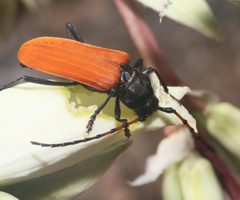
Tragidion agave is a of longhorned beetle in the Cerambycidae, described by Swift and Ray in 2008 from California and Baja California. It is one of two species in the known to breed in dead flower stalks of Agave (Agavaceae), the other being T. armatum. The species exhibits bright orange and black coloration characteristic of the genus, which functions as mimicry of spider wasps (family Pompilidae).
Pronunciation
How to pronounce Tragidion agave: /træˈdʒɪdiˌɑn əˈɡeɪvi/
These audio files are automatically generated. While they are not always 100% accurate, they are a good starting point.
Identification
Distinguished from other Tragidion by its association with Agave and distribution in California and Baja California. Differs from T. armatum, which also breeds in Agave and Yucca, by geographic range—T. armatum occurs in the desert southwest (Arizona, New Mexico, west Texas) while T. agave is restricted to California and Baja California. Specific morphological characters separating these species are not detailed in available sources.
Images
Habitat
Xeric in California and Baja California. Associated with Agave plants, where larvae develop in dead flower stalks.
Distribution
California and Baja California.
Host Associations
- Agave - larval Larvae develop in dead flower stalks
Similar Taxa
- Tragidion armatumAlso breeds in dead flower stalks of Agave and Yucca, but occurs in desert southwest (Arizona, New Mexico, west Texas) rather than California and Baja California
- Tragidion deceptumOccurs in montane of southwestern U.S. and northern Mexico, breeding in Quercus rather than Agave
- Tragidion densiventreOccurs in xeric lowland desert of southwestern U.S. and northern Mexico, breeding in Prosopis and Acacia rather than Agave