
Tragidion coquus
(Linnaeus, 1758)
Tragidion coquus is a of longhorn beetle in the Cerambycidae, originally described by Linnaeus in 1758. It is among the larger and more visually striking cerambycids in North America, with velvety black and vivid orange coloration that mimics tarantula hawk (Pompilidae). The species occurs broadly across the eastern and central United States, where it breeds in dead hardwoods, particularly oak. It is considered rare and difficult to encounter in the field despite its wide distribution.
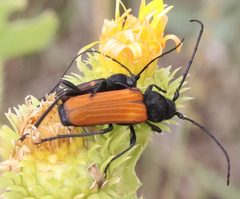
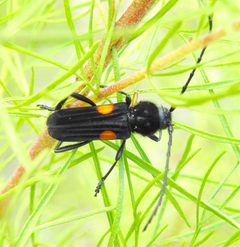
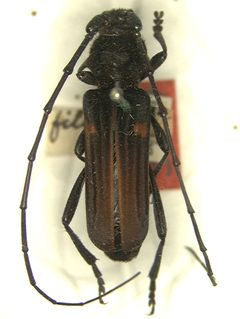
Pronunciation
How to pronounce Tragidion coquus: //trəˈɡiːdiən ˈkoʊkwəs//
These audio files are automatically generated. While they are not always 100% accurate, they are a good starting point.
Identification
Distinguished from other Tragidion by its broad eastern and central U.S. distribution combined with breeding in dead hardwoods (especially oak), whereas western typically utilize desert plants (Agave, Yucca, Acacia, Prosopis) or montane oaks. Distinguished from T. auripenne (Four Corners region) and T. densiventre, T. deceptum, T. agave, T. armatum, and T. annulatum (southwestern U.S. and Mexico) by geography and association. The specific epithet is sometimes misspelled as "coquum" but must retain the spelling "coquus" as it is a noun.
Images
Habitat
Breeds in dead hardwoods, especially oak (Quercus). have been associated with shortgrass prairie, oak/pine/juniper woodland, and rhyolite glade . The shows attraction to fermenting substrates including ethanol-baited traps and sweet red wine.
Distribution
Eastern and central United States; broadly distributed across this region. Specific records include Oklahoma (Alabaster Caverns State Park, Gloss Mountain State Park, Beaver Dunes Park, Black Mesa State Park), Missouri (Hughes Mountain Natural Area), and inferred presence throughout the range based on tree distribution.
Seasonality
are active in fall, with observations from October documented. The has been described as a "fall tiger " in reference to its autumn activity period, though this is a beetle, not a true tiger beetle.
Diet
Larvae feed on dead hardwood, particularly oak. have been observed attracted to fermenting fruit, ethanol, and sweet red wine in trapping studies.
Host Associations
- Quercus - larval primary breeding substrate; dead hardwood
Life Cycle
Larvae develop in dead hardwood branches. Specific details of , larval instars, , and longevity are not documented in available sources.
Behavior
are attracted to ethanol and sweet red wine baits, and have been documented in jug traps baited with pure ethanol, sweet red wine, or 50:50 blends. Attraction to fermenting fruit has been noted based on collection label data. The exhibits mimicry of tarantula hawk (Pompilidae), likely as defense against .
Ecological Role
Contributes to decomposition of dead hardwood material, particularly oak. The likely plays a role in nutrient cycling in eastern and central U.S. forest . As a mimic, it may also participate in Müllerian or complexes involving spider wasps.
Human Relevance
Popular among coleopterists due to its large size and attractive coloration. Considered a high-priority target for collectors. The species was among the earliest described cerambycids (Linnaeus, 1758), giving it historical taxonomic significance. Its rarity in collections despite broad distribution makes it a notable find for entomologists.
Similar Taxa
- Tragidion auripenneOccurs in xeric Four Corners region; unknown but likely distinct associations
- Tragidion densiventreSouthwestern desert breeding in Prosopis glandulosa and Acacia greggii; not overlapping in range
- Tragidion deceptumMontane southwestern mining heartwood of Quercus; restricted to southwestern U.S. and northern Mexico
- Tragidion agaveCalifornia and Baja California breeding in dead flower stalks of Yucca and Agave
- Tragidion armatumSouthwestern utilizing Agave and Yucca; lowland desert
- Tragidion annulatumCalifornia and Baja California strongly attracted to brushfires and burning vegetation; distinct fire-associated
Misconceptions
The specific epithet is frequently misspelled as "coquum" in some sources, but as a noun it must retain the original spelling "coquus" under the International Code of Zoological .
More Details
Taxonomic History
One of the earliest described cerambycid , described by Carl Linnaeus in the 10th edition of Systema Naturae (1758). The Tragidion underwent comprehensive revision by Swift and Ray (2008), which clarified species boundaries that had been confounded by morphological similarity, geographic variation, , and potential hybridization.
Conservation Status
Considered rare and difficult to encounter despite broad distribution. The has frustrated collectors for years due to its apparent scarcity relative to its range.
Sources and further reading
- BugGuide
- Wikipedia
- GBIF taxonomy match
- iNaturalist taxon
- NCBI Taxonomy
- Catalogue of Life
- Season Finale | Beetles In The Bush
- 🪲 Entomologizing w/ the WGNSS Entomology Group at Hughes Mountain Natural Area — 11 Oct 2025 | Beetles In The Bush
- New species and a review of the genus Tragidion | Beetles In The Bush