
Stygoparnus
Barr & Spangler, 1992
Comal Springs dryopid beetle (for sole species S. comalensis)
Species Guides
1- Stygoparnus comalensis(Comal Springs dryopid beetle)
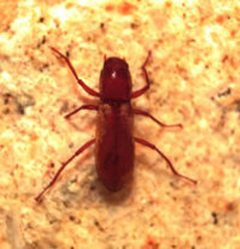
Stygoparnus is a of dryopid beetles containing the single Stygoparnus comalensis, known as the Comal Springs dryopid . The genus is to central Texas spring systems fed by the Edwards Aquifer. Its sole member is a federally endangered, subterranean-obligate aquatic beetle with and reduced pigmentation. The genus represents the only known aquatic lineage within the Dryopidae.
Pronunciation
How to pronounce Stygoparnus: /staɪɡoʊˈpɑrnəs/
These audio files are automatically generated. While they are not always 100% accurate, they are a good starting point.
Identification
The Stygoparnus contains only one , S. comalensis, distinguished from other Dryopidae by its subterranean aquatic and associated morphological reductions. measure 3–3.7 mm in length. Males possess tufts on the metasternum that are absent in females, though these are difficult to observe. Sex determination is most reliably achieved through lateral illumination to visualize internal abdominal structures: males display sternite 8, while females show gonocoxites and faint of sternite 8.
Images
Habitat
Spring systems in central Texas; specifically associated with near-surface in springs surrounded by sycamore trees (Platanus spp.) with mixed substrates ranging from silt to cobble. Despite suggesting subterranean , are primarily collected from near-surface environments. The occupies air pockets within karst cave systems rather than open water.
Distribution
to three spring systems in central Texas, United States: Comal Springs in Comal County, and two springs in neighboring Hays County (including Fern Bank Springs). All localities are associated with the Edwards Aquifer.
Human Relevance
The sole S. comalensis is federally listed as endangered in the United States (1997). Primary threats include groundwater pumping from the Edwards Aquifer for municipal and agricultural use, which reduces spring flow, along with pollution and disturbance. Critical habitat protection covers 139 acres of the subsurface aquifer. The species has been the focus of captive propagation efforts to establish self-sustaining , though with limited success due to low reproductive rates.
Similar Taxa
- Stenelmis sexlineataCo-occurs in Texas spring systems; both show attraction to wood substrates, but S. sexlineata does not prefer wood when leaves are available and exhibits different phototactic (hides from all light types rather than showing wavelength-specific responses).
- Heterelmis comalensisSympatric endangered from the same spring systems; both have cryptic external requiring lateral illumination for sex determination, but H. comalensis belongs to Elmidae and females are slightly larger with no external diagnostic features.
Sources and further reading
- BugGuide
- Wikipedia
- GBIF taxonomy match
- iNaturalist taxon
- NCBI Taxonomy
- Study Shines Light on ID'ing Males, Females of Endangered Beetles
- Stygoparnus comalensis Archives - Entomology Today
- Experimental tests of habitat preferences in the Comal Springs dryopid beetle, Stygoparnus comalensis
- Evolutionary Isolation and Ecological Stasis in the Endangered Comal Springs Dryopid Beetle ( Stygoparnus comalensis )
- Supplemental Information 1: Supplemental information for ‘Experimental tests of habitat preferences in the Comal Springs dryopid beetle, Stygoparnus comalensis ’.