
Heterelmis comalensis
Bosse, Tuff & Brown, 1988
Comal Springs riffle beetle
Heterelmis comalensis is a federally endangered aquatic to two spring systems in Texas. Described in 1988, this flightless measures approximately 2 mm and inhabits shallow gravel substrates in spring riffles fed by the Edwards Aquifer. The species has been the focus of intensive conservation research, including captive breeding programs and studies on identification.

Pronunciation
How to pronounce Heterelmis comalensis: /ˌhɛtəˈrɛlmɪs ˌkoʊməˈlɛnsɪs/
These audio files are automatically generated. While they are not always 100% accurate, they are a good starting point.
Identification
Distinguished from co-occurring Microcylloepus pusillus by -level characters. Sex determination requires lateral illumination to visualize internal abdominal structures; external measurements are unreliable. Distinguished from Stygoparnus comalensis by affiliation (Elmidae vs. Dryopidae) and subtle morphological differences.
Images
Appearance
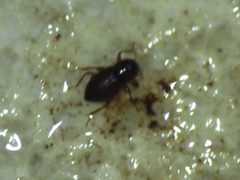
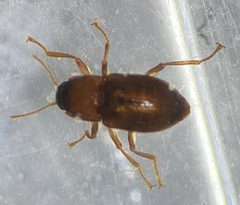
are approximately 2 mm in length. Wings are reduced and nonfunctional; the cannot fly. is minimal externally; females are slightly larger than males but lack reliable external distinguishing features. Internal abdominal structures visible under lateral illumination provide the most accurate sex identification: females show an strut of sternite 8 and sternite 8 itself, while males show only sternite 8.
Habitat
Shallow water in gravel substrates and riffles of spring systems. Specifically associated with spring showing microhabitat preferences within these systems. Requires well-oxygenated water due to respiration via .
Distribution
to Comal Springs in Comal County and San Marcos Springs in Hays County, Texas, USA. All known occur within the Edwards Aquifer system.
Diet
Feeds on microbial biofilm. In captivity, consumes biofilm developed on conditioned Platanus occidentalis (sycamore) leaves and wood dowels. Gut microbiome studies indicate captive beetles may utilize bacterial associated with nitrogen-rich environments not found in natural .
Life Cycle
Larvae possess gills and develop underwater. respire via —an air bubble maintained on body hairs that extracts oxygen from water. Underwater has been documented. Captive rearing shows 12% survival rate from larvae to adults. Females are , producing larvae across multiple reproductive events throughout life.
Behavior
remain submerged throughout life, extracting oxygen from water via respiration. Flightless due to reduced wings, restricting to within spring systems. Females require presence of male to produce larvae; production resumes if new male is provided after mate death.
Ecological Role
Aquatic within karst spring . Functions as a surrogate for monitoring Edwards Aquifer health. Part of an including eight threatened or endangered in the aquifer system.
Human Relevance
Federally listed (1997). Subject of Edwards Aquifer Conservation Plan. Captive propagation colony maintained at San Marcos National Fish Hatchery and Technology Center as insurance for potential reintroduction. Critical habitat designation expanded to 139 acres of subterranean aquifer in 2013.
Similar Taxa
- Microcylloepus pusillusCo-occurs in same spring ; distinguished by -level morphological characters
- Stygoparnus comalensisSympatric endangered aquifer ; belongs to Dryopidae rather than Elmidae, with different internal characteristics visible under lateral lighting
More Details
Captive breeding research
study of 24 captive females found mean production of 29.3 larvae per female (range 0–121), with output determined by longevity rather than body size. Optimal captive conditions required months of biofilm development on sycamore substrates and constant flow-through of Edwards Aquifer water.
Microbiome alteration in captivity
Captive beetles exhibit more diverse gut microbiomes than wild counterparts, with 24 amplicon sequence variants significantly different between groups. Overrepresented in captivity are linked to nitrogen-rich environments, raising questions about dietary adequacy of captive conditions.
Sources and further reading
- BugGuide
- Wikipedia
- GBIF taxonomy match
- iNaturalist taxon
- NCBI Taxonomy
- Catalogue of Life
- Heterelmis comalensis - Entomology Today
- Study Shines Light on ID'ing Males, Females of Endangered Beetles
- New Study Advances Lab Rearing of Endangered Beetle
- Heterelmis comalensis Archives - Entomology Today
- Stygoparnus comalensis Archives - Entomology Today
- Fecundity of First-Generation Captively Reared Heterelmis comalensis (Coleoptera: Elmidae)
- A comparison of wild and captive Comal Springs riffle beetle ( Heterelmis comalensis ) microbiomes
- Spring association and microhabitat preferences of the Comal Springs riffle beetle (Heterelmis comalensis)
- The effects of captivity on the microbiome of the endangered Comal Springs riffle beetle ( Heterelmis comalensis )
- Habitat and phenology of the endangered riffle beetle Heterelmis comalensis and a coexisting species, Microcylloepus pusillus, (Coleoptera: Elmidae) at Comal Springs, Texas, USA