
Stygoparnus comalensis
Barr & Spangler, 1992
Comal Springs dryopid beetle
Stygoparnus comalensis is a federally endangered, subterranean-obligate dryopid to three spring systems in the Edwards Aquifer region of central Texas. are approximately 2 mm long with and undeveloped wings, reflecting their troglobitic ancestry. The exhibits extreme genetic structure with no among localities, indicating evolutionary isolation. Captive studies reveal strong preferences for wood substrates and specific phototactic responses to light wavelength. The beetle serves as a surrogate species for monitoring aquifer health and threats from groundwater extraction, pollution, and drought-induced springflow reduction.
Pronunciation
How to pronounce Stygoparnus comalensis: //ˌstɪɡoʊˈpɑrnəs ˌkoʊməˈlɛnsɪs//
These audio files are automatically generated. While they are not always 100% accurate, they are a good starting point.
Identification
Distinguished from co-occurring aquatic beetles by combination of extremely small size (~2 mm), , undeveloped wings, and spring- distribution in Edwards Aquifer system. Sex determination requires lateral illumination to visualize internal abdominal structures: sternite 8 in males versus gonocoxites in females. External metasternal tufts present in males but difficult to observe. length >2.06 mm suggests female but misidentifies living females 6 of 11 times and males 3 of 9 times.
Images
Appearance
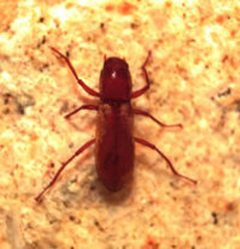
Small aquatic approximately 2 mm in length. and undeveloped wings present. Males possess tufts on the metasternum that females lack, though these features are difficult to observe. is otherwise minimal, with overlapping size ranges between sexes. Internal abdominal structures visible under lateral illumination: males show sternite 8, females show gonocoxites and faint of sternite 8.
Habitat
Spring-fed groundwater systems in Edwards Aquifer region. Near-surface in spring complexes, typically surrounded by sycamore trees (Platanus spp.) with mixed substrate sizes from silt to cobble, not dominated by surface bedrock. Stable water temperature approximately 23.4°C. Strong experimental preference for wood substrates over leaves or rocks. Subterranean-obligate (troglobitic) ancestry indicated by and reduced wings.
Distribution
to three spring systems in central Texas, United States: primarily Comal Springs system in Comal County, with additional in two springs in neighboring Hays County. Highly restricted range with no evidence of among localities.
Diet
Wood-conditioned material; individuals exhibit fuller guts when consuming wild-conditioned wood compared to captive-conditioned wood. Specific dietary components otherwise unknown.
Life Cycle
Long developmental period: larval stages require over one year to reach adulthood. Wild-caught have survived up to 21 months in captivity. Captive breeding shows low rates of laying, hatching, and . Limited reproductive output in captivity with mean of 29.3 offspring per female in related studies, though longevity rather than size predicts .
Behavior
Strong preference for wood over leaves and rocks in experimental conditions. Phototactic responses -specific: avoidance of shorter wavelength light (blue, green, UV) and attraction to longer wavelength red light. Attraction to conspecifics but not heterospecifics. No clear response to flowing water detected in experiments.
Ecological Role
Spring- ; part of aquatic in Edwards Aquifer spring . Serves as surrogate species for monitoring health of the aquifer system.
Human Relevance
Federally listed (1997). Critical expanded to 139 acres of below-ground aquifer in 2013. Subject of captive propagation efforts for conservation, including development of self-propagating . Threatened by groundwater pumping for municipal water supply, agricultural irrigation, pollution, and introduced competition. Extreme rarity: only 15 living known to USFWS in 2018.
Similar Taxa
- Heterelmis comalensisCo-occurs in same spring systems and shares pattern ('Comal Springs' ); distinguished by (Elmidae vs. Dryopidae), slightly larger size, and different internal abdominal structures visible under lateral illumination
- Stenelmis sexlineataCo-occurring elmid used as comparison in preference studies; distinguished by different phototactic responses (hides from all light types rather than showing wavelength-specific responses) and lack of strong wood preference when leaves are available
More Details
Evolutionary Significance
Genomic analysis reveals highly structured with no among the three known localities, indicating extreme evolutionary isolation. Despite substantial genomic divergence, populations show ecological and morphological stasis, suggesting stabilizing selection has constrained phenotypic differentiation. The three localities represent evolutionarily distinct units requiring separate conservation management.
Conservation Status
Survived severe drought in mid-1950s but declared endangered in 1997 due to changes. persistence threatened by declining springflows from aquifer overextraction and drought. Ongoing captive propagation efforts challenges due to ' low reproductive rates and long developmental times.
Sources and further reading
- BugGuide
- GBIF taxonomy match
- iNaturalist taxon
- NCBI Taxonomy
- Study Shines Light on ID'ing Males, Females of Endangered Beetles
- Stygoparnus comalensis Archives - Entomology Today
- Heterelmis comalensis - Entomology Today
- New Study Advances Lab Rearing of Endangered Beetle
- Heterelmis comalensis Archives - Entomology Today
- Experimental tests of habitat preferences in the Comal Springs dryopid beetle, Stygoparnus comalensis
- Evolutionary Isolation and Ecological Stasis in the Endangered Comal Springs Dryopid Beetle ( Stygoparnus comalensis )
- Supplemental Information 1: Supplemental information for ‘Experimental tests of habitat preferences in the Comal Springs dryopid beetle, Stygoparnus comalensis ’.