
Promecognathus
Chaudoir, 1846
Species Guides
2- Promecognathus crassus(Straight-jawed Pedunculate Ground Beetle)
- Promecognissimus laevissimus(smooth millipede hunter)
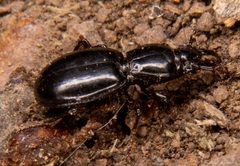
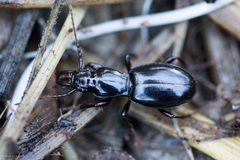
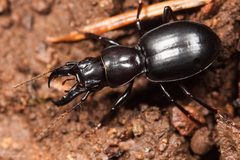
Promecognathus is a of ground beetles comprising two described , P. laevissimus and P. crassus. These beetles are of cyanide-producing flat-backed millipedes in the Xystodesmidae. They possess exceptional physiological to hydrogen cyanide, surviving doses 7–15 times greater than those lethal to other carabid beetles. This tolerance allows them to attack millipedes directly without behavioral avoidance of chemical defenses, representing the first documented case of cyanide tolerance in predatory insects.
Pronunciation
How to pronounce Promecognathus: //ˌprɒmɛkəˈɡneɪθəs//
These audio files are automatically generated. While they are not always 100% accurate, they are a good starting point.
Identification
Promecognathus can be distinguished from other ground beetles by their specialized association with cyanide-producing millipedes and their remarkable cyanide . The two , P. laevissimus and P. crassus, possess long, thin, pointed adapted for inserting between the armored plates of prey. Unlike other carabids that avoid or are incapacitated by millipede defenses, Promecognathus remains active when exposed to hydrogen cyanide and benzaldehyde.
Images
Habitat
Oak woodlands along the Pacific coast and coastal mountain ranges. Activity is moisture-driven; beetles become difficult to locate during dry periods.
Distribution
Restricted range from southern British Columbia to northern California, spanning coastal areas and coastal mountain ranges.
Seasonality
Peaks in late winter to early spring, depending on winter rainfall. At higher elevations and northern latitudes, activity shifts to later spring and early summer due to colder winters.
Diet
of flat-backed millipedes (Polydesmida), specifically Xystocheir dissecta (Xystodesmidae). Prey are cyanide-producing millipedes that synthesize hydrogen cyanide and benzaldehyde as chemical defenses.
Behavior
Hunts by leaping onto prey and biting repeatedly with long . Two attack modes observed: rear attack (climbs onto back, bites short of ) and head-on attack (climbs atop, bites and turns to same direction as prey, inserts mandibles between body plates with scissoring action). Does not exhibit avoidance toward cyanide; remains exposed throughout prolonged attacks lasting up to 45 minutes. Shows no behavioral response to cyanide or benzaldehyde, unlike other carabids that are deterred by benzaldehyde.
Ecological Role
occupying a unique by exploiting cyanide-defended prey that most predators cannot safely consume. This specialization reduces competition for food resources.
Human Relevance
Potential biomedical applications; study of cyanide mechanisms may inform treatments for cyanide poisoning in humans. Research by University of California, Berkeley scientists suggests biochemical investigation could lead to new medical countermeasures against cyanide exposure.
Similar Taxa
- Metrius contractusAlso exhibits exceptional cyanide and survives HCN exposure that incapacitates other carabids; however, no evidence of feeding , making its tolerance functionally enigmatic compared to the clearly adaptive tolerance in Promecognathus.
- Other CarabidaeMost ground beetles avoid live cyanide-producing millipedes or are quickly knocked down by cyanide vapor; they will consume pre-killed millipedes that cannot release defenses, demonstrating the unique physiological and behavioral adaptations of Promecognathus.
Sources and further reading
- BugGuide
- Wikipedia
- GBIF taxonomy match
- iNaturalist taxon
- NCBI Taxonomy
- Catalogue of Life
- Promecognathus Laevissimus - Entomology Today
- Promecognathus Beetle Millipede Brawl - Entomology Today
- These Beetles Withstand Cyanide Blasts to Eat Millipedes
- defensive behavior Archives - Entomology Today
- Kipling Will - Entomology Today
- The Millipede-Predation Behavior of Promecognathus and Exceptional Cyanide Tolerance in Promecognathus and Metrius (Coleoptera: Carabidae)