
Promecognissimus laevissimus
(Dejean, 1829)
smooth millipede hunter
Promecognathus laevissimus is a ground beetle specializing in on cyanide-producing millipedes. It possesses exceptional physiological to hydrogen cyanide and benzaldehyde, toxins that incapacitate most other . The exhibits unique prey-handling and has been extensively studied for its biochemical resistance mechanisms, which may have potential applications in human medicine for cyanide poisoning treatment.
Pronunciation
How to pronounce Promecognissimus laevissimus: /proʊmiːˈkɒɡnəθəs leɪˈvɪsɪməs/
These audio files are automatically generated. While they are not always 100% accurate, they are a good starting point.
Identification
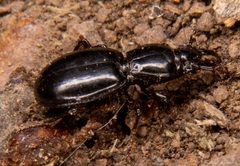
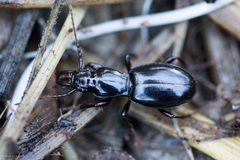
are black beetles 5–18 mm long with elongated and a narrow . Distinguished from by smooth (non-) ; P. crassus has more heavily sculptured surface texture. The long, slender mandibles are diagnostic for the and aid in handling prey.
Images
Habitat
Oak woodlands in coastal and coastal mountain ranges. Activity is moisture-driven; beetles retreat to sheltered locations during dry periods and are difficult to locate.
Distribution
Western North America from southern British Columbia through coastal Oregon and California to northern California; extends inland to Nevada.
Seasonality
Active from late winter through early spring, with timing dependent on winter rainfall patterns. At higher elevations and northern latitudes, activity shifts to late spring and early summer due to colder winters.
Diet
of polydesmidan millipedes, particularly Xystocheir dissecta. Feeds on millipedes that produce hydrogen cyanide and benzaldehyde as chemical defenses.
Behavior
. Hunts by leaping onto prey and biting repeatedly with elongated . Two attack modes observed: rear approach involves climbing onto the millipede's back and biting short of the ; frontal approach involves climbing atop, biting, and turning to the same direction as prey while inserting mandibles between body plates with scissoring action. Does not avoid cyanide release during prolonged attacks lasting up to 45 minutes.
Ecological Role
controlling of cyanide-producing millipedes. Occupies a specialized trophic with minimal competition due to unique toxin .
Human Relevance
Subject of biomedical research regarding cyanide mechanisms; potential applications for treating human cyanide poisoning.
Similar Taxa
- Promecognathus crassusCongeneric with overlapping range and ; distinguished by more robust body and sculptured () versus smooth elytra in P. laevissimus
- Metrius contractusShares exceptional cyanide but lacks specialization; tolerance mechanism unexplained by diet
Sources and further reading
- BugGuide
- Wikipedia
- GBIF taxonomy match
- iNaturalist taxon
- Catalogue of Life
- Promecognathus Laevissimus - Entomology Today
- These Beetles Withstand Cyanide Blasts to Eat Millipedes
- Promecognathus Beetle Millipede Brawl - Entomology Today
- Promecognathus Archives - Entomology Today
- Collecting in Australia’s remote McIlwraith range | Beetles In The Bush
- Kipling Will - Entomology Today
- The Millipede-Predation Behavior of Promecognathus and Exceptional Cyanide Tolerance in Promecognathus and Metrius (Coleoptera: Carabidae)