
Xystodesmidae
Cook, 1895
Cherry Millipedes, flat-backed millipedes
Tribe Guides
7Xystodesmidae is a of flat-backed millipedes in the order Polydesmida, established by O. F. Cook in 1895. The family comprises over 390 described across 62 , with many additional species remaining undescribed. Members are characterized by broad, compact bodies with prominent paranota (lateral keels), chemical defenses based on hydrogen cyanide and benzaldehyde, and frequent participation in Müllerian mimicry rings. Peak diversity occurs in the Appalachian Mountains, where approximately one-third of species are found.
Pronunciation
How to pronounce Xystodesmidae: //zɪstoʊˈdɛzmɪdiː//
These audio files are automatically generated. While they are not always 100% accurate, they are a good starting point.
Identification
Distinguished from other Polydesmida by the combination of broad, compact body shape and presence of prefemoral spines on the second leg segments in most . The prominent paranota create a distinctly flattened appearance compared to cylindrical millipedes. Chemical defense compounds (hydrogen cyanide and benzaldehyde) are detectable by characteristic almond-like odor. Species-level identification requires examination of male and other genitalic characters.
Images
Appearance
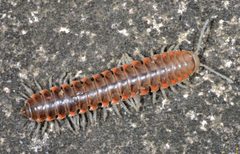
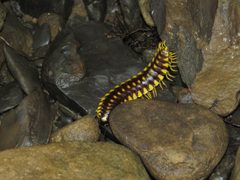
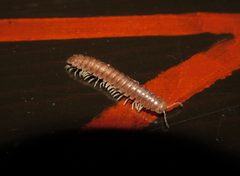
Body broad and compact, with moderately convex surface that tapers toward both and ends. Length ranges from 8 mm to 85 mm. Paranota (lateral extensions of dorsal segments) are large and prominent, giving a flattened appearance. are slender and long. Most possess one or more spines on the second leg segments (prefemoral spines). Coloration highly variable: ranges from pitch black to pallid, often with vivid aposematic patterns including yellow, orange, red, or white markings. Some species exhibit ( Motyxia).
Habitat
Primarily deciduous broadleaf forests, particularly in mesic microhabitats at middle to high elevations. Many occupy forest floor with abundant leaf litter, often found under rocks, logs, and buried in soil. Some lineages have adapted to cave environments (e.g., Devillea). The shows strong association with temperate forest across multiple continents.
Distribution
Northern Hemisphere distribution with centers of diversity in the Appalachian Mountains (eastern United States), Mediterranean Basin, and temperate regions of Asia. Present in Africa, Central and North America, Russia, and eastern Asia. Many exhibit extremely restricted ranges, with numerous species known only from single localities. The Nannaria (wilsoni species group) is restricted to the Appalachian region, while the minor species group occurs throughout eastern North America.
Diet
; feed on decaying leaf litter and other plant matter. Specific dietary preferences documented for few ; most information inferred from general .
Behavior
Many exhibit cryptic , remaining buried in soil or under leaf litter. Some species demonstrate mass aggregating and migrating behavior (particularly in Pleuroloma). Defensive behavior includes secretion of hydrogen cyanide and benzaldehyde from ozopores when disturbed, accompanied by aposematic displays in brightly colored species. Members of several Appalachian genera (Apheloria, Brachoria) participate in Müllerian mimicry rings, where unrelated species converge on similar color patterns. has been documented in the genus Motyxia, representing the only known case in the order Polydesmida.
Ecological Role
Decomposers in forest ; breakdown of leaf litter facilitates nutrient cycling. Participation in Müllerian mimicry rings suggests role in education and -level defense dynamics. to symbiotic mites ( Stylochyrus and Schwiebea), with potential for coevolutionary relationships.
Human Relevance
Some large, colorful (e.g., Apheloria corrugata, Harpaphe haydeniana) serve as charismatic representatives of forest biodiversity. Bioluminescent species (Motyxia) have scientific interest for understanding evolution of luminescence. Chemical defense compounds make some species unpalatable or hazardous if handled carelessly. Taxonomic research on the has been supported by citizen science contributions.
Similar Taxa
- Other Polydesmida familiesXystodesmidae distinguished by compact body shape, prominent paranota, and prefemoral spines; other in the order typically lack this combination or have different structures.
- Julida (order)Julid millipedes have cylindrical bodies without prominent paranota, contrasting with the flattened, keeled appearance of Xystodesmidae.
More Details
Taxonomic diversity
The contains three : Melaphinae (~10 ), Parafontariinae (~12 species in single ), and Xystodesminae (majority of diversity). The genus Nannaria has become the most species-rich in the family with 78 described species as of 2022, with estimates of over 200 species total. Many genera remain understudied with numerous undescribed species in collections.
Chemical defense
Hydrogen cyanide production is shared with few other and some insects. Xystodesmids possess a terminal oxidase that renders their own insensitive to cyanide, allowing them to tolerate their defensive compounds.
Segmental variation
The cave-dwelling Devillea exhibits exceptional segment number variation, with up to 29 segments (including ) in some , exceeding the typical 20 segments of Polydesmida. Intraspecific variation in segment number occurs within single sexes in some Devillea species.
Sources and further reading
- BugGuide
- Wikipedia
- GBIF taxonomy match
- iNaturalist taxon
- NCBI Taxonomy
- Congrats to UC Davis Scientists Iris Bright and Megan Ma: Selected for NSF REPS Program | Bug Squad
- Polydesmida | Beetles In The Bush
- celebrities | Blog
- The milliped genus Isaphe Cook (Polydesmida: Xystodesmidae)
- Phylogenetic review of the millipede genus Cherokia Chamberlin, 1949 (Polydesmida, Xystodesmidae)
- Apheloria polychroma, a new species of millipede from the Cumberland Mountains (Polydesmida: Xystodesmidae)
- A revision of the minor species group in the millipede genus Nannaria Chamberlin, 1918 (Diplopoda, Polydesmida, Xystodesmidae)
- Revision of the milliped genus Pleuroloma (Polydesmida: Xystodesmidae)
- A revision of the wilsoni species group in the millipede genus Nannaria Chamberlin, 1918 (Diplopoda, Polydesmida, Xystodesmidae)
- Redescription of Rhysodesmus dasypus (Gervais, 1847), the type species of the genus (Polydesmida: Xystodesmidae)
- Noteworthy Geographic Distributional Record for the Milliped, Apheloria virginiensis reducta (Polydesmida: Xystodesmidae), from the Arkansas Delta
- The symbiotic mites of some Appalachian Xystodesmidae (Diplopoda : Polydesmida) and the complete mitochondrial genome sequence of the mite Stylochyrus rarior (Berlese) (Acari : Mesostigmata : Ologamasidae)
- Description of a new species of the genus Riukiaria (Diplopoda, Polydesmida, Xystodesmidae) from eastern China, with the characterization of its complete mitochondrial genome.
- First description of a male Melapheapamea Hoffman & Lohmander, 1968 from Turkey (Diplopoda, Polydesmida, Xystodesmidae).