
Nannaria
Chamberlin, 1918
Twisted-Claw Millipedes
Species Guides
4- Nannaria cingulata(Swamp-Dwelling Twisted-Claw Millipede)
- Nannaria hardeni(Curt Harden's Twisted-Claw Millipede)
- Nannaria ohionis(Ohio Twisted-Claw)
- Nannaria terricola(Loam-dwelling Twisted-Claw)
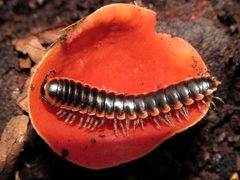
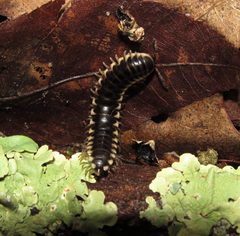
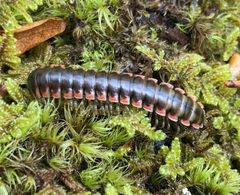
Nannaria is a of small-bodied millipedes in the Xystodesmidae, commonly known as twisted-claw millipedes. First described by Ralph Chamberlin in 1918, it is now the largest genus in its family with 78 described following major revisions in 2022. The genus comprises two monophyletic species groups: the widespread minor group found throughout eastern North America, and the wilsoni group restricted to the Appalachian Mountains. Unlike many colorful, flat-backed xystodesmids, Nannaria species are cryptic in appearance and exhibit subterranean that makes them difficult to collect.
Pronunciation
How to pronounce Nannaria: //nænˈnɛɹiə//
These audio files are automatically generated. While they are not always 100% accurate, they are a good starting point.
Identification
Difficult to identify to without examination of male under magnification. The two species groups are distinguished by gonopod : minor group has simple, stick-like gonopods, while wilsoni group has complex, twisting gonopods. Geographic distribution provides additional clues: wilsoni group is restricted to the Appalachian Mountains, while minor group occurs throughout eastern North America. The is distinguished from other Xystodesmidae by its cryptic (non-aposematic) coloration and subterranean habits. Unlike colorful Appalachian xystodesmids that form Müllerian mimicry rings, Nannaria lacks bright warning coloration.
Images
Appearance
Small-bodied millipedes measuring 15–38 mm in length. Coloration is cryptic: typically chestnut brown to black, often with orange, red, or white spots; uncommonly striped. Olive to black individuals may display pink keels or paranota. Lacks the bright aposematic coloration of other Xystodesmidae. Diagnostic morphological features include laterally positioned repugnatorial pores, paired processes, spatulate twisted pregonopodal claws (the source of the ), and subcoxal sternal spines. Gonopods are sexually dimorphic and -diagnostic: minor group has simple stick-like gonopods, while wilsoni group has complex twisting gonopods.
Habitat
Mesic microhabitats in deciduous forests, particularly in middle to high elevation areas for the wilsoni group. Found in leaf litter and upper soil layers, typically 2–3 cm beneath the surface. Collected by removing leaf litter, turning rocks and logs, or via pitfall traps. Suitable occurs in forested areas with accumulated organic matter. The wilsoni group shows affinity for middle to high elevation forests in the Appalachians, while the minor group occupies broader forested habitats across eastern North America.
Distribution
Eastern United States. The minor group: from western Arkansas and Missouri to just outside Rochester, New York in the north, and from the coast of Virginia to central Mississippi in the south. The wilsoni species group: restricted to the Appalachian Mountains, with a notable distribution gap in northeastern Tennessee and adjacent northwestern North Carolina that separates northern and southern portions of its range. New species are expected to be discovered in the southern Appalachian Mountains.
Diet
Decaying leaves and other plant matter.
Life Cycle
Juveniles require maturation before definitive identification is possible; in laboratory settings, juveniles have been housed in terraria until maturation.
Behavior
Strongly subterranean and cryptic. tend to remain buried in soil, either completely beneath the surface or with only a portion of the body exposed. Does not exhibit extensive surface-level activity compared to other xystodesmids. This makes deliberate collection difficult through traditional surface-searching methods. When disturbed, can release defensive chemicals from laterally positioned repugnatorial pores.
Ecological Role
Decomposer in leaf litter and soil . Breaks down decaying plant material, releasing nutrients into the .
Human Relevance
Subject of recent taxonomic research that brought public attention to diversity, including the Nannaria swiftae named after singer-songwriter Taylor Swift in 2022. The serves as an example of cryptic, understudied diversity in eastern North American forests. Many species have small geographic ranges and may warrant conservation attention.
Similar Taxa
- Other XystodesmidaeNannaria lacks the bright aposematic coloration (red, yellow, black patterns) that characterizes many Appalachian xystodesmids such as Apheloria and Brachoria, which form Müllerian mimicry rings. Nannaria is also more subterranean and less surface-active than these colorful relatives.
- Oenomaea pulchellaSister to Nannaria within tribe Nannariini; distinguished by morphological and molecular characters. Nannaria is more -rich and geographically widespread.
More Details
Taxonomic History
R. L. Hoffman worked on a revision of the from 1949 until his death in 2012, synthesizing material and drawings. Recent molecular phylogenetic studies using six genes (16S, 28S, EF1a, rpb1, COI, fbox) have provided the framework for describing 52 new in 2022 (35 in minor group, 17 in wilsoni group), tripling the genus's known diversity.
Conservation Significance
Many in both groups are micro-range or short-range endemics with restricted distributions, making them potentially vulnerable to loss and environmental change. The wilsoni group's distribution gap in northeastern Tennessee/northwestern North Carolina suggests historical or ecological factors limiting .
Research Methods
Recent revisions used over 1,800 museum specimens and extensive field collections from 17 US states. sequencing was essential for delimitation due to cryptic . Live photographs, distribution maps, and detailed collection notes were synthesized to support conservation and evolutionary investigations.
Sources and further reading
- BugGuide
- Wikipedia
- GBIF taxonomy match
- iNaturalist taxon
- NCBI Taxonomy
- Catalogue of Life
- Top new species discoveries for the first half of 2022
- A revision of the minor species group in the millipede genus Nannaria Chamberlin, 1918 (Diplopoda, Polydesmida, Xystodesmidae)
- A revision of the wilsoni species group in the millipede genus Nannaria Chamberlin, 1918 (Diplopoda, Polydesmida, Xystodesmidae)