
Harpaphe haydeniana
(Wood, 1864)
yellow-spotted millipede, almond-scented millipede, cyanide millipede
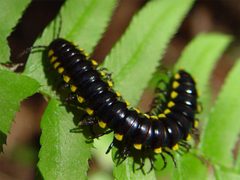
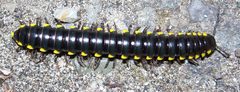
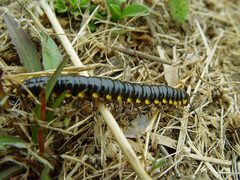
Harpaphe haydeniana is a flat-backed millipede native to the Pacific coast of North America, recognized by its black body with yellow-tipped lateral keels. The is notable for its chemical defense system, secreting hydrogen cyanide when threatened, which produces a characteristic almond odor. It plays a significant role in forest decomposition, particularly in redwood . Despite its suggesting uniqueness, both the color pattern and cyanide defense occur in other flat-backed millipedes globally.
Pronunciation
How to pronounce Harpaphe haydeniana: //hɑrˈpæfi heɪdəˈniːənə//
These audio files are automatically generated. While they are not always 100% accurate, they are a good starting point.
Identification
Approximately 20 body segments. Males have 30 leg pairs versus 31 in females, with the seventh segment modified into . Distinguished from H. pottera and H. telodonta by gonopod examination; H. telodonta has more brown coloration and more strongly pointed keels. Sharply pointed corners of paranota help distinguish Harpaphe from related Hybaphe and Chonaphe.
Images
Habitat
Moist forest environments, strongly associated with redwood forests. Found in areas of high humidity and abundant leaf litter.
Distribution
Pacific coast of North America from southeast Alaska to Monterey County, California; extends eastward to the Sierra Nevada mountains.
Diet
; feeds on decaying leaf litter and humus. individuals specifically consume humus.
Life Cycle
Lifespan of 2–3 years. with males using for sperm transfer. stages feed on humus before transitioning to broader detritivory.
Behavior
When threatened, secretes hydrogen cyanide as a chemical defense. This secretion produces an almond-like odor. The is accompanied by coiling or other defensive posturing typical of millipedes.
Ecological Role
Important decomposer in forest , breaking down leaf litter and recycling nutrients. Serves as prey for specialized , notably the ground beetle Promecognathus laevissimus.
Human Relevance
Not dangerous to humans, though cyanide secretions can cause irritation and pain if contacting mucous (mouth, , nose). Frequently encountered by hikers and naturalists in Pacific coast forests.
Similar Taxa
- Harpaphe telodontaOverlapping range in Humboldt and Del Norte counties, California; slightly more brown with more strongly pointed keels
- Harpaphe potteraOverlapping range in Mendocino and Humboldt counties; distinguishable only by male examination
- Hybaphe spp.Related in Xystodesmidae with similar markings; lacks sharply pointed paranota corners
- Chonaphe spp.Related with similar coloration; paranota corners less sharply pointed than Harpaphe
- Asiomorpha coarctataIntroduced Asian with superficial resemblance; established on American Gulf Coast, not native Pacific range
- Anoplodesmus saussuriiFrequently misidentified as H. haydeniana; not native to North America
Misconceptions
The 'cyanide ' and 'almond-scented millipede' imply this is unique in these traits, but hydrogen cyanide secretion and associated almond odor occur throughout Polydesmida and in flat-backed millipedes worldwide.