
Pleuroloma
Rafinesque, 1820
Pleurolomas
Species Guides
2- Pleuroloma cala
- Pleuroloma flavipes(traveling cherry millipede)
Pleuroloma is a of flat-backed millipedes in the Xystodesmidae, distinguished by its great age, extensive geographic range, and ecological adaptability. The genus comprises four recognized , with P. flavipes being the most widespread, ranging from the eastern Atlantic Coast to the central Great Plains. Members exhibit distinctive aggregating and migrating , particularly P. flavipes, which may contribute to its broad distribution. The genus is unique within Xystodesmidae for these behavioral traits and its ability to colonize diverse .

Pronunciation
How to pronounce Pleuroloma: //pluˈroʊ.lə.mə//
These audio files are automatically generated. While they are not always 100% accurate, they are a good starting point.
Identification
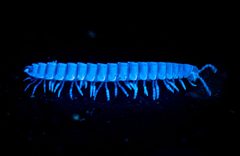
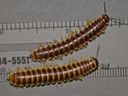
Flat-backed millipedes with lateral expansion of segments into paranota, giving a flattened profile distinct from cylindrical millipedes. Coloration typically involves dark body with bright yellow or orange markings—often wedge-shaped posterolateral spots—serving as aposematic warning signals. Specific identification requires examination of segmental profile, sternal configuration and , and male structure; determinations are most reliable when based on character combinations rather than single traits.
Images
Distribution
Eastern and central United States. Pleuroloma flavipes occurs from the Atlantic Coast to the central Great Plains; P. pinicola is restricted to coastal North and South Carolina; P. plana ranges from piedmont South Carolina to the Gulf Coast of north Florida; P. cala occurs in peninsular Florida south of the Suwannee River.
Behavior
Pleuroloma flavipes exhibits pronounced aggregating , forming masses and undertaking . This behavioral tendency appears to contribute to the ' extensive geographic range and ecological success. Similar aggregating behavior has not been documented for the other three species. All members of the produce hydrogen cyanide as a chemical defense against .
Similar Taxa
- CherokiaGenerically most closely related to Pleuroloma, but distinguished by distinctly different male , suggesting an early evolutionary dichotomy.
- ApheloriaShares similar aposematic coloration pattern (dark body with yellow markings) and paranota structure, requiring careful examination of and sternal characters for separation.
- BorariaExhibits comparable warning coloration and flat-backed ; identification relies on subtle differences in segmental profile and reproductive structures.