
Pleuroloma flavipes
Rafinesque, 1820
traveling cherry millipede, wandering cherry millipede
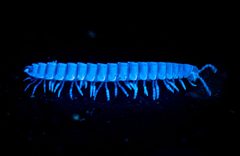
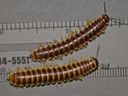
Pleuroloma flavipes is a flat-backed millipede in the Xystodesmidae, notable for having the widest distribution of any xystodesmid . The exhibits striking aposematic coloration with black bodies and yellow markings, and is known for its tendency to form large that move en masse. It produces hydrogen cyanide as a chemical defense against .

Pronunciation
How to pronounce Pleuroloma flavipes: /ˌplʊər.oʊˈloʊ.mə ˈfleɪ.vɪˌpɛs/
These audio files are automatically generated. While they are not always 100% accurate, they are a good starting point.
Identification
Distinguished from by subtle characters including segmental profile, sternal configuration and , and male structure. Most reliably separated from similar-appearing Apheloria and Brachoria by geographic range and, in males, leg coloration (yellow in P. flavipes versus typically not yellow in those ). Identification to species within Pleuroloma requires examination of male gonopods and combination of segmental and sternal characters; P. flavipes specifically is the only species in the genus occurring west of the Mississippi River.
Images
Habitat
Mesic forest environments including rich bottomland forests, upland deciduous woods, and mixed forests with hemlock, rhododendron, and mountain laurel. Found in diverse forest types across its broad range, from the Great Smoky Mountains to eastern deciduous forests. Occurs in areas with sufficient moisture and leaf litter.
Distribution
Eastern North America from southeastern North Dakota eastward to Connecticut, and southward to North Carolina, northern Louisiana, and southern Texas. The widest distribution of any xystodesmid . Records exist from west of the Mississippi River including Missouri and Texas.
Diet
; feeds on decaying leaf litter and organic matter. Specific dietary components not documented.
Behavior
Notable for forming large of individuals that move en masse in a common direction, hence the 'traveling cherry .' A documented aggregation of approximately 6,000 individuals was observed on a single bridge at McCormick's Creek State Park, Indiana in 1950. This aggregating and migrating appears to contribute to the ' extensive range. When disturbed, individuals produce hydrogen cyanide (HCN) as a chemical defense.
Ecological Role
Decomposer in forest , processing leaf litter and contributing to nutrient cycling. The ' aposematic coloration and chemical defense likely influences -prey dynamics in forest floor .
Human Relevance
Occasionally encountered in large numbers in human-modified environments such as bridges and roads during mass movements. The hydrogen cyanide defense compound is toxic but not considered a significant human health hazard under normal circumstances. Serves as an example of aposematic coloration and chemical defense in educational contexts.
Similar Taxa
- Apheloria virginiensis reductaConvergent black-and-yellow aposematic coloration through mimicry; distinguished by geographic distribution and male leg coloration
- Apheloria spp.Similar color pattern through mimicry; distinguished by structure and typically non-yellow male legs
- Brachoria spp.Convergent coloration; distinguished by and geographic range
- Pleuroloma pinicola restricted to coastal North and South Carolina; distinguished by segmental profile and male structure
- Pleuroloma plana ranging from piedmont South Carolina to Gulf Coast of north Florida; distinguished by segmental profile and sternal characters
- Pleuroloma cala restricted to peninsular Florida south of the Suwannee River; distinguished by subtle morphological characters
More Details
Chemical defense
Produces hydrogen cyanide (HCN) as a primary defense compound, which inhibits c oxidase and halts cellular respiration in most animals. The tolerates its own HCN production through possession of a terminal oxidase that makes insensitive to cyanide effects.
Taxonomic history
Of 12 nominal originally described in Pleuroloma, 10 have been synonymized under P. flavipes, reflecting the species' extreme morphological variability.
Phylogenetic relationships
Pleuroloma appears most closely related to Cherokia based on general , but distinctly different suggest an early divergence between these lineages.