
Poecilus diplophryus
Chaudoir, 1876
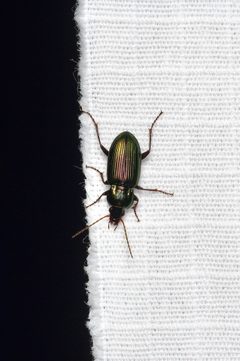
Poecilus diplophryus is a of ground beetle in the Carabidae, first described by Chaudoir in 1876. It belongs to a of small to medium-sized carabid beetles commonly found in agricultural and open . The species has been documented in North and Middle America, with records from the United States. Like other Poecilus species, it is likely a ground-dwelling sensitive to soil disturbance regimes.
Pronunciation
How to pronounce Poecilus diplophryus: /ˈpiːsɪlʊs dɪˈplɒfɹɪəs/
These audio files are automatically generated. While they are not always 100% accurate, they are a good starting point.
Identification
Identification of Poecilus diplophryus requires examination of morphological characters distinguishing it from . Poecilus generally exhibit elongated bodies, , and characteristic elytral striation patterns. Definitive identification typically necessitates reference to original species descriptions or diagnostic keys treating the Poecilus in the relevant geographic region.
Images
Distribution
Recorded from the United States, with broader distribution indicated as present in Middle America and North America. Specific locality details beyond country-level records are not well documented in available sources.
More Details
Taxonomic note
Poecilus diplophryus was described by Maximilien Chaudoir in 1876. The Poecilus contains numerous , many of which are poorly studied and difficult to identify without specialized taxonomic expertise. The specific epithet 'diplophryus' appears to be of Greek derivation, though its precise meaning in this context is not documented in available sources.
Data availability
Available information for this is extremely limited. GBIF records indicate presence in North and Middle America, and iNaturalist documents 27 observations, but no detailed studies of , , or were found in the provided sources. The species was not mentioned in the agricultural study on ground beetles, which focused on other carabid (Harpalus, Cicindela, Chlaenius, Bembidion, Patrobus, Colliuris).