
Chlaenius
Bonelli, 1810
Vivid Metallic Ground Beetles
Species Guides
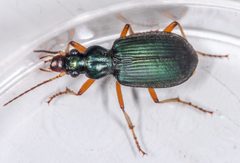
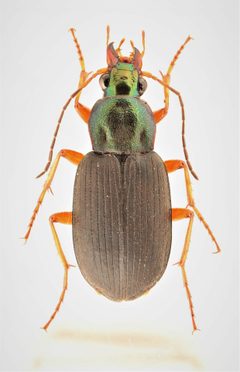
49Chlaenius is a large and diverse of ground beetles in the Carabidae, comprising approximately 1,000 recognized worldwide. The genus is most diverse in the Oriental and Afrotropical regions, though it also occurs extensively in the Palearctic, Near East, North Africa, and Nearctic realms. Members are commonly known as vivid metallic ground beetles due to their often striking metallic coloration. The genus is divided into numerous subgenera and includes species that serve as important biological indicators of soil health and agricultural practices.
Pronunciation
How to pronounce Chlaenius: /ˈkleɪ.ni.əs/
These audio files are automatically generated. While they are not always 100% accurate, they are a good starting point.
Identification
Chlaenius can be distinguished from other ground beetles by their combination of metallic coloration and . They differ from darkling beetles (Tenebrionidae) by their exposed forward-directed (vs. concealed mandibles in tenebrionids), filiform antennae (vs. bead-like antennae in most tenebrionids), and rapid running (vs. slow lumbering movement in darkling beetles). Within Carabidae, Chlaenius is recognized by the vivid metallic coloration on the and/or pronotum, though some related also show metallic colors requiring examination of specific structural features for definitive identification.
Images
Habitat
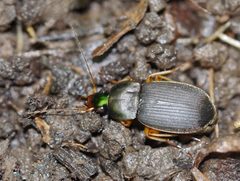
Found in diverse terrestrial , with many showing preferences for moist, shaded environments near water sources such as stream banks, woodland edges, and riparian zones. Some species occupy more open habitats including grasslands and agricultural fields. frequently occur under stones, logs, leaf litter, and other debris that provides shelter during daylight hours.
Distribution
Native to the (including Europe, the Near East, and North Africa), the Afrotropical realm, and the . The majority of known occurs in the Oriental and Afrotropical regions. The has been recorded from North America, Europe, Asia, Africa, and South America.
Seasonality
are generally active from spring through fall, with peak activity during summer months. Activity patterns vary by and latitude. occurs as adults, with individuals seeking shelter under cover objects or in soil crevices during cold periods.
Diet
Predatory. Both larvae and feed on small including insect larvae and other soft-bodied prey. Specific prey preferences vary among .
Life Cycle
Complete with four stages: , larva (three instars), pupa, and . Larval development occurs during summer months. Adults are the stage. Females excavate small burrows in soil for oviposition, laying eggs in spring and early summer.
Behavior
Primarily , with seeking shelter under cover objects during daylight hours. Many are rapid runners, characteristic of ground beetles. When disturbed, some species produce defensive secretions from abdominal glands. Activity patterns are influenced by temperature and moisture conditions.
Ecological Role
that contribute to regulation of soil and litter . Some are recognized as beneficial in agricultural systems, preying on pest insects and serving as biological indicators of soil management practices. The includes species sensitive to environmental disturbances such as intensive tillage and use.
Human Relevance
Beneficial insects in agricultural and garden due to on pest . Some species, such as Chlaenius tricolor, have been studied as indicators of sustainable farming practices, showing positive responses to reduced-tillage systems. No known significant negative impacts on humans; defensive secretions may be unpleasant if handled but are not harmful.
Similar Taxa
- CalosomaLarge, fast-running ground beetles with metallic coloration, but generally larger in size and with different body proportions
- CarabusGround beetles with metallic coloration, but typically more robust body form and different elytral sculpturing
- Eleodes (darkling beetles)Superficially similar dark coloration in some , but distinguished by concealed , bead-like , slow movement, and -standing defensive
More Details
Subgeneric classification
The is divided into numerous subgenera, reflecting its substantial morphological and ecological diversity. Subgeneric classification is based on characters including body shape, coloration patterns, and male genitalia structure.
Parasitism
In Australia, Chlaenius flaviguttatus is known to be parasitized by the mite Eutarsopolipus chlaenii, which dwells under the .
Egg parasitoids
of at least some Chlaenius , including C. impunctifrons, are parasitized by tiny in the Trimorus ( Platygastridae), which lay their eggs inside ground beetle eggs.
Sources and further reading
- BugGuide
- Wikipedia
- GBIF taxonomy match
- iNaturalist taxon
- NCBI Taxonomy
- Catalogue of Life
- Beneficial Beetle Diversity Blooms on Strip-Tilled Farms
- Bug Eric: Wasp Wednesday: Trimorus
- Bug Eric: Last Night to Blacklight?
- Bug Eric: ID Tip: Ground Beetle or Darkling Beetle?
- Bug Eric: 2016
- Life History and Biological Notes on Chlaenius Impunctifrons Say. (Coleoptera, Carabidæ).*
- The complete mitochondrial genome of a ground beetle, Chlaenius naeviger (Carabidae: Harpalinae: Chlaeniini), from South Korea.