
Poecilus
Bonelli, 1810
Greenclock Ground Beetles
Species Guides
7- Poecilus chalcites
- Poecilus corvus
- Poecilus cyanicolor
- Poecilus diplophryus
- Poecilus laetulus
- Poecilus lucublandus(Woodland Ground Beetle)
- Poecilus scitulus(woodland ground beetle)
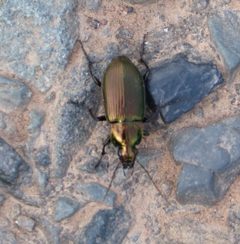
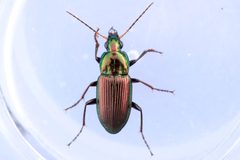
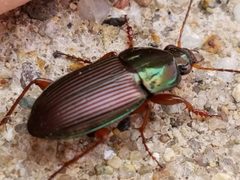
Poecilus is a of ground beetles in the Carabidae, comprising approximately 144 distributed across the Afro-tropical region, Palearctic (including Europe), the Near East, North Africa, and North America. Species within this genus are frequently encountered in agricultural landscapes, where they contribute significantly to epigeal (ground-dwelling) . Multiple species often occur sympatrically, exhibiting spatial partitioning within . The genus has been extensively studied as a bioindicator of agricultural practices and environmental disturbance due to its sensitivity to soil management techniques and exposure.
Pronunciation
How to pronounce Poecilus: /ˈpiːkɪləs/
These audio files are automatically generated. While they are not always 100% accurate, they are a good starting point.
Identification
Poecilus are ground beetles (Carabidae) in the Pterostichinae, tribe Pterostichini. Within the , species can be challenging to distinguish and may require examination of genitalic characters or detailed morphological analysis. Sympatric species such as P. cupreus, P. versicolor, P. lepidus, and P. punctulatus have been documented to show clear spatial separation within fields, though this separation is not fully explained by known ecological requirements. Species-level identification typically relies on subtle differences in coloration, body proportions, and male genitalia.
Images
Habitat
Agricultural landscapes including cultivated fields, field boundaries, forest edges, and dry warmed open areas. Specific show distinct microhabitat preferences: P. cupreus occurs primarily on fields, P. versicolor inhabits mainly field boundaries, and P. lepidus is restricted to dry, warmed open areas on both fields and boundaries. Winter rye fields and other arable lands support dense .
Distribution
Afro-tropical region, Palearctic (including Europe), the Near East, North Africa, and North America. Well-documented in Northwestern Russia, Germany (Berlin), and agricultural regions of North America. distribution within landscapes is spatially structured, with different species dominating fields versus field boundaries.
Life Cycle
Development includes and multiple larval stages. Laboratory studies on P. cupreus and P. sericeus demonstrate that eggs and all three larval instars are vulnerable to environmental stressors. Larvae construct underground cavities; this burrowing is disrupted by certain exposures. Hibernating behavior has been documented in temperate .
Behavior
Larvae exhibit burrowing and construct cavities under the soil surface. show spatial partitioning within , with clear microhabitat segregation among sympatric species. activity patterns and activity have been documented in multiple species. The four sympatric species P. lepidus, P. cupreus, P. versicolor, and P. punctulatus showed spatial separation within a winter rye field that was not explained by known ecological requirements.
Ecological Role
component of epigeal fauna in agricultural systems, comprising up to 53% of Carabidae captured in some studies and serving as potential ecological indicators. Sensitivity to environmental disturbances, minor climate changes, and soil management practices makes them valuable bioindicators of farming impacts on insect . Strip tillage and reduced soil disturbance practices support higher diversity and abundance.
Human Relevance
Used as bioindicators and model organisms for assessing impacts of agricultural practices on beneficial arthropods. Laboratory studies on P. cupreus and P. sericeus have demonstrated high susceptibility to multiple (Diazinon, Chlormephos, Terbuphos, Lindane, Aldicarb, Carbofuran), with ovicidal and larvicidal effects documented. These are sensitive to conventional tillage, plasticulture, and chemical soil treatments, making them important subjects for developing sustainable agricultural practices. Strip tillage has been shown to preserve Poecilus better than conventional practices.
Similar Taxa
- HarpalusAnother of ground beetles in Carabidae, often co-occurring in agricultural ; distinguished by different morphological characters and ecological preferences
- BembidionGround beetle frequently captured in agricultural surveys; differs in body form and associations
- ChlaeniusGround beetle including slug ; ecological role differs from Poecilus
More Details
Agricultural Sensitivity
Poecilus are among the most sensitive ground beetles to agricultural disturbances. Conventional tillage, plasticulture, and applications significantly reduce , while strip tillage and reduced disturbance practices support their conservation.
Species Richness
The contains approximately 144 , with multiple species frequently occurring sympatrically in the same agricultural fields through spatial partitioning.
Sources and further reading
- BugGuide
- Wikipedia
- iNaturalist taxon
- NCBI Taxonomy
- Catalogue of Life
- Beneficial Beetle Diversity Blooms on Strip-Tilled Farms
- The biology of four sympatric Poecilus species
- Laboruntersuchungen über den Einfluß einiger Pflanzenschutzmittel auf Ei‐ und Larvenstadien von Poecilus cupreus L. und Poecilus sericeus Fischer d. W. (Col., Carabidae)1
- Distribution of ground beetles of the genus Poecilus Bonelli, 1810 (Coleoptera, Carabidae) in the agrolandscape in Northwestern Russia
- Landscape complexity and agricultural pressure at the habitat-level scale determine impact of insecticide use on future generation of non-target arthropods (ground beetle Poecilus cupreus).