
Pterostichini
Bonelli, 1810
Woodland Ground Beetles
Genus Guides
12- Abaris(ground beetles)
- Abax
- Cyclotrachelus
- Gastrellarius
- Hybothecus
- Lophoglossus
- Myas
- Piesmus
- Poecilus(Greenclock Ground Beetles)
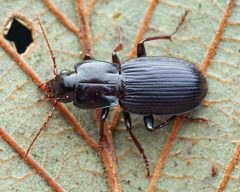
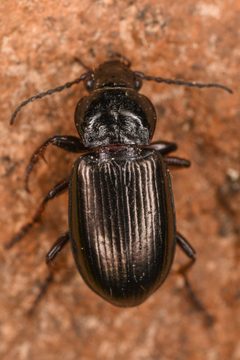
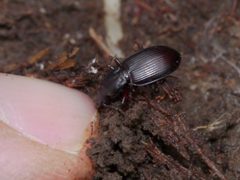
Pterostichini is a tribe of ground beetles in the Harpalinae, commonly known as woodland ground beetles. The tribe contains approximately 180 and over 3,800 described , though estimates vary. Members are primarily ground-dwelling beetles with diverse ecological roles as . Research on certain genera, particularly Pterostichus, has revealed complex patterns including iteroparity, flexible breeding periods, and responses to environmental conditions such as drought.
Pronunciation
How to pronounce Pterostichini: /ˌtɛroʊˈstɪkaɪni/
These audio files are automatically generated. While they are not always 100% accurate, they are a good starting point.
Images
Distribution
distribution with recorded across multiple continents including North America (California, USA), Europe (Bulgaria, Montenegro), Asia (China, India, Pakistan, Nepal, Turkey, Iraq), and Australia. Specific records include Mediterranean climate regions of California, mountainous areas of Bulgaria (Stara Planina, Rila, Pirin, Vitosha, Lyulin, Slavyanka Mountains), and high-altitude sites in Papua New Guinea (Mount Capella, 3960 m).
Seasonality
Activity patterns in studied (Pterostichus vicinus and P. californicus) show following accumulated precipitation, with spring activity peaks dominated by unmated individuals. Autumn and winter (rainy season) predominantly show mating marks, indicating breeding during this period. Adult summer has been observed.
Life Cycle
patterns documented in Pterostichus subgenus Hypherpes indicate typically cycles, or possibly semivoltine cycles in dry years. Rainy season breeding (autumn-winter) with iteroparity and lifespan exceeding one year. Adult summer and possibly facultative larval hibernation occur. Dynamic phenotypic polyvariance allows synchronization of adult activity periods through adjusted development time. Some individuals may as adults, completing development and becoming active at various points during the year.
Behavior
- and sex-specific cuticular abrasions (mating marks) generated during mating have been documented in multiple Pterostichus species. These marks allow distinction between mated and unmated preserved specimens. activity corresponds more strongly with accumulated rainfall of preceding rainy seasons than with in-year precipitation. Burrow-making and deposition into formed two-part soil capsules have been observed in related Australian (Nuridius, Nurus).
Ecological Role
Ground-dwelling predatory beetles contributing to soil and litter dynamics. Specific functions at tribe level not documented.
More Details
Taxonomic scope
The tribe Pterostichini includes diverse such as Pterostichus, Stomis, Molopsis (as subgenus of Tapinopterus), Nuridius, and others. Recent taxonomic work has described numerous new and revised generic boundaries, particularly in Chinese Stomis, Australian Nuridius, and Turkish Molopsis.
Research utility of mating marks
Cuticular mating marks on museum specimens provide a novel method for inferring patterns from historical collections, enabling retrospective analysis of breeding and responses to environmental variation such as drought periods.
Sources and further reading
- BugGuide
- Wikipedia
- iNaturalist taxon
- NCBI Taxonomy
- Catalogue of Life
- Taxonomic, nomenclatural, and faunistic records for species in tribes Melaenini, Moriomorphini, Pterostichini, Licinini, and Sphodrini (Coleoptera: Carabidae)
- Mating marks on museum specimens reveal breeding patterns in species of Pterostichus Bonelli (Carabidae, Pterostichini)
- New and unpublished data about Bulgarian ground beetles from the tribes Pterostichini, Sphodrini and Platynini (Coleoptera, Carabidae)
- Revision of Molopsis Schatzmayr (Coleoptera: Carabidae: Pterostichini), with descriptions of four new species
- Mating marks on museum specimens reveal breeding patterns in species of Pterostichus Bonelli (Carabidae, Pterostichini)
- Molecular phylogeny, classification, and description of new species of Australian Nuridius Sloane, 1890 (Carabidae: Pterostichini)
- Review of the Chinese Stomis, with description of nine new taxa and a new key (Carabidae: Pterostichini)