
Calleida viridipennis
Say, 1823
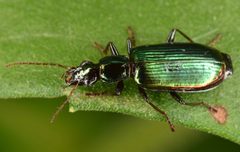
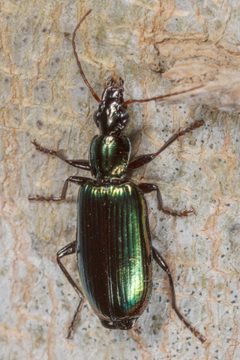
Calleida viridipennis is a ground beetle in the Carabidae, characterized by a metallic green-black , large , and functional wings enabling . It is a spring breeder that overwinters as an under tree bark, emerging in late February or early March. The is a documented of specific insect larvae, including the tortoise beetle Hemisphaerota cyanea and the fruittree leafroller Archips argyrospila.

Pronunciation
How to pronounce Calleida viridipennis: //kælˈiː.də vɪˌrɪ.diˈpɛn.nɪs//
These audio files are automatically generated. While they are not always 100% accurate, they are a good starting point.
Identification
Distinguished from similar carabid beetles by the combination of metallic green-black coloration, trapezoidal , and notably large . The larger eye size correlates with activity, separating it from carabid . Spring breeding and specific associations with baldcypress and black willow bark in forested wetlands provide additional distinguishing characteristics.
Images
Appearance
average 10 mm in length with a distinctive green-black metallic . The is trapezoidal in shape. The are notably large relative to body size. Functional wings are present beneath the exoskeleton, providing capability.
Habitat
Open forests and swamps, specifically forested wetlands. overwinter under the bark of baldcypress (Taxodium distichum) and black willow (Salix nigra) at heights exceeding 40 cm above water level. from sites occurs when temperatures become suitable and food sources are available.
Distribution
North America, ranging from southwestern New York to eastern Mexico, including southwestern Iowa. Documented in Texas, Louisiana, Florida, New Mexico, and the Caribbean island of Saint Martin. Possible sightings reported in Utah, Arizona, and California.
Seasonality
Spring breeder. emerge from in late February or early March. Larvae occur from late March to early or mid-October. Adults survive approximately one year.
Diet
of animal prey. Documented to prey on larvae of the tortoise beetle Hemisphaerota cyanea, forcing itself beneath or chewing through the larval fecal thatch defense. Also preys on caterpillars of the fruittree leafroller Archips argyrospila. Has been observed associated with fall webworm Hyphantria cunea after fruittree leafroller development is complete.
Host Associations
- Hemisphaerota cyanea - of larvaeTortoise beetle; circumvents fecal thatch defense
- Archips argyrospila - of caterpillarsFruittree leafroller; timed to caterpillar activity
- Hyphantria cunea - associatedFall webworm; association occurs after fruittree leafroller development completes
- Taxodium distichum - siteBaldcypress; bark used for shelter
- Salix nigra - siteBlack willow; bark used for shelter
Life Cycle
Complete with four stages: , larva, pupa, and . Eggs are oval, white to gray, 1.0–1.3 mm long, enclosed in a purse constructed of bark, silk, leaves, and grass, and suspended from leaves by a silk stalk. Larvae range 7.99–14.11 mm with metallic black to green tergites, trapezoidal yellow to reddish-brown , 4-segmented , and longer than antennae. Pupa measures 6.6–7.7 mm from head crest to abdominal apex. Spring breeding produces summer larvae; occurs in adult stage.
Behavior
activity pattern associated with large size. Overwinters as under tree bark, emerging in late February or early March when prey availability increases. involves active pursuit and physical penetration of prey defenses, including forcing beneath or chewing through protective structures. Metabolic suppression during conserves energy reserves.
Ecological Role
in forested wetland . Contributes to of herbivorous insects, particularly lepidopteran caterpillars and chrysomelid larvae. Serves as a bioindicator for environmental monitoring, with carabid beetles broadly used to assess fragmentation and ecosystem changes.
Human Relevance
Potential agent for agricultural and forest pests, specifically the fruittree leafroller Archips argyrospila. Subject of ecological research on -prey dynamics and physiology. Vulnerable to fragmentation, with documented declines in studied locations.
Similar Taxa
- Plochionus timidusShares similar (forested wetlands), under baldcypress and black willow bark, spring breeding , and on fruittree leafroller; distinguished by and potentially different activity patterns
- Other carabid beetlesMany carabids share general ground beetle ; C. viridipennis distinguished by metallic green-black coloration, large indicating habits, and specific spring breeder with
More Details
Sex Ratio
Female to male sex ratio of 1.1:1, consistent with Fisher's Theory of Equal Investment and representing an evolutionarily stable strategy.
Conservation Concern
Documented decline in carabid at Plummers Island, Maryland between 1901–1915 and 1970–1978, with C. viridipennis among affected . fragmentation identified as threat to carabid .
Sources and further reading
- BugGuide
- Wikipedia
- GBIF taxonomy match
- iNaturalist taxon
- Catalogue of Life
- Meloidae Holdings | Entomology Research Museum
- Seasonal Occurrence of Calleida viridipennis (Say) and Plochionus timidus Haldeman (Coleoptera: Carabidae), Predators of the Fruittree Leafroller, Archips argyrospila (Walker), in Louisiana