
Lebiini
Bonelli, 1810
Genus Guides
9- Agra(elegant canopy beetles)
- Apenes
- Calleidina
- Cymindis
- Dromiusina
- Euproctinus
- Lebiina
- Nemotarsus
- Pericalina
Lebiini is a tribe of ground beetles within the Carabidae, containing over 250 and approximately 4,800 described . Members exhibit considerable morphological diversity and occupy a wide range of across tropical and subtropical regions worldwide. The tribe includes several subtribes such as Agrina, Dromiusina, Metallicina, Pericalina, and Physoderina.
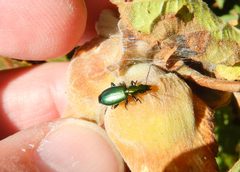
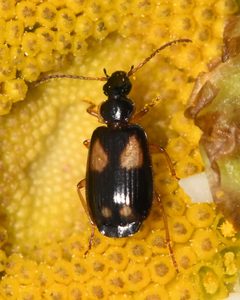
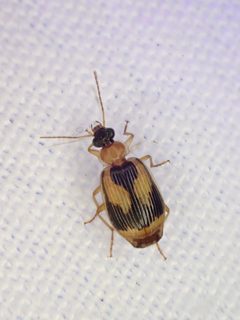
Pronunciation
How to pronounce Lebiini: /lɛˈbiː.aɪnaɪ/
These audio files are automatically generated. While they are not always 100% accurate, they are a good starting point.
Identification
Lebiini can be distinguished from other carabid tribes by combinations of characters including: often with distinctive color patterns or metallic sheen; pronotum shape variable but frequently narrowed posteriorly; ; and male genitalia with distinctive configurations of the and parameres. Many within Lebiini are arboreal or associated with specific microhabitats such as under bark, in leaf litter, or on vegetation.
Images
Habitat
vary widely among and . Some genera are arboreal, found on vegetation, tree trunks, and in forest . Others inhabit leaf litter, soil, or occur under bark of dead or decaying trees. Certain species are associated with sandy desert environments. The tribe spans multiple terrestrial from tropical rainforests to arid regions.
Distribution
Global distribution with highest diversity in tropical and subtropical regions. Present in Tropical Asia, Sub-Saharan Africa, Australasia, the Neotropics (Central and South America), and the Oriental region including Southeast Asia, Indonesia, and the Philippines. Some extend into temperate zones including Taiwan, China, and Japan.
Diet
Predatory. Members of the tribe are , feeding on other small . Specific prey records include on pupae under bark.
Life Cycle
Holometabolous with , larva, pupa, and stages. Larvae are terrestrial and predatory. Mature larvae of at least some develop under bark or in similar concealed microhabitats.
Behavior
Many are associated with arboreal or elevated , with observed on vegetation, tree trunks, and fogged from forest . Some species are found in rotting logs in rainforests. Activity patterns vary; some are .
Ecological Role
in terrestrial , contributing to regulation of in forest , particularly in arboreal and soil/litter microhabitats.
Similar Taxa
- CalleidiniHistorically confused with Lebiini; subtribe Agrina was formerly included in Calleidina. Distinguished by different combinations of morphological characters including male genitalia structure and body proportions.
- LachnophoriniSimilar arboreal habits in some ; distinguished by differences in tarsal structure, elytral punctation patterns, and genitalic .
More Details
Taxonomic Complexity
Lebiini contains numerous subtribes (Agrina, Dromiusina, Metallicina, Pericalina, Physoderina) that have undergone substantial revision. The subtribe Agrina was formerly treated as part of Calleidina. Generic boundaries and concepts within the tribe remain active areas of taxonomic research.
Species Diversity
With over 4,800 described across more than 250 , Lebiini represents one of the most species-rich tribes within Carabidae. Many species are rare in collections, and numerous new species continue to be described, particularly from underexplored tropical regions.
Sources and further reading
- BugGuide
- Wikipedia
- iNaturalist taxon
- NCBI Taxonomy
- Catalogue of Life
- The Pan-Pacific Entomologist 88(2)—Penrose Memorial issue | Beetles In The Bush
- Taxonomic revision of the genus Parena Motschulsky, 1860(Coleoptera, Carabidae, Lebiini, Metallicina)
- Larval Morphology of Mochtherus luctuosus Putzeys (Coleoptera: Carabidae: Lebiinae: Lebiini: Pericalina) with Notes on Their Biology
- Revision of the Oriental Genus Physodera Eschscholtz, 1829 (Coleoptera, Carabidae, Lebiini, Physoderina), with the descriptions of two new species
- Revision of genus Pericalus from China, with descriptions of four new species (Carabidae, Lebiini, Pericalina)
- A remarkable new lebiine genus with two new species from Pakistan, Afghanistan and Iran (Coleoptera: Carabidae: Lebiini)
- A taxonomic review of the pericaline ground-beetles in Taiwan, with descriptions of new species (Coleoptera, Carabidae, Lebiini)
- The beetle family Carabidae of Costa Rica: The genus Epikastea Liebke of the Plochonida Group, with new Neotropical species and notes on their way of life (Insecta: Coleoptera, Lebiini, Agrina)