
Pericalina
Hope, 1838
Genus Guides
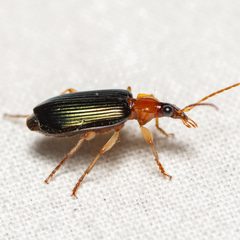
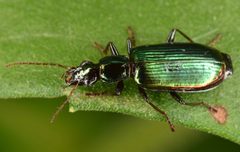
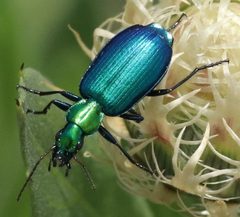
5Pericalina is a subtribe of ground beetles (Carabidae: Lebiinae: Lebiini) comprising arboreal distributed across tropical and subtropical forests of the New World and Asia. The subtribe includes several complexes distinguished by morphological characters of the mouthparts, pronotum, and ovipositor. New World eucheiloid members are characterized by securiform labial palpomere 3, serrate-setose pronotal margins, and flattened stylomere 2 of the ovipositor. Asian members such as Pericalus exhibit flattened body forms adapted for life under bark. The group has undergone significant diversification in tropical South America with subsequent northward into Central America and independent radiations in Asia.
Pronunciation
How to pronounce Pericalina: /ˌpɛrɪkəˈlaɪnə/
These audio files are automatically generated. While they are not always 100% accurate, they are a good starting point.
Identification
Distinguished from other pericaline complexes (thyreopteroid, eurycoleoid, somotrichoid, pericaloid) by the combination of securiform labial palpomere 3, serrate-setose pronotal margins, and flattened stylomere 2 of the ovipositor in New World eucheiloids. Asian Pericalus identified by coloration, number of setigerous pores on the third elytral interval, and shape of elytral angles. -level separation relies on structural features of the , mouthparts, and male and female genitalia.
Images
Habitat
Arboreal; associated with forest . New World eucheiloids occupy various forest types with differentiation by forest type. Asian Pericalus inhabit tropical to subtropical forests, occurring under bark of fallen logs and on surfaces of dead logs. Larvae have been found under bark of dead broad-leaf tree stumps.
Distribution
New World: northern Argentina to southernmost United States (Brownsville, Texas), with principal diversification in tropical South America and Cenozoic invasions into Central America. Asia: tropical-subtropical areas of Asian continent (northern Myanmar, northeast India, southeast Xizang, west Yunnan) and Sundaland region (Greater Sunda Islands, Malay Peninsula); in China recorded from south Yunnan, Hainan, south Xizang, Guizhou, and Guangxi.
Diet
Predatory; at least some larvae prey on living pupae of other insects under bark. feeding habits not explicitly documented.
Host Associations
- Uleiota arboreus Reitter - preyObserved as prey of Mochtherus luctuosus larva under bark
Life Cycle
Larval stage occurs under bark of dead trees. Mature larval described for Mochtherus luctuosus. Complete details not documented.
Behavior
fast-running on surfaces of dead logs at night; occasionally attracted to lights. Arboreal habit throughout group. Larvae predatory under bark.
Similar Taxa
- Thyreopteroid complex of PericalinaLacks securiform labial palpomere 3, serrate-setose pronotal margins, and flattened stylomere 2 of ovipositor characteristic of eucheiloids
- Eurycoleoid complex of PericalinaDistinguished from eucheiloids by different morphological character states of mouthparts and ovipositor
- Somotrichoid complex of PericalinaSeparated from eucheiloids by structural differences in labial palpomere and ovipositor stylomere
- Pericaloid complex of PericalinaDiffers from eucheiloids in key diagnostic characters of mouthparts and reproductive structures
More Details
Evolutionary history
Phylogenetic analysis based on 60 character states from 33 characters indicates Hansus is sister group to the ancestral stock of Inna + Eucheila. Principal theater of evolution has been tropical South America, with diversification involving body size, and mouthparts (feeding adaptations), reproductive structures, and superficial body characters related to avoidance. Five lineages invaded Middle America probably during Cenozoic time from middle Tertiary to Quaternary.
Taxonomic composition
Includes three New World eucheiloid (Hansus, Inna, Eucheila) with 16 , and Asian genera including Pericalus with at least 19 in the subgenus Pericalus alone.
Sources and further reading
- BugGuide
- iNaturalist taxon
- Catalogue of Life
- Revision of genus Pericalus from China, with descriptions of four new species (Carabidae, Lebiini, Pericalina)
- THE SPECIES OF EUCHEILOID PERICALINA: CLASSIFICATION AND EVOLUTIONARY CONSIDERATIONS (COLEOPTERA: CARABIDAE: LEBIINI)
- Larval Morphology of Mochtherus luctuosus Putzeys (Coleoptera: Carabidae: Lebiinae: Lebiini: Pericalina) with Notes on Their Biology