
Mochtherus
Schmidt-Goebel, 1846
Species Guides
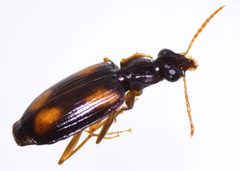
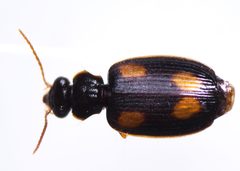
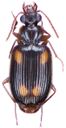
1Mochtherus is a of ground beetles (Carabidae: Lebiinae) comprising approximately 11 described distributed across East and Southeast Asia, Australia, and New Guinea. The genus was established by Schmidt-Goebel in 1846. Larval has been documented for at least one species, M. luctuosus, revealing predatory habits under bark. Most species appear to be associated with forest in tropical and subtropical regions.
Pronunciation
How to pronounce Mochtherus: /ˈmɒkθərəs/
These audio files are automatically generated. While they are not always 100% accurate, they are a good starting point.
Identification
Members of Mochtherus belong to the subtribe Pericalina within Lebiini, characterized by features typical of this group including compact body form and specialized mouthparts. Specific diagnostic characters for the versus related pericaline genera are not documented in available sources. likely show the elongated, somewhat flattened body plan common to many lebiine ground beetles.
Images
Habitat
Forest environments, particularly under bark of dead broad-leaf trees. Larvae of M. luctuosus have been collected specifically from beneath bark of dead broad leaf tree stumps.
Distribution
East Asia (South Korea, Japan, Taiwan), Southeast Asia (Philippines, Malaysia, Singapore, Indonesia including Sulawesi), New Guinea, and Australia. Individual show restricted ranges; M. tetraspilotus has the broadest distribution across East and Southeast Asia and Australia.
Diet
Predatory. Larvae of M. luctuosus have been observed preying on living pupae of the Uleiota arboreus.
Host Associations
- Uleiota arboreus - preyLarval prey item observed for M. luctuosus
Life Cycle
Larval stage described for M. luctuosus; mature larva characterized by typical carabid features with specialized predatory adaptations. Complete with , larval, pupal, and stages assumed based on characteristics, though not directly documented.
Behavior
Arboreal or subcortical habits indicated by larval collections from under bark. Predatory on immobile prey (pupae) observed in larvae.
Ecological Role
in forest , particularly within dead wood and bark microhabitats. Likely contributes to regulation of saproxylic insect .
Similar Taxa
- Other Pericalina generaMochtherus shares subtribe Pericalina with multiple ; differentiation requires examination of male genitalia and other subtle morphological characters not summarized in general sources.
More Details
Taxonomic history
The has undergone gradual accumulation, with most species described in the 20th and 21st centuries. Recent descriptions include M. dentatus (2016) and M. obscurabasis (2019).
Research limitations
Biological information is extremely limited, derived almost entirely from a single larval description of M. luctuosus. habits, reproductive , and ecological interactions remain undocumented for most .