
Lachnophorini
LeConte, 1853
Genus Guides
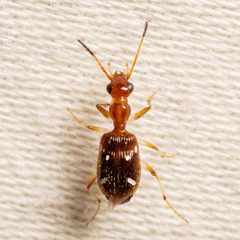
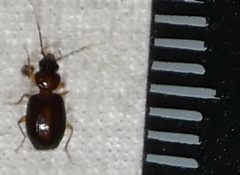
5Lachnophorini is a tribe of ground beetles ( Carabidae) comprising approximately 18 and more than 190 described . The tribe exhibits remarkable morphological diversity and divergent ecological habits, with most species being very small (less than 3.74 mm in body length). A 2014 taxonomic synopsis added a new genus (Peruphorticus) and 24 new species, significantly expanding known diversity. The tribe shows distinct biogeographic patterns, with Neotropical species in the Amazon Basin and Middle and South America, and additional representatives in the Paleotropics and Australia. Recent research indicates local ecological and morphological convergence related to use within the Amazon Basin radiation.

Pronunciation
How to pronounce Lachnophorini: /lækˈnɒfɒrəˌnaɪ/
These audio files are automatically generated. While they are not always 100% accurate, they are a good starting point.
Identification
Identification to level requires examination of subtle morphological characters detailed in the 2014 taxonomic synopsis (Erwin & Zamorano 2014), which provides a key to 18 genera across Western and Eastern Hemispheres. -level identification often necessitates dissection and examination of genitalic structures. The tribe can be distinguished from other Carabidae tribes by combinations of characters including body size, pronotum shape, and elytral characteristics, though specific diagnostic features are not summarized in available sources. Geometric morphometric analysis of pronotum and landmarks has proven useful for distinguishing species within clades.
Images
Habitat
occupancy varies markedly among and correlates strongly with body form. Species with slender pronotum tend to occur in open environments such as sandy beaches adjacent to water. Species with shorter, broader pronotum and inhabit leaf-litter and arboreal habitats. The Balligratus is restricted to montane pluvial forest at elevations of 1,200–3,600 m in the equatorial Andes. The Amazon Basin harbors significant diversity across multiple habitat types including lowland tropical rainforest.
Distribution
Western Hemisphere: predominantly Neotropical, with records from Amazon Basin rainforests, Middle and South America. Specific localities include Brazil (Amazonas, Pará, Mato Grosso), Peru (Pakitza, Río Samiria, Río Napo, Río Sucusari), Colombia (Leticia), Ecuador (Limoncocha), Bolivia (Río Mamoré), Argentina (Río Uruguay), Paraguay (Río Paraguay), Surinam (Surinam River), and Guyana. Andean montane forests of Ecuador (Balligratus). Eastern Hemisphere: Paleotropical and Australian regions.
Life Cycle
Larval stages are poorly known. The larva of only one has been described. Authors speculate larvae may be ectoparasitic based on vast size ranges within well-collected species and comparative with related groups, though this remains unconfirmed.
Behavior
Morphological convergence related to use has been documented, with eco-morphological trait disparity correlating with habitat occupancy. The wingless Balligratus represents a unique evolutionary trajectory within the tribe, having secondarily lost capability in association with montane forest habitat.
Ecological Role
Explicitly described as and that attack and consume prey smaller than themselves. As members of Carabidae, they contribute to predatory regulation of small in their respective .
Similar Taxa
- Other Carabidae tribesLachnophorini can be distinguished by combination of extremely small body size (most <3.74 mm), diverse but characteristic pronotum shapes, and specific elytral features detailed in Erwin & Zamorano (2014) identification key.
More Details
Taxonomic History
The tribe has been largely ignored by carabidologists until recent comprehensive study. A 2014 synopsis by Erwin & Zamorano established groundwork for refined studies, describing a new (Peruphorticus) and 24 new (23 in Asklepia, 1 in Peruphorticus). Five genera (Homethes, Aeolodermus, Stenocheila, Diplacanthogaster, Selina) were reassigned as incertae sedis. Three higher-level groups were proposed: Lachnophorina, Eucaerina, and incertae sedis.
Phylogenetic Research
Phylogenetic analysis of Ecuadorian Amazon identified 8 clades with constant rate of divergence. Lineage-through-time analysis supports accumulation of in proportion to time rather than adaptive radiation pattern. Morphological shape variation shows significant correlation with occupancy, indicating local ecological during Amazon Basin radiation.
Sources and further reading
- BugGuide
- Wikipedia
- iNaturalist taxon
- NCBI Taxonomy
- Catalogue of Life
- 24 New Beetle Species Discovered in the Lachnophorini Tribe
- A synopsis of the carabid beetle tribe Lachnophorini reveals remarkable 24 new species | Blog
- Uncategorized | Blog - Part 21
- Pensoft blog - Part 126
- Diplacanthogaster bicolor Archives - Entomology Today
- Drivers of diversification in a continental radiation of ground beetles (Coleoptera: Carabidae: Lachnophorini)
- Balligratus, new genus of wingless ground beetles from equatorial Andean montane forest (Coleoptera: Carabidae: Lachnophorini)
- A synopsis of the tribe Lachnophorini, with a new genus of Neotropical distribution and a revision of the Neotropical genus Asklepia Liebke, 1938 (Insecta, Coleoptera, Carabidae)
- Figure 79 from: Erwin T, Zamorano L (2014) A synopsis of the tribe Lachnophorini, with a new genus of Neotropical distribution and a revision of the Neotropical genus Asklepia Liebke, 1938 (Insecta, Coleoptera, Carabidae). ZooKeys 430: 1-108. https://doi.org/10.3897/zookeys.430.8094
- Figure 7–10 from: Erwin T, Zamorano L (2014) A synopsis of the tribe Lachnophorini, with a new genus of Neotropical distribution and a revision of the Neotropical genus Asklepia Liebke, 1938 (Insecta, Coleoptera, Carabidae). ZooKeys 430: 1-108. https://doi.org/10.3897/zookeys.430.8094
- Figure 57–62 from: Erwin T, Zamorano L (2014) A synopsis of the tribe Lachnophorini, with a new genus of Neotropical distribution and a revision of the Neotropical genus Asklepia Liebke, 1938 (Insecta, Coleoptera, Carabidae). ZooKeys 430: 1-108. https://doi.org/10.3897/zookeys.430.8094
- Figure 3–6 from: Erwin T, Zamorano L (2014) A synopsis of the tribe Lachnophorini, with a new genus of Neotropical distribution and a revision of the Neotropical genus Asklepia Liebke, 1938 (Insecta, Coleoptera, Carabidae). ZooKeys 430: 1-108. https://doi.org/10.3897/zookeys.430.8094
- Figure 56 from: Erwin T, Zamorano L (2014) A synopsis of the tribe Lachnophorini, with a new genus of Neotropical distribution and a revision of the Neotropical genus Asklepia Liebke, 1938 (Insecta, Coleoptera, Carabidae). ZooKeys 430: 1-108. https://doi.org/10.3897/zookeys.430.8094
- Figure 37–40 from: Erwin T, Zamorano L (2014) A synopsis of the tribe Lachnophorini, with a new genus of Neotropical distribution and a revision of the Neotropical genus Asklepia Liebke, 1938 (Insecta, Coleoptera, Carabidae). ZooKeys 430: 1-108. https://doi.org/10.3897/zookeys.430.8094
- Figure 33–36 from: Erwin T, Zamorano L (2014) A synopsis of the tribe Lachnophorini, with a new genus of Neotropical distribution and a revision of the Neotropical genus Asklepia Liebke, 1938 (Insecta, Coleoptera, Carabidae). ZooKeys 430: 1-108. https://doi.org/10.3897/zookeys.430.8094
- Figure 75 from: Erwin T, Zamorano L (2014) A synopsis of the tribe Lachnophorini, with a new genus of Neotropical distribution and a revision of the Neotropical genus Asklepia Liebke, 1938 (Insecta, Coleoptera, Carabidae). ZooKeys 430: 1-108. https://doi.org/10.3897/zookeys.430.8094
- Figure 78 from: Erwin T, Zamorano L (2014) A synopsis of the tribe Lachnophorini, with a new genus of Neotropical distribution and a revision of the Neotropical genus Asklepia Liebke, 1938 (Insecta, Coleoptera, Carabidae). ZooKeys 430: 1-108. https://doi.org/10.3897/zookeys.430.8094
- Figure 1 from: Erwin T, Zamorano L (2014) A synopsis of the tribe Lachnophorini, with a new genus of Neotropical distribution and a revision of the Neotropical genus Asklepia Liebke, 1938 (Insecta, Coleoptera, Carabidae). ZooKeys 430: 1-108. https://doi.org/10.3897/zookeys.430.8094
- Figure 76–77 from: Erwin T, Zamorano L (2014) A synopsis of the tribe Lachnophorini, with a new genus of Neotropical distribution and a revision of the Neotropical genus Asklepia Liebke, 1938 (Insecta, Coleoptera, Carabidae). ZooKeys 430: 1-108. https://doi.org/10.3897/zookeys.430.8094
- Figure 2 from: Erwin T, Zamorano L (2014) A synopsis of the tribe Lachnophorini, with a new genus of Neotropical distribution and a revision of the Neotropical genus Asklepia Liebke, 1938 (Insecta, Coleoptera, Carabidae). ZooKeys 430: 1-108. https://doi.org/10.3897/zookeys.430.8094