
Euphorticus
G.Horn, 1881
Species Guides
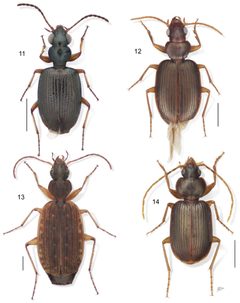
1Euphorticus is a of ground beetles in the Carabidae, established by G.Horn in 1881. It belongs to the tribe Lachnophorini within the Lebiinae. The genus contains five described distributed across the Americas, from the United States to South America.
Pronunciation
How to pronounce Euphorticus: /juːˈfɔːrtɪkəs/
These audio files are automatically generated. While they are not always 100% accurate, they are a good starting point.
Identification
Members of Euphorticus are distinguished from other Lachnophorini by characters of the as defined by Horn (1881), though specific diagnostic features require examination of . The genus is placed in the subtribe Lachnophorina based on morphological affinities with other lachnophorine genera.
Images
Distribution
The occurs in the New World from the southern United States (Arizona, Texas) through Central America (Guatemala, Nicaragua, Panama, Cuba) to South America (Colombia, French Guiana, Brazil).
Similar Taxa
- LachnophorusAlso in tribe Lachnophorini and subtribe Lachnophorina; Euphorticus differs in genitalic and external morphological characters as revised by Erwin (1974) and Bousquet (2002)
- AnchonoderusAnother New World in Lachnophorini; Euphorticus is distinguished by the structure of the elytral intervals and male genitalia
More Details
Taxonomic history
The was established by George Henry Horn in 1881. The type is Euphorticus occidentalis G.Horn, 1891, by subsequent designation. The genus has been revised as part of broader treatments of the Lachnophorini by Erwin (1974) and Bousquet (2002).
Species composition
The five described are: Euphorticus laevicollis (Reiche, 1843) from Colombia and French Guiana; Euphorticus leucoscelis (Bates, 1878) from Panama and Nicaragua; Euphorticus occidentalis G.Horn, 1891 from the United States; Euphorticus pilosus (Dejean, 1831) from Brazil; and Euphorticus pubescens (Dejean, 1831) from the United States, Guatemala, Mexico, and Cuba.