
Hemisphaerota cyanea
(Say, 1824)
palmetto tortoise beetle, Florida tortoise beetle, iridescent blue chrysomelid beetle
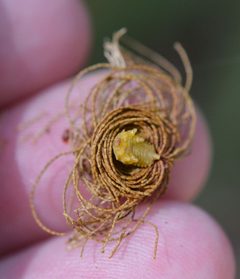
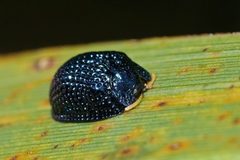
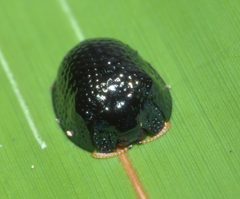
Hemisphaerota cyanea is a small, metallic blue tortoise beetle in the leaf beetle Chrysomelidae. measure 4.6–5.6 mm and possess distinctive hemispherical bodies with dark blue or purple and pronotum. The is to the southeastern United States where it feeds exclusively on palms, particularly saw palmetto. Both adults and larvae exhibit remarkable defensive adaptations: adults use specialized adhesive with approximately 10,000 bristles per foot to clamp onto leaves, while larvae construct elaborate fecal thatches that conceal and protect them from .
Pronunciation
How to pronounce Hemisphaerota cyanea: /hɛˌmɪsfɪˈroʊtə saɪˈeɪniə/
These audio files are automatically generated. While they are not always 100% accurate, they are a good starting point.
Identification
Distinguished from other tortoise beetles by its exclusive association with palms, dark metallic blue coloration, and hemispherical body shape. The combination of orange with black bases and the specific plant (palms) separates it from similar Cassidinae. The adhesive with visible bristle pads are diagnostic when examined closely. No other North American tortoise beetle specializes on palms.
Images
Appearance
Small with hemispherical, dome-shaped body. Length 4.6–5.6 mm. and pronotum dark metallic blue to purple. short, orange with black basal segments. large and modified with dense adhesive bristles. Body strongly convex, giving tortoise-like silhouette.
Habitat
Sand scrub and pine scrub where native palms occur. Found on fronds of saw palmetto and other palm in open, sandy areas with sparse . Occurs in coastal and near-coastal environments of the deep southeastern United States.
Distribution
Southeastern United States: Florida, Georgia, Alabama, Texas, Louisiana, and Mississippi. Most common in peninsular Florida.
Seasonality
active year-round. Larvae and pupae present mid to late summer. Females lay March to mid-April.
Diet
Feeds on palm foliage. and larvae both feed on palmetto plants, particularly saw palmetto (Serenoa repens), but also cabbage palm (Sabal palmetto), dwarf palmetto (Sabal minor), and scrub palmetto (Sabal etonia). Feeding creates trough-like scars on leaf .
Host Associations
- Serenoa repens - primary saw palmetto, most common
- Sabal palmetto - cabbage palm
- Sabal minor - dwarf palmetto
- Sabal etonia - scrub palmetto
Life Cycle
yellow and elongated, laid March to mid-April, cemented to leaves and covered with protective fecal coating. Larvae hatch and immediately begin constructing fecal thatch using anal fork to fasten strands. Larvae feed under thatch, enlarging it as they grow through instars. occurs beneath the thatch. emerge after approximately one week. Larval and pupal stages occur mid to late summer.
Behavior
clamp onto leaves when disturbed, pressing all flat and secreting oil to strengthen adhesion. Can withstand pulling forces up to 0.8 grams (60 times body mass) for two minutes. When , uses only small fraction of adhesive bristles, appearing to 'tip-toe'. Larvae remain anchored to substrate with tarsal claws, moving slowly without disengaging all claws. Larvae can actively maneuver fecal thatch using caudal fork to deflect threats from different directions.
Ecological Role
Herbivore specializing on native palms. Feeding damage is generally minor and rarely causes significant tree damage. Serves as prey for specialized including the assassin bug Arilus cristatus and red widow spider Latrodectus bishopi. Larvae are preyed upon by Calleida beetles, which can penetrate fecal thatch defenses.
Human Relevance
Occasional minor pest of ornamental palms. Subject of scientific interest due to remarkable adhesive mechanisms, which have been studied for biomimetic applications. The fecal thatch construction has been documented as an example of elaborate insect architecture.
Similar Taxa
- Other Cassidinae tortoise beetlesH. cyanea distinguished by palm-specific association, dark blue metallic coloration, and hemispherical body form. Most other North American tortoise beetles feed on herbaceous plants or woody plants other than palms.
More Details
Adhesive mechanism
Each contains approximately 10,000 adhesive bristles with two terminal pads each, totaling over 60,000 bristles across all six legs. Glandular pores secrete oil that spreads by capillarity to pre-wet pads for maximum adhesion.
Fecal thatch construction
Larvae produce fecal strands within minutes of hatching, alternating 'right hand' and 'left hand' strands by flexing anal turret. Strands are cemented to caudal fork with sticky secretion. Thatch fully formed within 12 hours. Caudal fork retained through , becoming composite structure of stacked instar forks.
Sources and further reading
- BugGuide
- Wikipedia
- GBIF taxonomy match
- iNaturalist taxon
- Catalogue of Life
- predator avoidance | Beetles In The Bush | Page 4
- Florida | Beetles In The Bush | Page 2
- Archives | Beetles In The Bush
- Chrysomelidae | Beetles In The Bush | Page 3
- Heliconiidae | Beetles In The Bush
- Defensive use of a fecal thatch by a beetle larva ( Hemisphaerota cyanea )