
Latrodectus bishopi
Kaston, 1938
Red Widow
Latrodectus bishopi, the red widow spider, is a venomous cobweb spider to the sand-pine scrub of central and southern Florida. First described as a variety of L. mactans in 1938 and elevated to status in 1964, it is distinguished from other widow spiders by its distinctive coloration and lack of a complete hourglass marking. The species is listed as threatened in the United States due to its restricted range and habitat specificity.


Pronunciation
How to pronounce Latrodectus bishopi: /ˌlætrəˈdɛktəs ˈbɪʃəpaɪ/
These audio files are automatically generated. While they are not always 100% accurate, they are a good starting point.
Identification
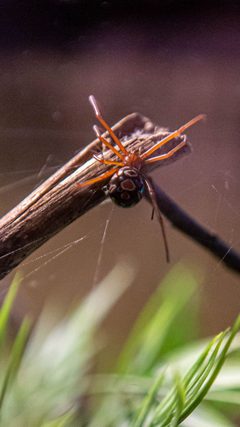
Distinguished from Latrodectus mactans by genitalic features: male palpal bulb embolus has one fewer loop, and female spermathecal connecting ducts have one fewer loop. Externally, the red-orange and vermillion legs contrast with the black spotted with red, and the incomplete or absent hourglass on the abdomen separates it from sympatric black widow .
Images
Appearance
Females have a red-orange , vermillion red legs, and a black with yellow rings outlining rows of red spots. The underside lacks the complete hourglass marking typical of other widow spiders, instead bearing one or two small red marks. Females are nearly double the size of males.
Habitat
Restricted to sand-pine scrub : inland dry sand dunes dominated by sand pine (Pinus clausa). Within this , constructs webs primarily in palmetto bushes (Serenoa repens and Sabal etonia) at heights of 30 cm or more above ground.
Distribution
to central and southern Florida, United States. Range limited to the Florida peninsula within sand-pine scrub vegetation.
Diet
Known of Hemisphaerota cyanea (a tortoise beetle). General feeding habits presumed similar to other Latrodectus but specific prey range otherwise undocumented.
Life Cycle
sacs stored in the funnel-shaped retreat of the web. Specific details of developmental stages, lifespan, and reproductive not documented in available sources.
Behavior
Constructs tangled webs with a funnel-shaped retreat below. Stores sacs in this retreat. Unlike more widow , it seldom comes into contact with humans due to restricted natural .
Ecological Role
within sand-pine scrub . Potential prey for sphecid and Florida scrub jay (Aphelocoma coerulescens), though events documented only circumstantially.
Human Relevance
Venomous, with neurotoxic venom (LD50 in mice: 2.20 mg/kg). One documented bite resulted in mildly painful throbbing lasting several hours. No bites recorded in medical literature; limited human contact due to restriction. Listed as threatened in the United States.
Similar Taxa
- Latrodectus mactansOverlaps in Florida; distinguished by genitalic and external coloration (L. mactans has black coloration with red hourglass, not red-orange and vermillion legs)
- Latrodectus geometricusPresent in Florida; brown coloration with orange or yellow hourglass marking, geometric pattern on , and more habits
More Details
Taxonomic history
Originally described by B. J. Kaston in 1938 as Latrodectus mactans variety bishopi, honoring Marshall B. Bishop who collected the . Elevated to full by McCrone and Levi in 1964 based on genitalic differences.
Conservation status
Listed as threatened in the United States due to status and restricted distribution within Florida's sand-pine scrub, a globally rare .
Venom composition
Contains latrotoxins typical of the . Each spider contains approximately 0.157 mg venom.
Sources and further reading
- BugGuide
- Wikipedia
- GBIF taxonomy match
- iNaturalist taxon
- NCBI Taxonomy
- Catalogue of Life
- There's a Black Widow Spider in the Parade! | Bug Squad
- Beautiful but dangerous: Black Widow Spiders, Latrodectus spp. — Bug of the Week
- Widow watch - Black Widow Spider, Latrodectus mactens — Bug of the Week
- Brown Widow Spiders' Aggression Likely Driver of Black Widow Decline
- Bug Eric: Tiny Wasp Hero Slays Redback Spiders in Australia
- Do Chestnut, Lemon, or Peppermint Scents Repel Spiders?