
Hemisphaerotini
Monrós & Viana, 1951
Genus Guides
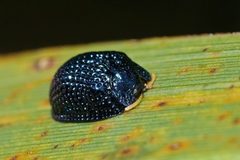
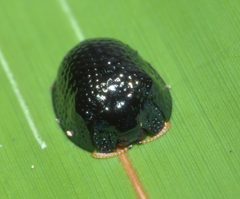
1Hemisphaerotini is a tribe of tortoise beetles and hispines in the leaf beetle Chrysomelidae, first described by Monrós and Viana in 1951. The tribe is restricted to the Neotropical region and contains at least two —Hemisphaerota and Spaethiella—with more than 40 described . Members of this tribe exhibit the characteristic domed body form of tortoise beetles, with expanded and pronotum that shield the and appendages. The stages (, larvae, and pupae) have been described in the literature.
Pronunciation
How to pronounce Hemisphaerotini: //ˌhɛmɪsfɛˈrɒtɪnaɪ//
These audio files are automatically generated. While they are not always 100% accurate, they are a good starting point.
Identification
Hemisphaerotini can be distinguished from other tortoise beetle tribes by its Neotropical distribution and the combination of two recognized : Hemisphaerota and Spaethiella. Members possess the typical tortoise beetle with a strongly convex, shield-like body. Specific diagnostic features separating it from related tribes such as Cassidini or Delocraniini require examination of subtle morphological characters including tarsal structure, antennal proportions, and precise body outline; these details are not comprehensively documented in general sources.
Images
Distribution
Restricted to the Neotropical region, encompassing Central and South America and the Caribbean.
Life Cycle
, larvae, and pupae have been described, though specific developmental details and duration of stages are not documented in available sources.
Similar Taxa
- CassidiniAnother tribe of tortoise beetles with similar domed body form; differs in geographic distribution and composition.
- DelocraniiniRelated tortoise beetle tribe; separation requires detailed morphological examination.
More Details
Taxonomic history
The tribe was established by Monrós and Viana in 1951. The two included , Hemisphaerota (Chevrolat in Dejean, 1836) and Spaethiella (Barber & Bridwell, 1940), represent distinct lineages within the Cassidinae .