
Arilus cristatus
(Linnaeus, 1763)
North American wheel bug, wheel bug
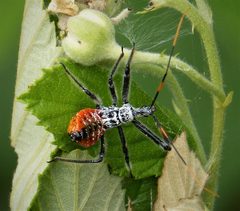
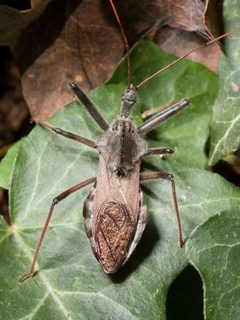
Arilus cristatus, the North American wheel , is a large assassin bug distinguished by a semicircular, wheel-shaped pronotal crest. reach up to 38 mm in length and are gray to brownish-gray, while nymphs are bright red and black without the characteristic wheel structure. The is a that employs front legs and a powerful to subdue and liquefy prey. It is valued as a agent but possesses a defensive bite to humans that is notably painful and prolonged.
Pronunciation
How to pronounce Arilus cristatus: /ˈæɹɪləs krɪsˈtɑːtəs/
These audio files are automatically generated. While they are not always 100% accurate, they are a good starting point.
Identification
The wheel-shaped pronotal crest distinguishes from all other North American assassin bugs. Nymphs may be confused with other reduviid nymphs but are identified by their specific red-and-black color pattern and association with masses. The large size (up to 38 mm) separates adults from most other native assassin bugs. The long, curved folded beneath the when not in use is characteristic of the Reduviidae.
Images
Habitat
Occurs in diverse terrestrial including deciduous forests, woodlands, orchards, agricultural fields, and suburban landscapes. Frequently found on sunflowers, goldenrod, cotton, locust tree trunks, and in fruit and nut groves. Requires vegetation that supports abundant prey . and nymphs hide in leafy cover when not actively hunting.
Distribution
Eastern North America from southern Canada through the eastern and central United States, extending south to Mexico and Guatemala. Western range limit approximately at Iowa and Texas. The only of Arilus occurring in the United States; other four extant species in the are restricted to Central and South America.
Seasonality
active primarily during daylight hours from late spring through autumn. laid in autumn, overwinter, and hatch the following May or June. Nymphs present spring through mid-summer, with adults emerging by July. One per year throughout most of the range; varies with local climate, with in warmer regions potentially exhibiting altered timing.
Diet
of soft-bodied insects and larvae. Documented prey includes caterpillars (fall webworm, cabbage worm, tent caterpillars, orange dogs), larvae and (Japanese beetle, Mexican bean beetle), larvae, aphids, plant hoppers, and other true bugs including brown marmorated stink bugs. Also known to prey on beneficial such as lady beetles and honey bees, and exhibits , particularly nymphs consuming other nymphs and females consuming males post-mating.
Life Cycle
Overwinters as in wheel-shaped clusters cemented to twigs, branches, and bark with gummy adhesive. Females deposit 40–200 eggs per mass. Eggs hatch in spring (May–June) into 8 mm nymphs. Five nymphal instars, with average inter- interval of approximately 18.8 days; fifth instar to transition is the longest. Total development from egg hatch to adult averages 94 days. Adults reach maturity by July. Females die after oviposition. Egg by such as Ooencyrtus johnsoni has been documented.
Behavior
that relies on camouflage and slow, deliberate movement due to limited speed. Approaches prey cautiously, seizes it with front legs, and impales with to inject paralyzing and digestive . Prey tissues are liquefied and consumed through the proboscis via a muscular pump in the . Capable of stridulation (audible sound production) by rubbing the proboscis tip against a thoracic groove; function unknown. is slow and produces a distinct buzzing sound. When threatened, may evert releasing defensive compounds; bite is used as last defense. Generally retreats from human approach but will bite if handled or provoked.
Ecological Role
Significant and agent in agricultural and natural . increases have been observed in response to of pests such as brown marmorated stink bugs and spotted lanternflies, suggesting potential for top-down pest suppression. Presence indicates intact with sufficient prey to support large predators. Also functions as intraguild predator, consuming other beneficial arthropods.
Human Relevance
Beneficial for organic agriculture and due to on crop pests. Bite to humans is medically significant: extremely painful, causing immediate localized pain, swelling, and subsequent numbness that may persist for days to weeks. Discomfort can continue for up to six months in some cases, though prolonged may involve secondary or allergic reaction. Bite is not life-threatening but is considered more severe than most hymenopteran stings. Handling requires gloves or avoidance.
Similar Taxa
- Zelus longipes (milkweed assassin bug)Similar size and coloration, but lacks wheel-shaped crest; has sticky forelegs for prey capture rather than pure grasping.
- Pselliopus barberi (orange assassin bug)Similar orange and black nymphal coloration, but are smaller with striped orange-and-black pattern and lack the distinctive pronotal wheel.
- Other Reduviidae nymphsMay share red-and-black nymphal coloration, but wheel nymphs are specifically associated with wheel-shaped masses and reach larger sizes.
Misconceptions
The function of the wheel-shaped pronotal crest remains unknown despite speculation; it does not serve in prey capture or known mechanical function. The is sometimes mistakenly considered exclusively beneficial, but it also preys on and other beneficial insects. The painful bite is sometimes assumed to be highly venomous, but effects are primarily enzymatic and mechanical rather than .
More Details
Scent gland chemistry
Possesses two distinct with separate functions: one for defense against , one for reproductive . The defensive secretion is detectable to humans but less potent than that of pentatomid stink bugs.
Attraction to turpentine
Has been observed to be attracted to turpentine oil, a trait noted in historical literature and field observations.
Laboratory rearing challenges
Difficult to maintain in captivity due to and specific prey requirements; successful rearing requires isolation of individuals and provision of suitable live prey.
Sources and further reading
- BugGuide
- Wikipedia
- GBIF taxonomy match
- iNaturalist taxon
- NCBI Taxonomy
- Catalogue of Life
- Bug vs. bug - Assassinating stink bugs is the game of the wheel bug, Arilus cristatus — Bug of the Week
- Death of a stink bug, Part 2: Bug vs. Bug - Brown Marmorated Stink Bug, Halyomorpha halys, meets the wheel bug, Arilus cristatus — Bug of the Week
- To eat a stink bug, part 3 - Bug vs Bug, Brown Marmorated Stink Bug, Halyomorpha halys, meets the wheel bug, Arilus cristatus — Bug of the Week
- Bugs in orange and black: Three assassins - milkweed assassin bug, Zelus longipes; orange assassin bug, Pselliopus barberi; and wheel bug, Arilus cristatus — Bug of the Week
- Bugs in Orange and Black III – Argus tortoise beetle, Chelymorpha cassidea; oleander caterpillar, Syntomeida epilais; and wheel bug, Arilus cristatus (MISSING LINKS) — Bug of the Week
- Wheel Bug Takes a Spin, Arilus cristatus — Bug of the Week
- Wheel Bug, Arilus cristatus (Linnaeus) (Insecta: Hemiptera: Reduviidae)
- Life History and Laboratory Rearing of Arilus cristatus (Heteroptera: Reduviidae) in Southern Illinois