
Arilus
Hahn, 1831
wheel bugs
Species Guides
1- Arilus cristatus(North American wheel bug)
Arilus is a of large assassin bugs (Reduviidae) commonly called wheel bugs due to the distinctive semicircular, wheel-like crest on the pronotum. The genus contains five extant found primarily in the Americas, plus one fossil species. Members are of insects, using front legs to capture prey and a piercing-sucking beak to inject digestive that liquefy tissues for consumption.
Pronunciation
How to pronounce Arilus: //ˈæ.ɹɪ.ləs//
These audio files are automatically generated. While they are not always 100% accurate, they are a good starting point.
Identification
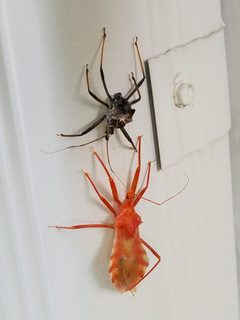
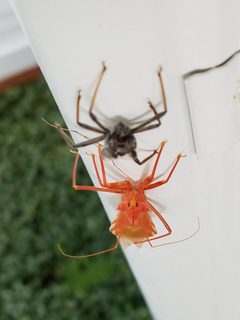
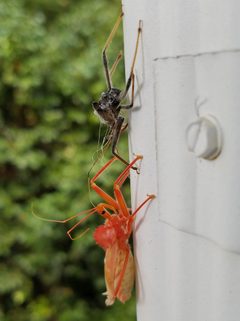
The semicircular, wheel-like pronotal crest is diagnostic for the and immediately distinguishes Arilus from other assassin bugs. The combination of large size, gray to brownish-black coloration, and front legs further separates these insects from similar . Nymphs can be recognized by their bright red and orange .
Images
Appearance
Large, robust true bugs with a distinctive semicircular crest on the pronotum resembling a spoked wheel. typically reach 25-38 mm in length. Body coloration is generally gray to brownish-black. The front legs are enlarged and modified for grasping prey. Nymphs display bright coloration: pale orange when newly hatched, maturing through orange-black-orange patterns with red and orange .
Habitat
Found on various plants including trees, shrubs, and crops. are laid on bark and branches. are attracted to lights.
Distribution
Primarily the Americas. Specific distribution varies by : Arilus cristatus ranges from southern Canada to Florida and west to Texas and Iowa; other species occur in Central and South America.
Seasonality
active from late spring through fall, with peak abundance in late summer. hatch the following spring (May-June in temperate regions). Single per year with overlapping stages.
Diet
of soft-bodied insects. Prey includes caterpillars (fall webworm, tent caterpillars), beetles (, , ), larvae, aphids, plant hoppers, and other true bugs including stink bugs.
Life Cycle
laid in autumn in compact hexagonal clusters attached to twigs and tree bark. Eggs overwinter and hatch in spring. Nymphs pass through five instars before maturing in late summer. appear in late June to late July depending on latitude.
Behavior
Slow-moving ambush . Approaches prey cautiously, seizes with front legs, and impales with beak to inject digestive . Produces defensive secretions from abdominal glands. Non-aggressive toward humans but capable of delivering a painful defensive bite if handled.
Ecological Role
Important agent in agricultural and natural . Contributes to suppression of pest including such as brown marmorated stink bugs and spotted lanternflies.
Human Relevance
Considered beneficial for of crop pests. Capable of inflicting a painful bite if handled carelessly, causing severe localized pain. Sometimes attracted to lights and may enter structures.
Similar Taxa
- ZelusOther assassin bugs with legs, but lack the distinctive wheel-shaped pronotal crest; often more slender with different color patterns.
- PselliopusAssassin bugs with orange and black coloration, but smaller and lack the semicircular pronotal crest characteristic of Arilus.
More Details
Species diversity
contains five extant : Arilus cristatus (North American wheel bug), A. carinatus, A. depressicollis, A. gallus, and A. nigriceps, plus one fossil species (A. faujasi). Three additional species originally described in Arilus are currently of uncertain placement (incertae sedis).
Feeding mechanism
Like other reduviids, Arilus uses extraoral digestion: digestive are pumped into prey through the beak, liquefying tissues which are then sucked back through the same structure using a muscular pump in the .
Sources and further reading
- BugGuide
- Wikipedia
- GBIF taxonomy match
- iNaturalist taxon
- NCBI Taxonomy
- Catalogue of Life
- Bug vs. bug - Assassinating stink bugs is the game of the wheel bug, Arilus cristatus — Bug of the Week
- Death of a stink bug, Part 2: Bug vs. Bug - Brown Marmorated Stink Bug, Halyomorpha halys, meets the wheel bug, Arilus cristatus — Bug of the Week
- To eat a stink bug, part 3 - Bug vs Bug, Brown Marmorated Stink Bug, Halyomorpha halys, meets the wheel bug, Arilus cristatus — Bug of the Week
- Bugs in orange and black: Three assassins - milkweed assassin bug, Zelus longipes; orange assassin bug, Pselliopus barberi; and wheel bug, Arilus cristatus — Bug of the Week
- Bugs in Orange and Black III – Argus tortoise beetle, Chelymorpha cassidea; oleander caterpillar, Syntomeida epilais; and wheel bug, Arilus cristatus (MISSING LINKS) — Bug of the Week
- Wheel Bug Takes a Spin, Arilus cristatus — Bug of the Week
- Wheel Bug, Arilus cristatus (Linnaeus) (Insecta: Hemiptera: Reduviidae)
- Life History and Laboratory Rearing of Arilus cristatus (Heteroptera: Reduviidae) in Southern Illinois
- Pre-Copulatory Behavior of the Wheel BugArilus gallus(Hemiptera: Reduviidae)
- The Wheel Bug Arilus gallus (Hemiptera: Reduviidae): Life History and Description of Immature Stages
- Prevalence of COVID-19-associated pneumonia signs on chest computed tomography in cancer patients: the ARILUS study
- Prognostic role of COVID-19 pneumonia signs and other CT-biomarkers for survival in patients with malignant neoplasms: the ARILUS project