
Pselliopus
Bergroth, 1905
orange assassin bugs
Species Guides
9- Pselliopus barberi(Orange Assassin Bug)
- Pselliopus cinctus(Ringed Assassin Bug)
- Pselliopus inermis(Orange assassin bug)
- Pselliopus latifasciatus
- Pselliopus marmorosus
- Pselliopus punctipes(ringed assassin bug)
- Pselliopus(orange assassin bug)
- Pselliopus spinicollis(ringed assassin bug)
- Pselliopus zebra(Zebra assassin bug)
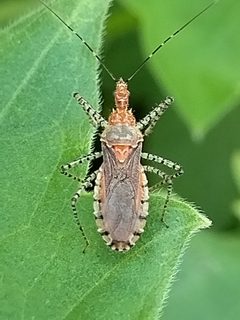
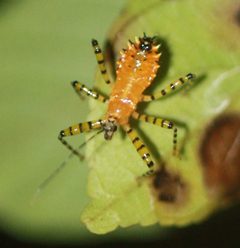
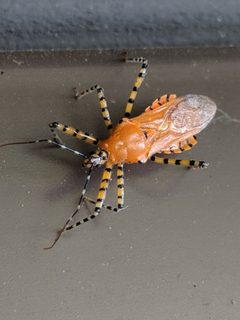
Pselliopus is a of assassin bugs in the Reduviidae, Harpactorinae. The genus contains 27 described restricted to the New World. Several species, particularly Pselliopus barberi, are noted for their bright orange and black coloration and relatively large size. Members of this genus are predatory insects that have been observed feeding on various prey including aphids, leafhoppers, and bees. Some species are considered potential agents for pest management.
Pronunciation
How to pronounce Pselliopus: /psɛ.lɪˈoʊ.pəs/
These audio files are automatically generated. While they are not always 100% accurate, they are a good starting point.
Identification
in this can be distinguished from other Harpactorinae by their often conspicuous orange and black striped coloration, relatively large body size compared to many other assassin bugs, and long legs. Pselliopus barberi specifically shows bright orange with black "jailhouse stripes." The genus can be separated from the similar milkweed assassin bug (Zelus longipes) by differences in color pattern and leg structure—Zelus longipes has distinctly sticky forelegs adapted for prey capture, while Pselliopus species lack this and instead rely on stealth and ambush.
Images
Habitat
in this have been observed in meadow , on flowering plants such as goldenrod, and in ornamental landscapes. Pselliopus spinicollis has been documented on tarweed (Madia elegans) in California. Pselliopus barberi is frequently associated with goldenrod blossoms and other herbaceous vegetation in open, sunny areas.
Distribution
Restricted to the New World. Documented from the United States (including Vermont and southern states), Mexico, and Central and South America. Specific distribution varies by .
Seasonality
and nymphs have been observed active in late summer and autumn. In temperate regions, activity likely corresponds with prey availability during growing seasons.
Diet
Predatory. Pselliopus barberi has been observed feeding on leafhoppers and aphids. Pselliopus cinctus has been documented stalking bees. Pselliopus spinicollis feeds on dead insects (carrion) as well as live prey. Nymphs of Pselliopus barberi have been photographed feeding on crapemyrtle aphids (Sarucallis kahawaluokalani).
Life Cycle
with , nymph, and stages. Specific details of egg-laying and stages are not documented for most in the .
Behavior
Ambush that moves slowly and stealthily to approach prey. Lacks the sticky forelegs used by some other assassin bugs for prey capture, instead relying on careful stalking and rapid strike with the . Has been observed waiting motionless on flowers for visiting insects.
Ecological Role
that contributes to of herbivorous insects. In California tarweed systems, Pselliopus spinicollis increased in abundance when insect carrion was experimentally added to plants, resulting in reduced herbivory and increased plant . Serves as a , leafhoppers, and other small arthropods in ornamental and natural landscapes.
Human Relevance
Some are of interest as potential biological pest control agents. Pselliopus barberi and related species contribute to natural suppression of on crapemyrtle and other ornamental plants. No documented negative impacts on humans; like all assassin bugs, can deliver a painful bite if handled carelessly.
Similar Taxa
- Zelus longipesBoth are brightly colored orange and black assassin bugs in Harpactorinae, but Zelus longipes has distinctly sticky forelegs coated with resinous secretions for prey capture, while Pselliopus lacks this and relies on stealth.
- Arilus cristatusBoth are large, conspicuous New World assassin bugs used in , but Arilus cristatus has a distinctive wheel-like structure on the and more robust body form.
More Details
Taxonomic note
The was established by Bergroth in 1905 and contains 27 described as of recent counts.
Research significance
Pselliopus spinicollis was a key in a landmark study demonstrating that plant-trapped insect carrion can enhance indirect plant defense by increasing predator abundance, reducing herbivory, and increasing plant .
Sources and further reading
- BugGuide
- Wikipedia
- GBIF taxonomy match
- iNaturalist taxon
- NCBI Taxonomy
- Catalogue of Life
- Bring on the Tourists! | Bug Squad
- A Good Morning for a Bee | Bug Squad
- Bugs in orange and black: Three assassins - milkweed assassin bug, Zelus longipes; orange assassin bug, Pselliopus barberi; and wheel bug, Arilus cristatus — Bug of the Week
- Bugs in orange and black – Three spooky assassins: milkweed assassin bug, Zelus longipes; orange assassin bug, Pselliopus barberi; and wheel bug, Arilus cristatus — Bug of the Week
- Bug of the Week Academy Awards 2018 — Bug of the Week
- Crapemyrtle Aphid: A Cosmopolitan Pest of a Popular Ornamental Tree